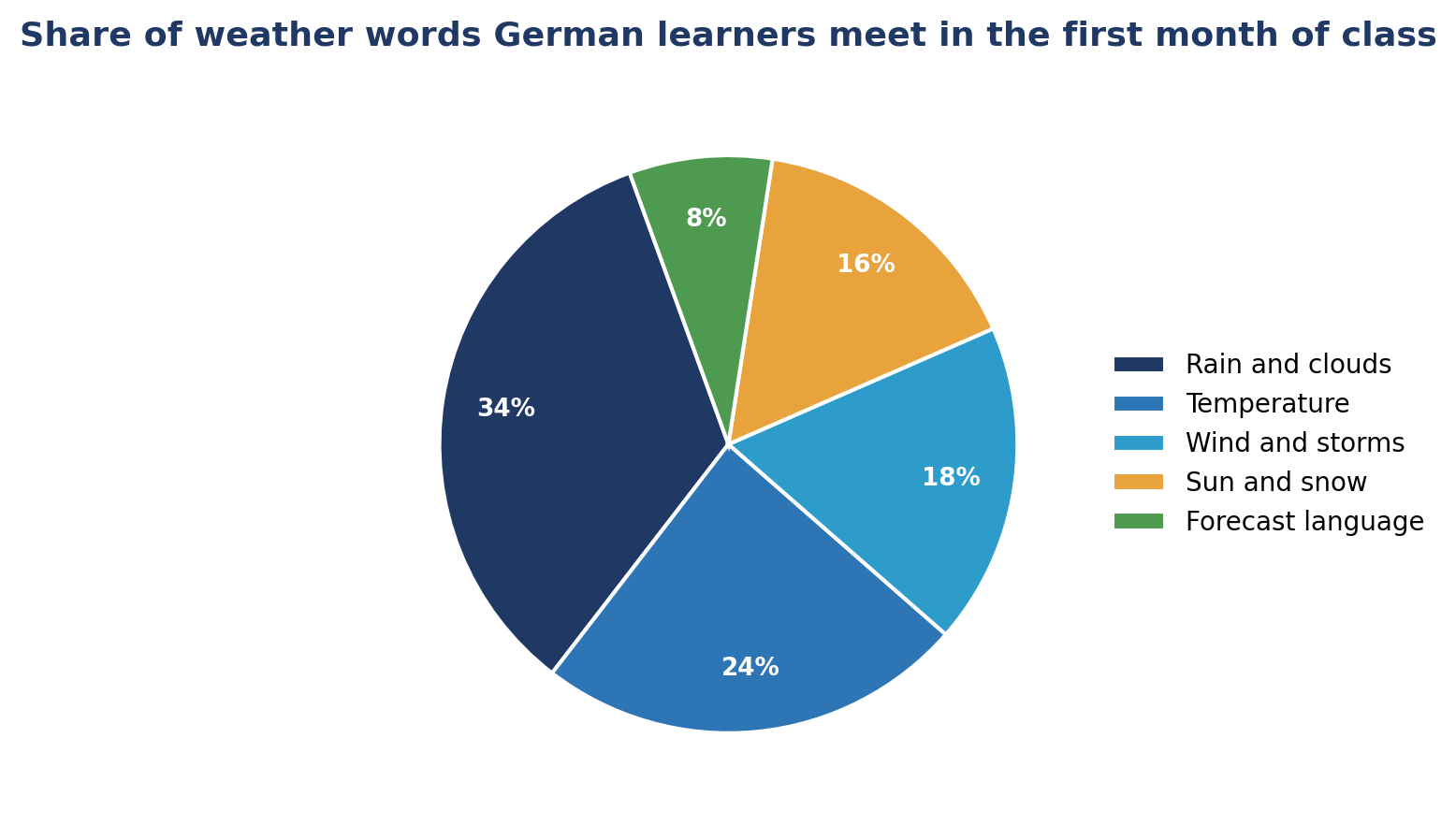
Nobody warns you: weather is the first conversation you will ever have in German. In the lift. At the bakery. In every awkward silence from Hamburg to Vienna.
So learn it properly, and you unlock sixty seconds of small talk on day one. Here is german vocabulary weather, sorted the way your brain actually needs it.
What you will get from this guide
- The core weather nouns, verbs and adjectives with gendered articles
- Ready-made phrases you can say today
- Temperature and season vocabulary with examples
- A listening routine for real German weather reports
The Words You Will Use Every Day
Start with nouns. In German every weather word carries a gender, so learn the article with the noun — always.
Twelve words. Enough to survive any lift in Berlin.
The Five Verbs That Do All the Work
Weather in German is mostly three little verbs plus es — the impersonal "it".
Notice the shape: es regnet is not "it is raining" word for word. German often uses the simple present where English uses the continuous.
Adjectives: Describing the Sky in One Word
These are the adjectives that appear in every weather report and every polite complaint.
The classic mistake is mixing kalt and kühl. Cold is kalt; a pleasant chill is kühl. Germans will notice.
Weather talk is listening practice in disguise
The words only stick when you hear them at speed, in a real forecast, with a real accent. Practise German listening with a personal AI voice tutor that gives you feedback at your own pace, any time.
Try a German listening class →Create a free accountAsking and Answering: Your First Real Conversation
Six lines. Memorise them and you will never stand silent in a lift again.
That last one is the most German sentence on the list. Use it with a small sigh and you will pass as a local.
Seasons and Temperature Talk
Seasons are simple, and the prepositions are not. Learn the pairs.
For temperature, German uses Grad like English uses "degrees", and Minus for below zero.
Saying "Es sind 20 Grad" is fine. So is "Es ist 20 Grad". Both are heard daily.
Words That Only Appear in Weather Reports
If you want to understand a real Wetterbericht, these are the last piece.
Wechselhaft is the word forecasters reach for when they have nothing to promise. Which, in Germany, is often.
A Ten-Minute Listening Routine
Vocabulary without listening evaporates. Do this daily.
Do it for a week and örtlich stops being a spelling exercise and becomes a sound you recognise.
Turn 60 words into real conversation
Vocabulary is the raw material; guided practice is the workshop. Bring these weather words into a self-paced speaking session with AI feedback and make them yours for good.
Start learning German →Create a free accountFrequently Asked Questions
How do you ask about the weather in German? Use "Wie ist das Wetter?" for the general question and "Wie wird das Wetter morgen?" for tomorrow. Both are standard and safe at any level.
Is it "es regnet" or "es ist regnerisch"? "Es regnet" means rain is falling right now. "Es ist regnerisch" describes the day in general. German uses the simple present far more than English uses the continuous.
What gender is Wetter? Weather is neuter: das Wetter. Because it is a mass noun, you rarely use a plural form.
Why do German weather reports say "örtlich"? It means "locally" and signals scattered conditions — rain here, dry two streets away. Expect it in almost every forecast.
References & Further Reading
- Duden — Deutsches Universalwörterbuch, entries for Wetter, Niederschlag and related terms
- Goethe-Institut — A1 vocabulary list, topic area "Wetter und Jahreszeiten"
- Deutsche Welle — Deutsch lernen audio course, weather and daily-life units
- Deutscher Wetterdienst (DWD) — official German weather reports for listening practice
- Institut für Deutsche Sprache (IDS Mannheim) — corpus data on impersonal es constructions
Ready to hear these words in the wild? Start a self-paced German lesson and practise your first real weather conversation at languageskills.net/german.