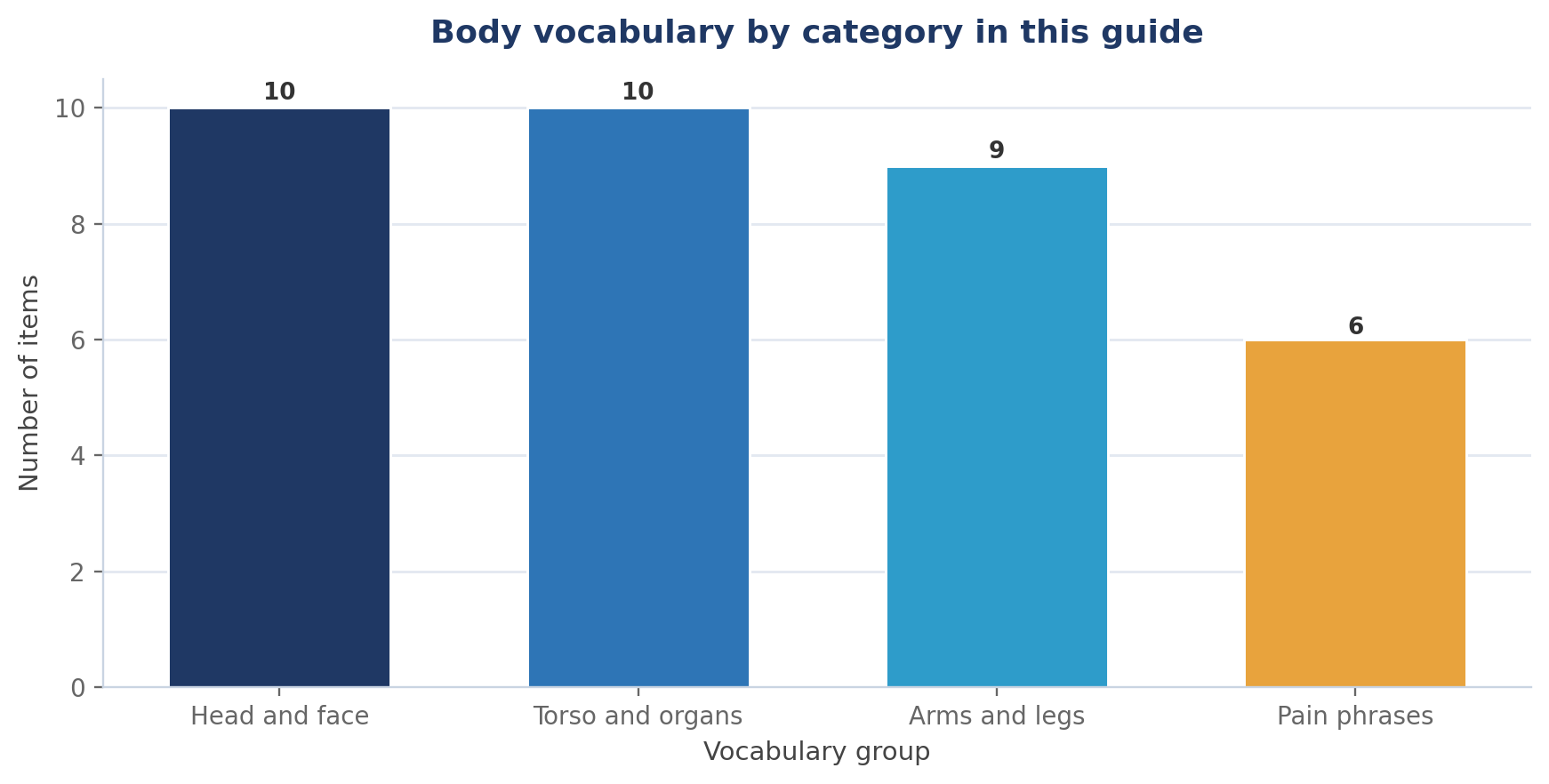
Your body is the one topic you can never run out of things to say about — and the one topic every beginner German exam quietly tests. Learn der Kopf, der Arm and das Bein and you unlock doctor visits, gym small talk, clothes shopping, describing pain, and a hundred everyday sentences that would otherwise die in your throat.
der Körper (the body) sits on every Goethe, telc and ÖSD beginner syllabus. Learn it early, learn it aloud, and learn it inside whole sentences. That is the difference between a word list and real German.
What you will get from this guide
- Core body vocabulary with article and plural for every noun
- The plural patterns that let you guess instead of memorise
- The pain phrases that make a German doctor's visit survivable
- A short daily routine that turns the list into speech
Head and face
Torso and organs
Arms and legs
Notice the umlaut trap. der Fuß becomes die Füße and die Hand becomes die Hände, but das Bein becomes die Beine and der Arm becomes die Arme with no change to the vowel. Say the plural out loud every time you learn a new noun, and your future self at the speaking exam will thank you.
Plural patterns worth knowing
Phrases that actually matter: pain and the doctor
Words alone will not get you through an appointment. These patterns will — and they are instantly productive.
The structure Mir tut + [body part] + weh is the one to drill. Swap the noun and the sentence stays correct: Mir tut der Rücken weh. Mir tut das Knie weh. Mir tut der Hals weh. Drill it until it arrives without thinking.
Turn sixty body words into real German conversation
A word list gives you bricks. Speaking gives you the house. A personal AI voice tutor teaches structured lessons and gives you speaking practice with instant feedback, so Mir tut der Rücken weh becomes automatic instead of academic — at your own pace, any time.
Start learning German →Create a free accountHow to practise so the words actually stick
Reading tables feels productive. It usually is not. These five methods are.
Learners consistently underestimate how much faster vocabulary sticks when it is spoken aloud and corrected. That is why the strongest study routines pair self-study with speaking practice — see how a Course Pass fits that model.
Beyond the doctor's office
Body vocabulary pays off in far more places than beginners expect. Clothes shopping: Das Hemd ist zu eng an den Schultern. The gym: Trainierst du deinen Rücken? A haircut: Nur ein bisschen kürzer, bitte. Small talk about sleep, stress and sport. Body words are high-frequency German — they turn up in songs, adverts, headlines and every A1 speaking card.
The learners who breeze through A1 speaking are rarely the ones who memorised the longest lists. They practised the shortest list out loud, repeatedly, with instant feedback. Be that learner.
Learn der Körper with an AI voice tutor, not a silent PDF
Vocabulary becomes useful the moment it leaves the page, and that happens fastest when you speak it aloud and get feedback. Course Pass lessons are self-paced, level-matched (A1 to B2) and built around the words you will actually use.
See German courses →Create a free accountFrequently Asked Questions
**What is der Körper in German — is it masculine?** Yes, der Körper is masculine: der Körper, des Körpers, die Körper. It means "body" and, in chemistry, "substance"; context makes the meaning clear.
**What is the difference between der Magen and der Bauch?** der Magen is the actual organ, the stomach. der Bauch is the belly you can see and touch. Mein Bauch tut weh suggests a general tummy ache, not a medical stomach problem.
Which body words should I learn first? Start with Kopf, Auge, Nase, Mund, Ohr, Arm, Hand, Bein, Fuß and Bauch. They cover almost every A1 exam prompt and everyday situation.
How do I remember the genders? Learn every noun as a full unit with its article and plural — das Auge, die Augen — and say it aloud. Learning bare nouns is how gender mistakes become permanent.
References & Further Reading
- Goethe-Institut — Goethe-Zertifikat A1 (Start Deutsch 1) exam information
- Deutsche Welle — Nicos Weg, a free A1 German video course
- Duden — German dictionary with genders and plural forms
- DWDS — Digital Dictionary of the German Language, with corpus examples
- Council of Europe — CEFR reference level descriptions