You stand at the bakery counter. The woman behind it says something fast. You hear noch, or maybe noch etwas. Everyone waits. Your brain produces nothing but the word Danke.
Shopping is the first real German test most learners face — and the fastest one to pass. The vocabulary is small, the sentences repeat, and the same twenty exchanges cover ninety percent of shops.
What you will get from this guide
- The shops, goods and phrases you need at A1
- Real mini-dialogues for bakery, supermarket and clothing
- Numbers, quantities and polite requests
- Listening habits that make shop German stick
The Shops: Where to Go
Start with the map. These words appear on doors, signs and street corners everywhere in Germany, Austria and Switzerland.
Do not confuse die Buchhandlung (bookshop) with die Bücherei (library). One sells books, the other lends them, and Germans will notice.
Inside the Shop: The Signs You Must Read
Shop navigation is half the vocabulary.
Pfand matters more than it looks. Return your bottles to the machine, get the Pfandautomat receipt, hand it to the cashier. Free money and a very German ritual.
Groceries: The Words on Your List
Memory trick: learn every noun with its article, always. Der Käse travels as one word in your head. Learn Käse alone and you will guess wrong for a year.
Quantities and Numbers: How Much Do You Want?
German shops live on measurements. This is where A1 learners gain the most ground fast.
Notice the pattern: quantity + item + bitte. That one formula works in almost every German shop you will ever enter.
The Ten Phrases That Carry the Whole Trip
Memorise these and you can shop anywhere.
Ich möchte beats Ich will every time. Ich will sounds like a demand; Ich möchte sounds like a customer.
Hear it before you need it.
Phrase lists are silent. Shops are not. Our AI voice tutor's listening practice puts these exact sentences in real German voices at real speed, so the bakery does not ambush you.
Try free German listening practice →Create a free accountThree Mini-Dialogues to Rehearse Out Loud
Read the German aloud. Then answer the shopkeeper's line yourself.
Clothes, Sizes and Colours
Useful A1 material that shows up in every clothing shop.
Key sentence: Kann ich das anprobieren? — Can I try this on? And if it does not fit: Kann ich das umtauschen?
How Fast These Words Stick
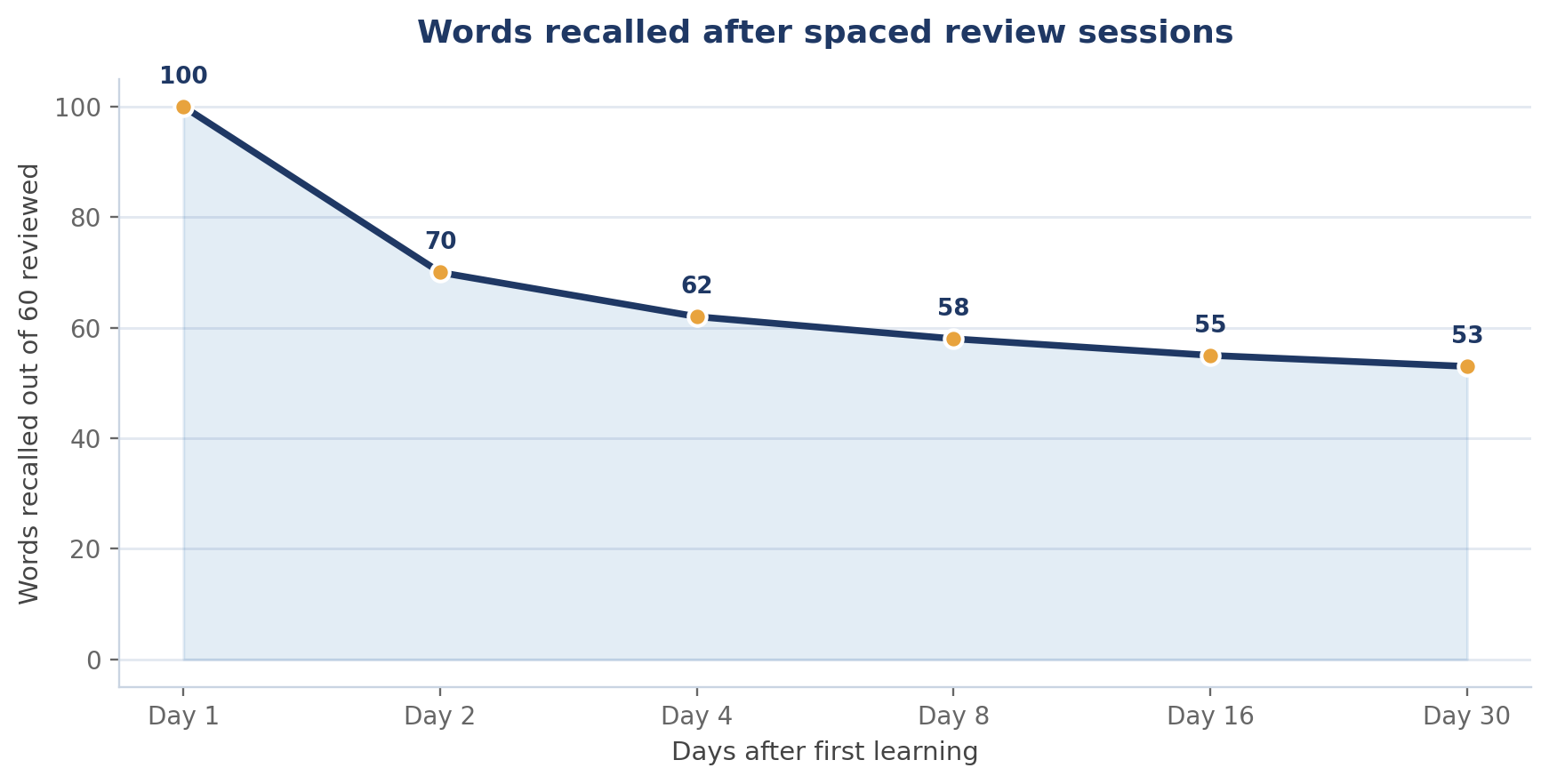
Vocabulary retention follows a steep curve if you review at the right intervals.
The drop between day one and day two is normal and not failure. What matters is that the curve flattens. Words reviewed at day one, four, eight and sixteen tend to stay put.
Paying: Cash Still Rules in Germany
Germany remains a stubbornly cash-loving country. Budget for it.
Say Stimmt so and you sound like you have lived in Berlin for a decade.
Shopping vocabulary is only half the skill.
You can learn 200 words tonight and still freeze when a cashier speaks at speed. Our self-paced German courses pair this vocabulary with AI voice-tutor speaking practice, from A1 to B2.
Explore German courses →Create a free accountFrequently Asked Questions
What are the most important German shopping phrases? Ich möchte …, bitte and Was kostet das? cover most situations. Add Kann ich mit Karte zahlen? and Das ist alles, danke and you can complete almost any transaction.
What is the difference between "Ich will" and "Ich möchte"? Both mean "I want," but möchte is polite and will is blunt. In shops, always use möchte.
Do German shops take credit cards? Many do now, but cash remains common and some small shops are cash only. Carry euros and ask Kann ich mit Karte zahlen? before you queue.
What does "Pfand" mean in a German supermarket? It is a deposit on bottles and cans. Return them at the machine, take the receipt, and hand it to the cashier for a refund.
References & Further Reading
- Goethe-Institut — A1 vocabulary lists and the Start Deutsch 1 wordlist.
- Deutsche Welle Nicos Weg A1 — shopping dialogues with subtitles.
- Duden — article and gender reference for every German noun.
- Council of Europe, CEFR Companion Volume — A1 descriptors for everyday transactions.
- Deutsche Welle Deutschtrainer — free audio lessons including shops and money.
Learn ten words today. Use three of them tomorrow. That is how the counter stops being scary.