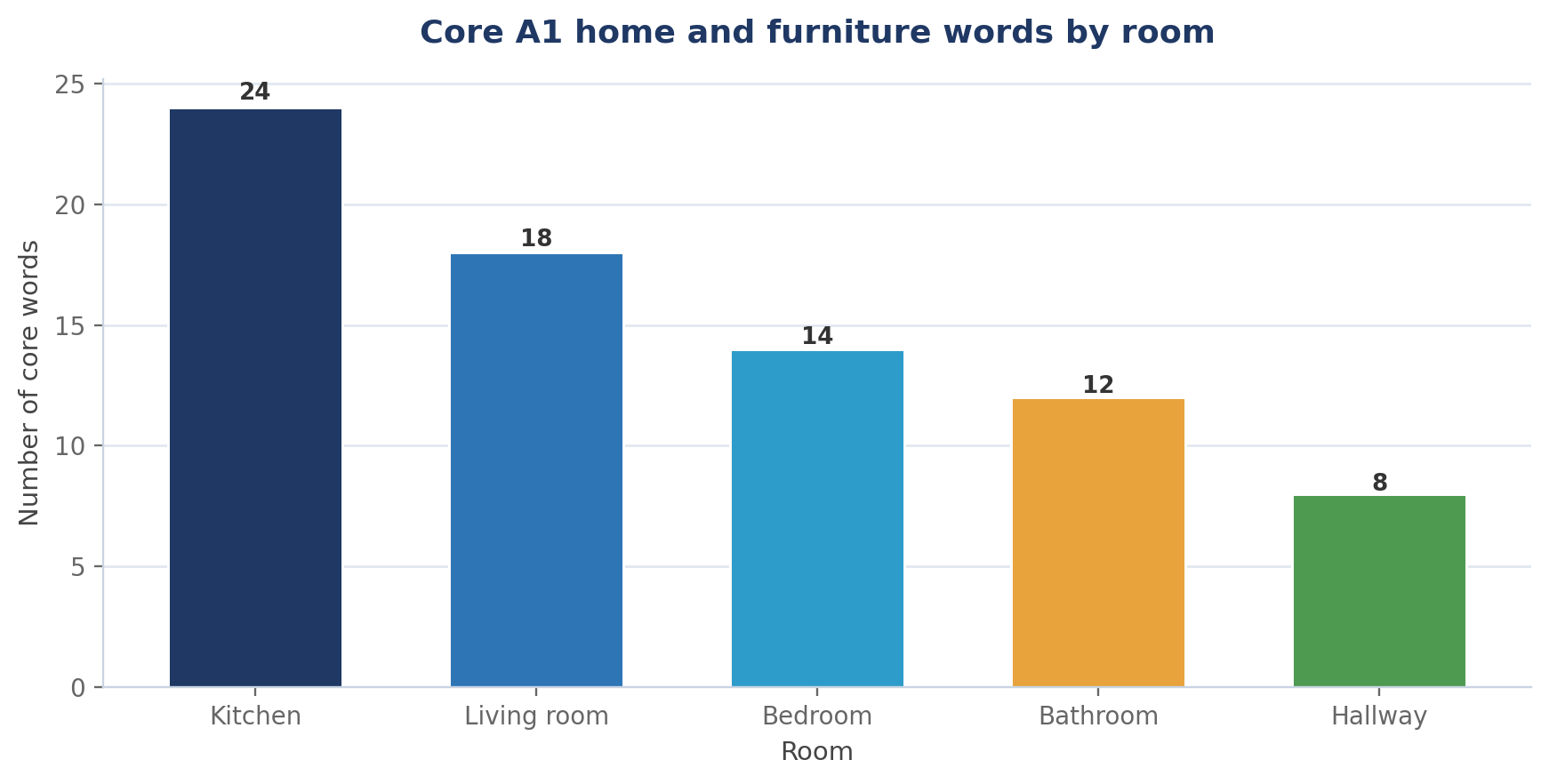
Two weeks into German, you will invite someone to your flat. And that is the moment the vocabulary deserts you. You can say you like your apartment — you simply cannot name a single thing standing in it. This guide fixes that, room by room, with the article attached to every word so you learn die Küche and not the dangerous half-word Küche.
What you will get from this guide
- Core German words for rooms, furniture, kitchen and bathroom
- Every noun with its article and its plural
- Example sentences you can actually reuse
- The place prepositions that turn a word list into conversation
Start with the rooms
Learn the rooms first. They are your mental filing cabinet, and German gives you beautiful compound words to hang on them.
Notice the pattern: Zimmer builds words by stacking a first element in front. Wohn- (living), Schlaf- (sleep), Bade- (bath). Learn the building blocks and you multiply your vocabulary for free.
Furniture and everyday objects
Around the kitchen and bathroom
Turn this word list into real conversation
Knowing der Schrank is step one. Saying Der Schrank steht neben der Tür without hesitating is step two — and step two only comes from speaking with a person. Practise your new vocabulary with a personal AI voice tutor that gives you speaking feedback — at your own pace, any time.
Learn German with an AI voice tutor →Create a free accountThe prepositions that make the words work
A vocabulary list is a drawer full of parts. These little words are the screws.
Here is the trick that pays for itself. For position — where something already is — these prepositions take the dative. For movement toward a place, they take the accusative.
Das Buch liegt auf dem Tisch. (position, dative) Ich lege das Buch auf den Tisch. (movement, accusative)
Same preposition, one letter of difference, completely different meaning. Learn the pair as a unit and you will never confuse legen with liegen again.
How to actually remember these words
Three habits separate learners who retain this vocabulary from those who relearn it every month.
Attach the article from the first meeting. A word learned as Küche will be misused as der Küche forever. A word learned as die Küche is finished.
Group by scene, not by alphabet. Walk through your own flat and name every object out loud. Your kitchen becomes a classroom you visit daily, at zero cost.
Say a full sentence, not a label. Das ist ein Stuhl beats Stuhl. Sentences carry grammar, and grammar is what makes vocabulary usable.
Give your German a room to grow in
A Course Pass gives you a personal AI voice tutor that builds vocabulary through conversation — your kitchen, your commute, your weekend — instead of flashcard drills. Learn the words you will genuinely say.
Explore German courses →Create a free accountFrequently Asked Questions
Is German furniture vocabulary hard to learn? The words are long but transparent. Once you know Zimmer, Tisch and Schrank, compounds like Schlafzimmer and Küchentisch explain themselves.
Do I need to memorise plurals? For active use, yes — especially for objects you own in multiples, like chairs, cups and towels. For most furniture, singular is enough at A1.
What is the German word for apartment? Die Wohnung. A rented flat is die Mietwohnung; a house is das Haus; shared accommodation is die WG (Wohngemeinschaft).
Which preposition means "at home" in German? The phrase is zu Hause for being at home, and nach Hause for going home. Bei mir means "at my place".
References & Further Reading
- Goethe-Institut — Start Deutsch 1 (A1) word list and exam materials
- Duden — Wörterbuch and noun declension guide
- Deutsche Welle — Nicos Weg: free A1 German course with vocabulary
- Council of Europe — CEFR A1 vocabulary and topic descriptors
- IDS Mannheim — Grammis: prepositions and case in German