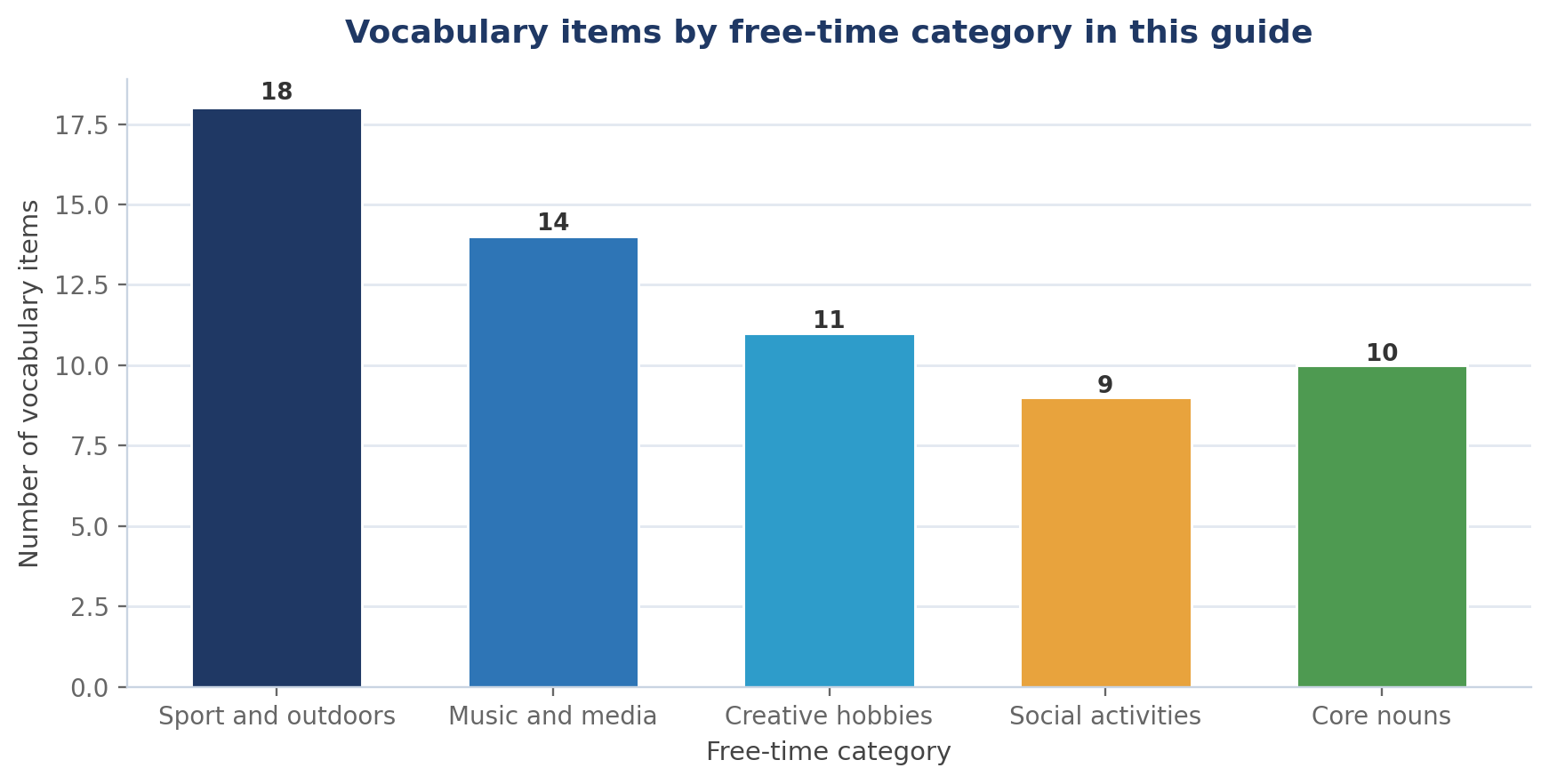
Ask any German speaker what they did at the weekend and you will hear one of about twenty words. Ich war wandern. Ich habe gelesen. Ich spiele Fußball. That is the wonderful thing about free-time vocabulary: it is a small, closed set, and it comes up in every single friendly conversation you will ever have.
Learn these words and you unlock small talk, dating, office kitchens, Verein culture and roughly a third of the A2 speaking exam. It is the highest-return vocabulary list in German.
What you will get from this guide
- Core hobby nouns with article and plural
- The verbs that describe what you actually do
- Phrases for asking and answering about free time
- The Verein culture that explains German weekends
Hobbies: the core nouns
The verbs that bring hobbies to life
Sport and outdoor activities
Notice how German turns activities into tidy nouns by capitalising the verb: Radfahren, Joggen, Klettern. Any infinitive can do this, which means your vocabulary multiplies the moment you notice the trick.
Music, media and creative hobbies
Phrases for real conversations
That last phrase — Hast du Lust, mitzukommen? — is social gold. It is the standard way Germans invite someone along, and answering Ja, gern! marks you as a normal human being rather than a textbook.
Turn hobby words into real weekend plans
Vocabulary becomes friendship when you can use it in conversation. A personal AI voice tutor gives you speaking practice with Hast du Lust, mitzukommen?, plus instant feedback that helps you fix your word order.
Practise German conversation with your AI tutor →Create a free accountThe Verein: why German weekends look the way they do
One word explains a great deal of German social life: der Verein, a registered club. Germany has hundreds of thousands of them — football, choir, gymnastics, shooting, chess, sailing. Almost every town has several.
Ich bin im Verein is a complete, idiomatic sentence meaning "I belong to a club". Join one and your German improves faster than any course could manage, because you will hear the same twenty words every week until they are yours.
How to practise this vocabulary
Keep a short list of the five hobbies you genuinely care about and become fluent in those. Depth in five beats a vague acquaintance with fifty.
Talk about what you love — in German
The fastest vocabulary you will ever keep is the vocabulary you enjoy using. Self-paced AI tutor lessons let you bring your real hobbies to the table, so speaking practice never feels like homework.
Explore the German course →Create a free accountFrequently Asked Questions
What is the German word for free time? die Freizeit. In your free time is in meiner Freizeit or simply in der Freizeit.
How do I say "I like playing football" in German? Ich spiele gern Fußball. The adverb gern is the standard way to express liking an activity.
**Is Hobby the same in German?** Yes — das Hobby, plural die Hobbys. Germans use it freely, alongside more traditional words like Freizeitbeschäftigung.
Do Germans really join clubs? Very often. The Verein is central to German social life, and joining one is one of the quickest ways to make friends and practise German weekly.
References & Further Reading
- Deutsche Welle — Nicos Weg and other free German courses
- Goethe-Institut — German language levels and A2 exam information
- Duden — German dictionary with genders and plurals
- DWDS — Digital Dictionary of the German Language, with corpus examples
- Deutscher Olympischer Sportbund — Information on German sports clubs