You are in a German doctor's office, the door closes, and every word you ever learned evaporates. This guide puts them back — the exact vocabulary for booking, describing pain and understanding what you are told.
What you will get from this guide
- The words for booking an appointment and registering at reception
- Body parts and pain vocabulary with example sentences
- The sentence pattern that describes almost any symptom
- Phrases you will hear back from the doctor, decoded
At reception: getting through the door
All German health vocabulary starts with one verb: vereinbaren — to arrange. The full phrase is einen Termin vereinbaren, and it is the key that opens everything else.
One cultural note worth knowing before you walk in: German practices are run on appointments, and arriving without one is normal only during Sprechstunde. Bring your card, say your name, sit down, wait to be called.
Body parts: the vocabulary you must not be shy about
You cannot describe pain without naming the place. This is the core set, and it is short enough to learn in one sitting.
Learn the plural with the noun. Der Zahn is useless alone; die Zähne is what you will need at the dentist.
The one sentence pattern that describes any symptom
Here is the engine of the whole appointment:
Mein / Meine + [body part] + tut weh.
Mein Kopf tut weh. My head hurts. Mein Rücken tut weh. My back hurts. Meine Augen tun weh. My eyes hurt.
When it is plural, the verb switches to tun and the pronoun to meine. That is the entire rule.
To be precise about where and how much, add location and intensity.
Notice the pattern with Mir ist… — that structure is how German handles "I feel", and it appears constantly at the doctor's.
Ready to turn reading into real German? Start your self-paced course today.
Start the German course →Create a free accountSay it once, get it right, remember it forever Reading a phrase list is step one. Saying mein Rücken tut weh under mild pressure, with a teacher listening, is step two. Our self-paced A2 German course, with a personal AI voice tutor, drills exactly this kind of real-world script. Button: Join a German class →
Symptoms, conditions and the words on the form
Illness vocabulary is where German gets wonderfully literal. Many terms are built from the body part plus a suffix, so once you know the parts above, you already half-know the diagnoses.
That -schmerzen suffix is a productivity machine. If you can name the part, you can name the pain.
What the doctor says back
Half of a successful appointment is comprehension, and doctors speak fast. These are the phrases you will hear most.
If you catch only one, catch Seit wann? — because the answer needs a time expression, and that is where A2 learners freeze.
Time expressions: seit is your best friend
German uses seit with the present tense for something that started in the past and is still true. This trips up English speakers every single time.
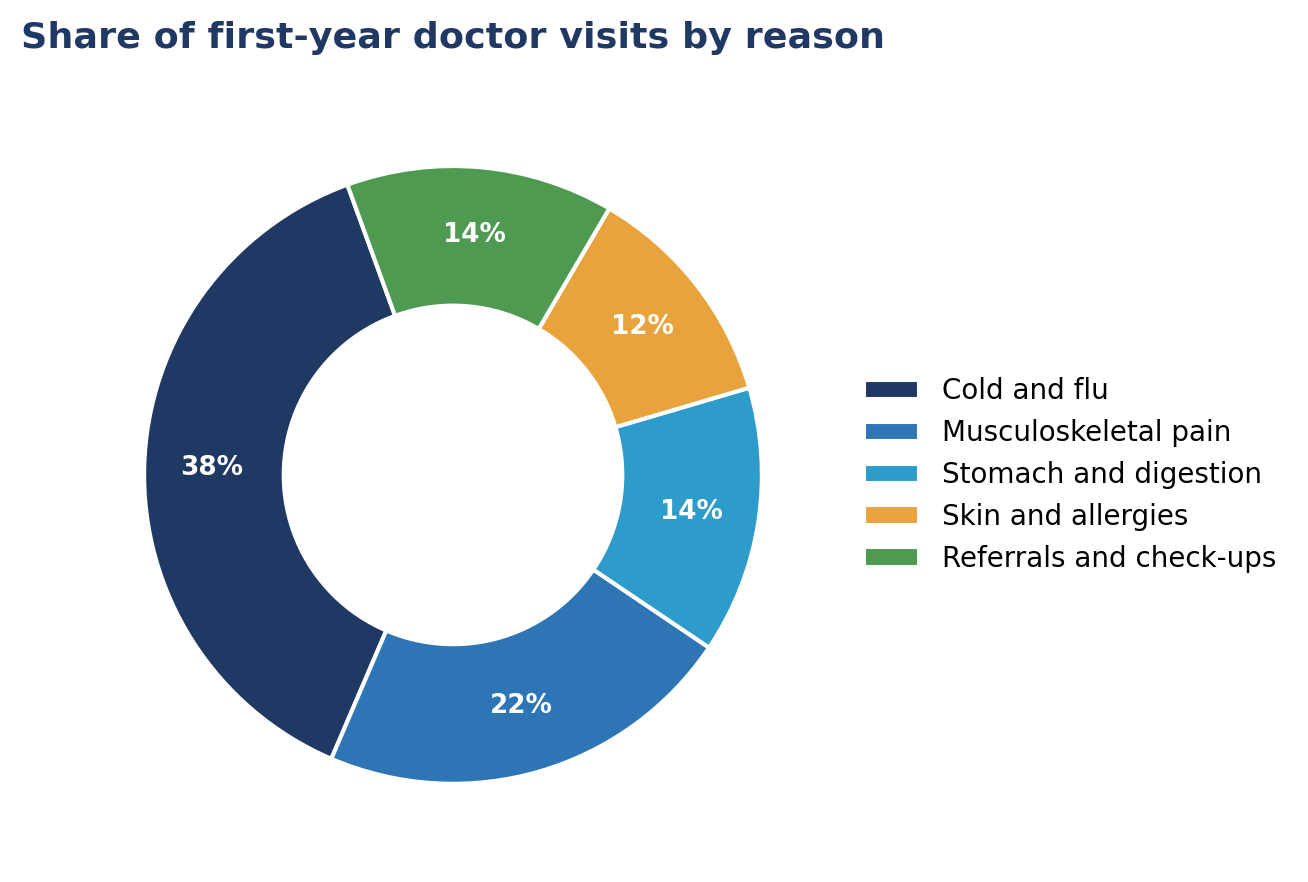
The chart below shows how often these situations actually come up for learners in their first year in a German-speaking country.
The pharmacy, one step later
If the doctor says ich verschreibe Ihnen etwas, your next stop is the Apotheke, not the Drogerie. The distinction matters: an Apotheke dispenses medicine, a Drogerie sells shampoo.
Say Ich habe ein Rezept and hand it over. That is a complete pharmacy transaction.
Frequently Asked Questions
How do I say "I need a doctor" in German? Ich brauche einen Arzt. In an emergency, dial 112 — the German emergency number, and the operator can route you to a doctor on call.
**What is the difference between Arzt and Doktor?** Arzt is the profession. Doktor is an academic title in German, so not every Arzt is a Doktor. Say Ich gehe zum Arzt, not zum Doktor, unless you are greeting the person by title.
Do German doctors speak English? Many do, particularly in cities. But relying on that in a medical conversation is a bad plan. The vocabulary above covers the appointment end to end.
**Is weh tun separable?** Yes. Mein Kopf tut weh splits the verb in the main clause, and wehtun stays together in a subordinate clause: Ich glaube, dass mein Kopf wehtut.
Build the vocabulary before you need it
Nobody wants to rehearse illness words for the first time in a waiting room. A self-paced German course with a personal AI voice tutor lets you practise them calmly, out loud, until the words are simply there.
Start with a free trial →Create a free accountReferences & Further Reading
- Goethe-Institut, Wortliste A1–B1 — the official vocabulary list covering health topics: goethe.de
- Deutsche Welle, DW Learn German — free audio lessons including Beim Arzt dialogues.
- Duden, Deutsches Universalwörterbuch, Dudenverlag — for plurals and word formation.
- Bundesministerium für Gesundheit — official information on the German health system: bundesgesundheitsministerium.de
- telc, Prüfungsvorbereitung A2 — exam materials using everyday medical and appointment contexts.