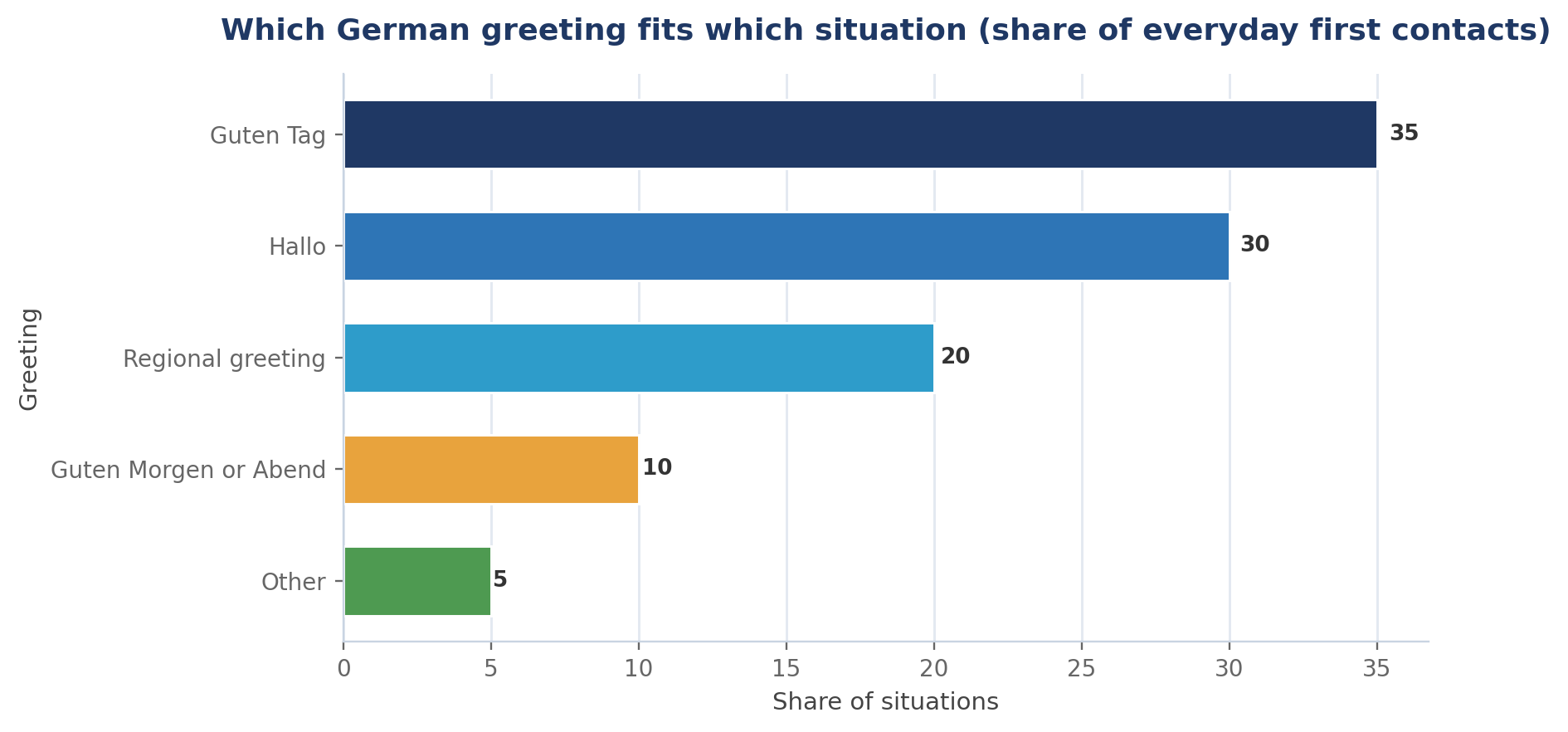
You say Guten Tag in a Berlin bakery and get a nod. You say it to a teenager in Munich and you get a look reserved for tax inspectors.
Same words. Same country. Wrong room.
German greetings are a small vocabulary with sharp social edges. Learn them properly and your first thirty seconds in any conversation stop being a gamble.
What you will get from this guide
- Every essential greeting, with the register it belongs to
- How to introduce yourself and ask questions back
- The regional map, and the phrases Germans actually answer with
The Greetings, Ranked by Formality
The safe default is Guten Tag. It never offends. But note the two regional treasure words: Moin in the north works at any hour, and Servus in the south doubles as both hello and goodbye.
Hello and Goodbye Are the Same Word
This surprises beginners constantly.
How to Introduce Yourself
Three sentences carry almost the whole job.
Ich heiße literally means "I am called". It is the standard, not the stiff option. Ich bin is even more relaxed.
Asking Back — The Part Beginners Skip
A greeting without a return question is a monologue. Germans notice.
The du/Sie choice is the real grammar here. Use Sie with strangers, officials, older people, and anyone in uniform. Use du with friends, students, children, and peers who have offered it. Offering du is called the Duzen — and being invited to switch is a small social promotion.
Hear it before you say it.
Greetings sound nothing like they look on paper — Grüß Gott loses half its letters in speech. Self-paced German listening practice with an AI voice tutor gets your ear to A1 speed fast. Start German listening practice →
Start the German course →Create a free accountHow Are You? And the Answers That Fool You
German has a famous trap: Wie geht's? is usually not a question. It is a greeting, and the expected answer is short.
Say Es geht and you sound like a native having an average Tuesday. Say it in the formal register and you sound gloomy. Context does the work.
Manners That Buy You Goodwill
Bitte is the Swiss Army knife of German. It means please, you're welcome, go ahead, and here you are — all depending on the moment.
A First Conversation, Assembled
Six lines. That is the entire A1 introduction, and it opens almost every door.
Three Habits to Build Now
Say the greeting twice in the first lesson — once quietly, once aloud — because German vowel length changes meaning across regions. Answer with a return question every single time, even if it is just Und du?. And pick your register deliberately: formal until invited otherwise. Getting Sie right early makes you sound respectful; getting it wrong, even grammatically perfectly, sounds oddly intimate.
First impressions are vocabulary.
Greetings are the highest-return words in German — you use them daily and they set the tone for everything after. A self-paced course pass drills them with an AI voice tutor until they come out without thinking. Get your German course pass →
Start the German course →Create a free accountFrequently Asked Questions
What is the most common German greeting? Guten Tag for neutral and formal situations, Hallo for casual ones. In northern Germany, Moin is the default at any hour.
Is Hallo rude in a shop? No, it is completely normal in most of Germany. In Austria and Switzerland, Grüß Gott or Grüezi is safer with older shopkeepers.
When do I switch from Sie to du? When the other person offers it — usually with the phrase Wir können uns duzen — or when you are clearly in a peer or student setting. Never switch first with someone senior.
Do I really need regional greetings as a beginner? Not to speak, but to understand. Servus and Moin will hit your ear constantly, and recognising them in the first sentence stops the panic.
References & Further Reading
- Goethe-Institut — A1 German course and vocabulary resources: https://www.goethe.de/en/spr/kup/prf.html
- Deutsche Welle Nicos Weg A1 — greetings and introductions in dialogue: https://learngerman.dw.com/en/overview
- Duden — German usage and style guidance: https://www.duden.de/sprachwissen
- Common European Framework of Reference for Languages, Council of Europe: https://www.coe.int/en/web/common-european-framework-reference-languages
- LanguageSkills.net German listening practice and courses: https://languageskills.net/german