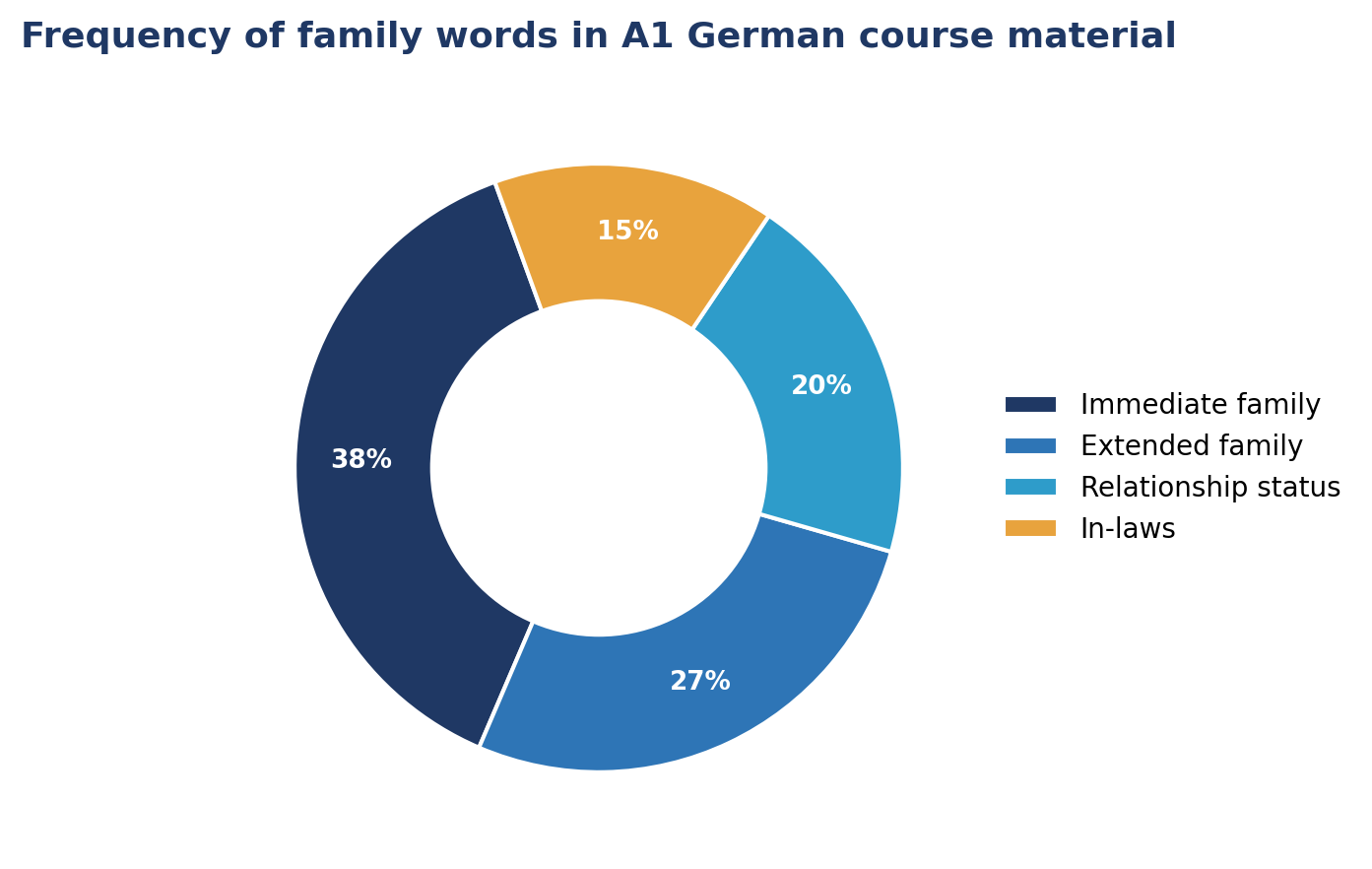
The first question a German neighbour asks you is almost never about your job. It is Hast du Kinder? — do you have children. Family is the doorway vocabulary of every first conversation, and german vocabulary family members is where A1 stops being abstract and starts being personal.
Learn these words and you can talk about the people you love, in the language you are learning.
What you will get from this guide
- Every core family word, with article and plural
- Example sentences you can steal today
- The possessive words (mein, dein) that glue it together
- The culture note nobody teaches you
The Core Words: Immediate Family
Learn each noun with its article. Always. Die Mutter is one unit; Mutter alone is only half a word.
Note the two oddities. Eltern and Geschwister exist only in the plural — you cannot have one Elter. And the umlaut does real work: Mutter becomes Mütter, not Mutters.
Extended Family and In-Laws
This is where German gets gloriously precise. English says "grandmother"; German chooses a side.
The prefix Schwieger- is your shortcut. Add it to almost any family word and you have the in-law version.
Relationship Status and Emotions
A1 conversations move fast from names to feelings. These words appear in every introduction.
Careful with one trap: mein Freund in the singular usually means boyfriend, while ein Freund von mir means a friend of mine. One little preposition keeps you out of trouble.
Possessive Articles: The Glue
You cannot talk about family without these six words.
Small warning: euer loses its middle e before an ending — eure Tante, not euere.
Ten Sentences You Can Use Tomorrow
These are the sentences that survive real conversation. Read them aloud — that is where A1 lives.
- Ich habe zwei Kinder, einen Sohn und eine Tochter.
- Meine Eltern wohnen in Hamburg.
- Meine Schwester ist verheiratet.
- Ich bin ledig.
- Wir haben eine große Familie.
- Mein Bruder ist älter als ich.
- Meine Großmutter heißt Anna.
- Hast du Geschwister?
- Meine Frau kommt aus Spanien.
- Meine Familie ist sehr wichtig für mich.
Hear the words, not just read them
Family vocabulary is easy to recognise and hard to pronounce. Ten minutes of real German audio a day fixes Brüder, Tochter and the umlauts — long before you need them in conversation.
Start free listening practice →Create a free accountHow to Describe People, Not Just Name Them
Naming your sister is A1. Describing her is where the marks live. Add one adjective per sentence.
Use als for comparisons after a comparative: Meine Schwester ist älter als ich. Not wie. That error is audible to every German speaker.
The Grammar That Arrives With Family Words
Three small structures do most of the work here.
Possessives agree with the noun, not the owner. Sein Vater and ihre Mutter — the ending follows the person or thing possessed.
Family words love the dative. Ich helfe meiner Mutter. Wir besuchen unseren Onkel.
Plural forms change the verb. Meine Eltern wohnen in Berlin, never wohnt.
A Cultural Note Worth Knowing
German family words carry social habits. Oma and Opa are used constantly, even by adults, and using them signals warmth — but you only use them for your own grandparents, not for other people's. And when Germans ask Hast du Geschwister?, they are not being nosy. It is simply the standard second question after Woher kommst du?
Learning the word list is half the job. Learning when to say it is the other half.
From word list to real conversation
You know the words now. A personal AI voice tutor turns them into stories about your own family — correct articles, correct endings, correct pronunciation. That is the difference between a vocabulary list and speaking German.
See the German course →Create a free accountFrequently Asked Questions
What is the German word for parents? Die Eltern. It is plural only, always with the definite article in the plural form.
**Should I learn Mutter or Mama?** Learn both. Mutter is standard and needed for writing and exams; Mama, Papa, Oma and Opa are what you will hear in everyday speech.
How do I say "my brother's wife" in German? Die Frau meines Bruders or the simpler spoken version meine Schwägerin — sister-in-law.
**Is Verwandte the same as Familie?** Close but not identical. Familie is your close family; Verwandte means relatives, blood or by marriage, near or distant.
References & Further Reading
- Duden — Wörterbuch — articles, plurals and pronunciation for every German noun.
- Goethe-Institut — A1 word list — the official vocabulary scope for A1.
- Deutsche Welle — Learn German — free audio courses including family topics.
- Common European Framework of Reference (CEFR) — what A1 actually requires.
- Statistisches Bundesamt — real German household and family data for reading practice.