A German friend asks how you are. You have three words ready — gut, schlecht, müde — and you have been rotating them for months like a broken vending machine. Meanwhile your real day contained relief, irritation, mild dread and one moment of pure joy.
German vocabulary emotions fix this. Not by adding fifty poetic words, but by adding twelve you will genuinely reach for before Friday.
What you will get from this guide
- The twelve emotion words A2 learners use most, with articles and example sentences
- Adjectives vs nouns: traurig against die Traurigkeit
- Reflexive verb patterns such as sich freuen, the ones textbooks under-teach
- A listening routine that moves new feeling words from recognition to speech
Start with the Twelve That Pay Rent
You do not need Wehmut yet. You need these.
Watch aufgeregt. English speakers assume it means excited-and-happy, but it also covers agitated. Sei nicht so aufgeregt is not a compliment about your enthusiasm.
Adjectives You Use with sein
Most emotion vocabulary in German behaves like a description, not a thing. You are müde, not "having tiredness".
Two prepositions do most of the work: über for the cause of a feeling, auf for the person it points at. Learn the pair, not fourteen separate rules.
The Reflexive Verbs Germans Say Out Loud
This is where textbook German and street German part ways. Germans do not simply "be happy" — they freuen sich.
Timing matters with sich freuen. Ich freue mich auf points to the future. Ich freue mich über points to something already here. Same verb, different clock.
Nouns: When Feelings Become Things
Adjectives describe a moment. Nouns name a state, and German loves building them from adjectives with -heit and -keit.
All feminine. That is not a coincidence — -heit, -keit and -ung nouns are reliably die. Learn that, and you never guess an article again for this family.
Hear these words, don't just read them
Ready to turn reading into real German? Start your self-paced course today.
Start the German course →Create a free accountA word you have read is a word you cannot yet say. Listening practice drops erleichtert, aufgeregt and sich freuen into real German speech at real speed, so your ear and mouth learn them together. Button: Start German listening practice →
Phrases That Carry Emotion Without Adjectives
Sometimes German says more with a shrug of a fixed phrase.
Keep Ich habe die Nase voll for friends and family. In a formal meeting, use Das ist nicht zufriedenstellend and keep your nose out of it.
Building a Listening Routine That Sticks
Vocabulary without repetition evaporates in a week. Build a loop.
The Sunday recording is the honest one. Aufgeregt and erleichtert both hide stress patterns that English speakers flatten. Hearing your own version exposes it fast.
From recognising feelings to expressing them
Ready to turn reading into real German? Start your self-paced course today.
Start the German course →Create a free accountUnderstanding gestresst in a podcast is a milestone. Saying Ich bin heute gestresst, weil... in a live conversation is the real one. Self-paced speaking practice with AI feedback gives you a place to say it — and a correction when you need it. Button: Create my free account →
Frequently Asked Questions
How do I say "I am excited" in German? Often Ich freue mich sehr or Ich bin gespannt. Use Ich bin aufgeregt with care, because it can mean anxious or worked up rather than happy-excited.
Is it "Ich bin Angst" or "Ich habe Angst"? Always Ich habe Angst. Angst is a noun, so it needs haben, unlike adjectives such as nervös which take sein.
What is the difference between "traurig" and "Traurigkeit"? Traurig is the adjective you use in normal speech: Ich bin traurig. Die Traurigkeit is the noun form, and it sounds literary or reflective, more at home in songs and essays.
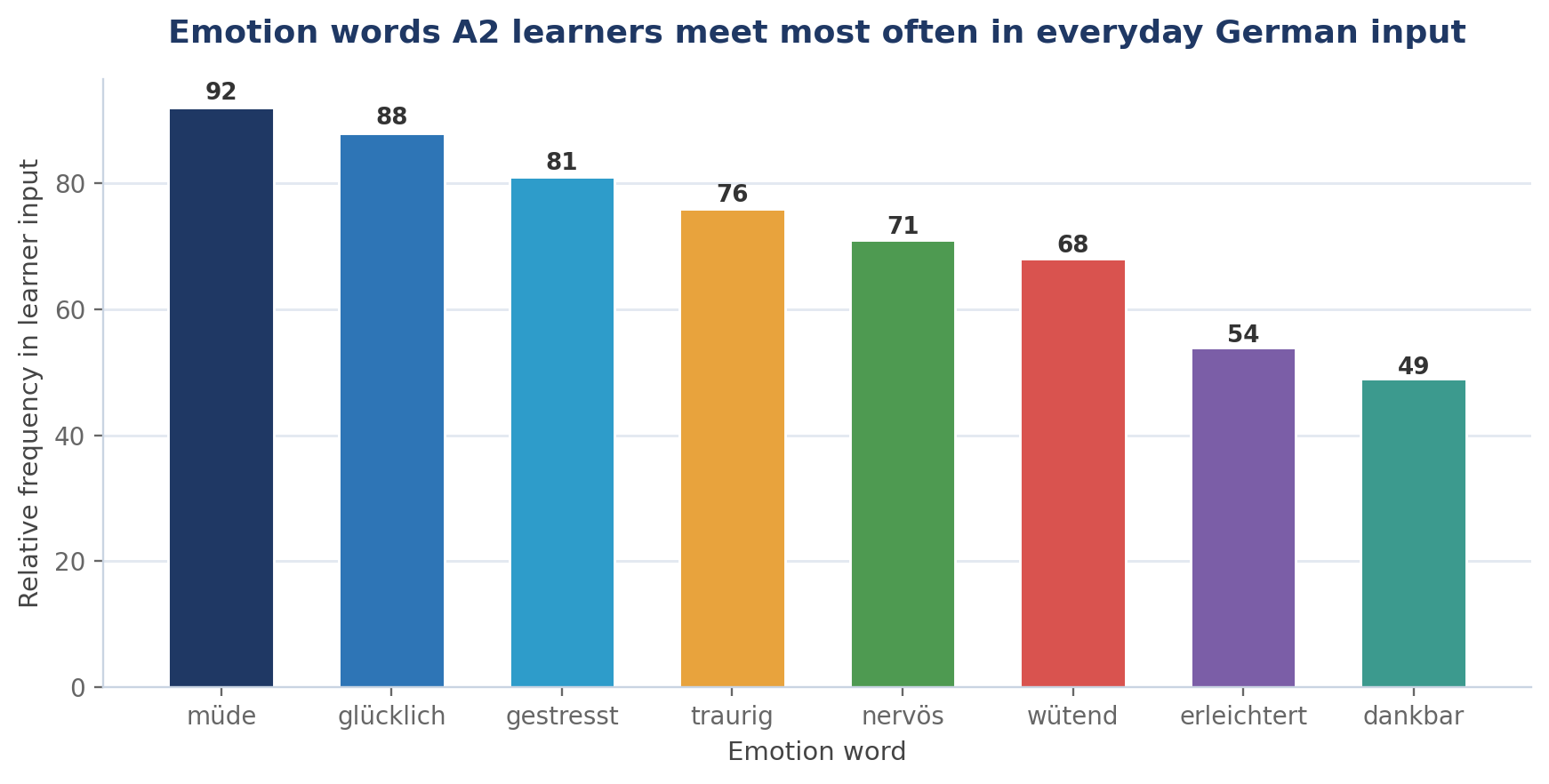
Which emotion words should an A2 learner learn first? Start with müde, glücklich, gestresst, traurig, nervös and sich freuen. They cover most daily situations and are the ones you will hear in the first five minutes of almost any German conversation.
References & Further Reading
- Duden — definitions, articles and usage notes for German emotion vocabulary: https://www.duden.de
- Goethe-Institut — A2 level description and German course information: https://www.goethe.de
- Deutsche Welle — free German listening material at A2 and beyond: https://learngerman.dw.com
- DWDS — Digitales Wörterbuch der deutschen Sprache, corpus-based examples of real usage: https://www.dwds.de
- Deutsche Welle — Wort der Woche and vocabulary series for learners: https://learngerman.dw.com/de/wort-der-woche