A German colleague will forgive an imperfect verb. They will not forgive Hallo in a first email to a client you have never met.
German business correspondence has a register of its own — formal where English is casual, structured where English is loose, and unforgiving about the difference between Sie and du. Here is the vocabulary that carries the whole job.
What you will get from this guide
- Subject-line and greeting vocabulary by relationship
- 40+ phrases for requests, attachments, deadlines and closings
- The Sie / du rule spelled out
- German email conventions English speakers routinely get wrong
The Five Blocks of a German Business Email
German emails are more templated than English ones. Readers expect the same skeleton every time.
A comma follows the salutation, and the convention is to continue in lower case on the next line. Sehr geehrte Frau Müller, then vielen Dank für Ihre E-Mail. Not a capital letter.
Subject Lines and Greetings by Relationship
Sehr geehrte is the safe default with anyone you have not met. Hallo is entirely normal between colleagues, and entirely wrong for a first approach to a client.
Sie or du? The Rule That Decides Everything
German companies increasingly use du internally while keeping Sie externally. If you are unsure, use Sie — nobody has ever been offended by being addressed formally.
The Phrase Bank
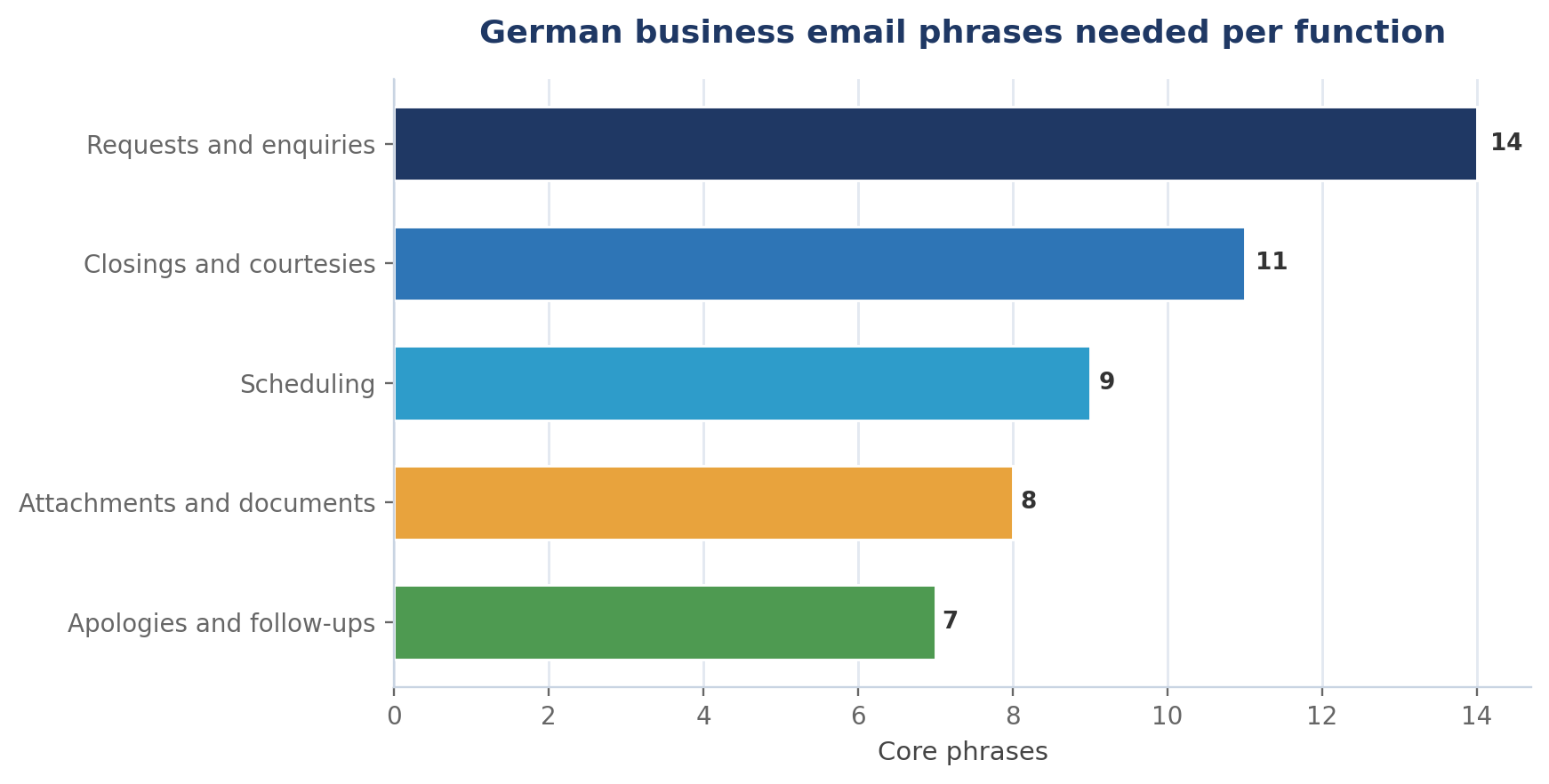
Requests are the biggest block, and the one where register matters most. A bare imperative — Senden Sie mir das Dokument — is grammatical and faintly rude. Könnten Sie mir das Dokument bitte senden? does the same job and keeps the relationship intact.
Reading phrases is easy. Writing them under deadline pressure is not.
German business writing is a practised skill. LanguageSkills.net's self-paced AI voice tutor guides you through structured lessons on register, tone and the Sie/du line, so you can practise on your own schedule before your client notices anything.
See German business courses →Create a free accountA Model Email You Can Adapt
Sehr geehrter Herr Weber, vielen Dank für Ihre Nachricht und das freundliche Angebot. Ich schreibe Ihnen bezüglich des Projekts „Umstellung Q3". Im Anhang finden Sie unsere überarbeitete Version. Könnten Sie mir bitte mitteilen, ob die Lieferzeiten für Sie so realisierbar sind? Ich würde mich bis Donnerstag über eine kurze Rückmeldung freuen. Bei Fragen stehe ich Ihnen gerne zur Verfügung. Mit freundlichen Grüßen Ravi Kumar
Note the punctuation: no commas after the salutation line's full stop, and no comma after the closing formula. German convention leaves Mit freundlichen Grüßen unpunctuated.
Five Conventions English Speakers Get Wrong
- Capitalising after the salutation comma. German continues in lower case.
- Writing Dear literally as Liebe/r to a stranger. Reserve Liebe for people you actually know.
- Using exclamation marks for friendliness. German business prose uses them sparingly.
- Skipping the subject line detail. German readers expect a precise Betreff: Angebot Projekt X, Frist 14.05.
- Closing with Danke alone. Use Vielen Dank im Voraus or a full Grußformel.
Register: The Difference Between Correct and Professional
The right-hand column is not stiff — it is the ordinary register of German business life. Matching it is what makes you sound fluent rather than merely accurate.
Write German email that gets answered
Our German business track covers correspondence, meetings and negotiation at B1–B2, with self-paced AI voice-tutor lessons and speaking practice with AI feedback. Start with the free level check and we will place you exactly.
Get your German Course Pass →Create a free accountFrequently Asked Questions
Is Hallo acceptable in a German business email? Between colleagues, yes — it is standard. For a first contact with a client or authority, use Sehr geehrte instead.
What does Mit freundlichen Grüßen mean? Literally "with friendly greetings", it is the standard German equivalent of "Kind regards". Freundliche Grüße is slightly shorter and equally acceptable.
Do Germans use exclamation marks in emails? Rarely in professional contexts. A Betreff with an exclamation mark can read as urgent or even aggressive.
How formal should a German application email be? Fully formal. Use Sehr geehrte/r plus surname, a precise subject line, and Mit freundlichen Grüßen. Applications are the most formal register in German working life.
References & Further Reading
- Duden — German spelling, punctuation and the comma after salutations: https://www.duden.de
- Goethe-Institut — German for professional purposes and B1–B2 business exams: https://www.goethe.de
- Deutsche Welle — Deutsch im Beruf business German materials: https://learngerman.dw.com
- Council of Europe — CEFR descriptors for written correspondence: https://www.coe.int
- LanguageSkills.net — German business and professional courses: https://languageskills.net/german
The Takeaway
German business email is a small, closed vocabulary used with real precision. Learn the five blocks, the eight phrases in the bank, and the Sie rule. Your grammar can be B1 and your emails can still read as completely professional — because register, not fluency, is what German readers judge first.