You have seen "A1" on a course page and "B2" on a job advert and quietly guessed what they meant. They are not marketing labels. They are the Common European Framework of Reference, and they decide who hires you, which visa you qualify for, and which university will let you in.
What you will get from this guide
- Plain-English definitions of all six CEFR levels
- Realistic guided-hour estimates for German
- Which exam maps to which level
- How to place yourself honestly in ten minutes
What the CEFR Actually Is
The Common European Framework of Reference for Languages is a Council of Europe scale published in 2001, expanded with a Companion Volume in 2020. It describes what a learner can do — not how many words they know. Six levels, three bands: A for basic user, B for independent user, C for proficient user.
The genius of the CEFR is that it is skill-neutral. You can be B2 in reading and B1 in speaking, and that is a real, common, perfectly respectable profile. Think of it as three broad bands split in half.
The Six Levels, Translated Into Real Life
Notice that the jump from B1 to B2 is where most careers change, and the jump from A2 to B1 is where most learners quit. Both are worth naming out loud before you plan anything.
How Long Each Level Takes
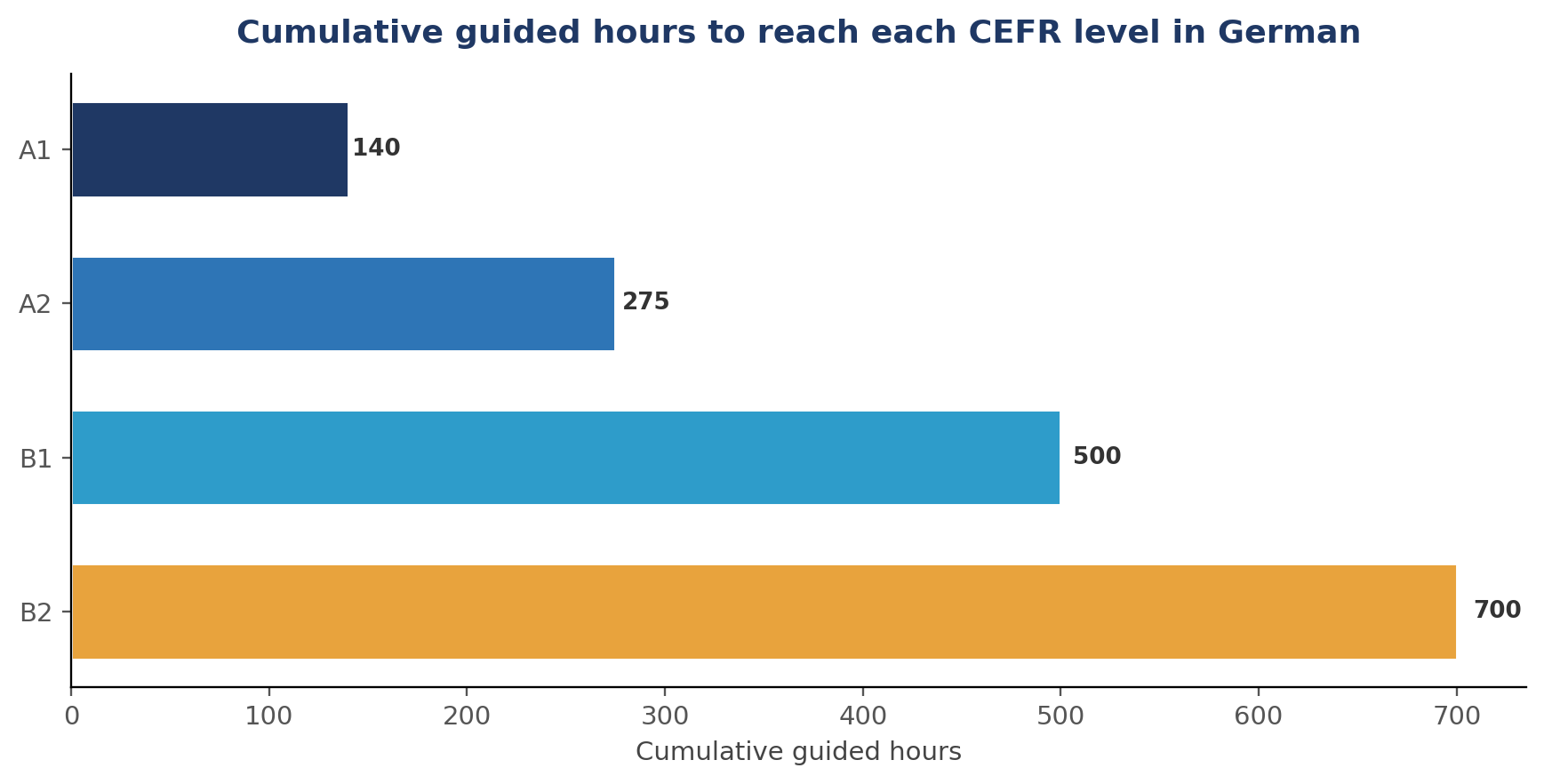
This is the table every learner wants and no publisher loves, because it depends on your language background. For English speakers, the US Foreign Service Institute has long estimated German at around 750 class hours for professional working proficiency, placing it in its "Category II" group. CEFR-aligned German course providers tend to plan in the ranges below.
All of these are planning estimates, not promises. Prior language learning, daily consistency and access to live conversation move you up or down within these bands considerably.
Which Exam Maps to Which Level
The exams are not interchangeable, even at equal CEFR level. They differ in format, focus and where they are accepted.
One practical warning: universities and employers almost never accept a self-assessment. They want a certificate from a recognised body. Which means your CEFR level is, in administrative terms, whatever your last exam said it was.
Place Yourself in Ten Minutes
Self-assessment is imperfect but useful for choosing a course, not for a job application. Try each statement and find the highest one you can honestly do today.
Be strict with yourself. Most learners over-estimate by half a level, because recognising a word feels like knowing it. Recognition is not production, and exams test production.
Find out where you really are — with an AI tutor, not a guess
A ten-question self-test chooses your course. It cannot tell you that your grammar is B2 while your spoken fluency is A2. Self-paced German instruction with an AI voice tutor gives you an honest level, and a route to the next one.
Get a free account →Create a free accountThe Levels Nobody Talks About: B1 to B2
If you want to know where the real wall is, it is here. B1 lets you function. B2 lets you compete. The difference is not vocabulary volume — it is automaticity, register, and the ability to be interesting in the language.
Three things move a learner from B1 to B2 faster than anything else:
- Output under pressure. Structured discussion and debate, where you must form arguments in real time.
- Register awareness. Knowing when du and Sie matter, and how formal writing differs from speech.
- Volume of authentic input. Long-form podcasts, news, unsubtitled series. Not clips.
Grammar study alone plateaus at B1. Above it, you need hours of messy, live, corrective speaking.
Choosing Your Target Level
Do not aim at C2 because it sounds impressive. Aim at the level that unlocks the thing you want.
Pick the level, then walk the shortest route to it
Every goal above has a number attached, and every number has a course behind it. A self-paced German course pass gives you level-matched lessons, an AI tutor that tracks your progress, and structured practice when you are close.
Explore German courses →Create a free accountFrequently Asked Questions
How long does B2 German take? Roughly 600–800 cumulative guided hours for most English-speaking learners, more if your study is intermittent. At one hour a day of guided instruction, that is often a year and a half or more.
Is B2 German fluent? B2 is professional working fluency: you can hold your own in meetings and argue a point. It is not native-like and it is not effortless. C1 is where most people start describing themselves as fluent without apologising.
Can I take a Goethe exam without a course? Yes. Goethe-Institut exams are open to anyone and can be booked directly. Most candidates still prepare with structured teaching, especially for the writing and speaking papers.
Do CEFR levels expire? The certificates generally do not expire. Some institutions, though, require a certificate issued within the last two years, so check the specific requirement before you pay for an exam.
References & Further Reading
- Council of Europe. Common European Framework of Reference for Languages: Learning, Teaching, Assessment — Companion Volume, 2020.
- Goethe-Institut. Examination levels and descriptions, goethe.de.
- telc gGmbH. Examination catalogue and level mapping, telc.net.
- TestDaF-Institut. Test format and TDN score descriptions, testdaf.de.
- U.S. Foreign Service Institute. Language difficulty categorisation for English speakers.