A1 is the level everyone skips past in conversation and nobody skips past in reality. It is where you find out whether you are a "language person" or someone who quits in week three. Here is the unglamorous, complete truth about German A1 — what it contains, how long it takes, and what separates learners who reach it comfortably from those who stall out at Ich heiße…
Let's start with the one sentence that matters. A1 does not mean you can speak German. A1 means you can survive in German. That is the whole promise, and it is a genuinely powerful one.
What German A1 Actually Means
The CEFR defines A1 as a breakthrough level. Translated from committee language into human language:
Notice what is not on that list: debates, jokes, nuance, rapid-fire native speech, or reading a German newspaper. A1 is deliberately narrow. That narrowness is your friend — it means the target is finite and you can actually hit it.
The A1 numbers at a glance
- Vocabulary: 650–700 active words (plus passive recognition of ~1,000)
- Guided study: 80–100 hours
- Grammar rules: roughly 25 core structures
- Typical timeline: 3 months at 7 hours per week
- Certification: Goethe-Zertifikat A1, telc Deutsch A1, ÖSD A1
The German A1 Syllabus, Topic by Topic
Every reputable A1 syllabus — Goethe's included — circles the same terrain. If your course does not cover these, it is not an A1 course.
How Much Vocabulary Do You Really Need for A1?
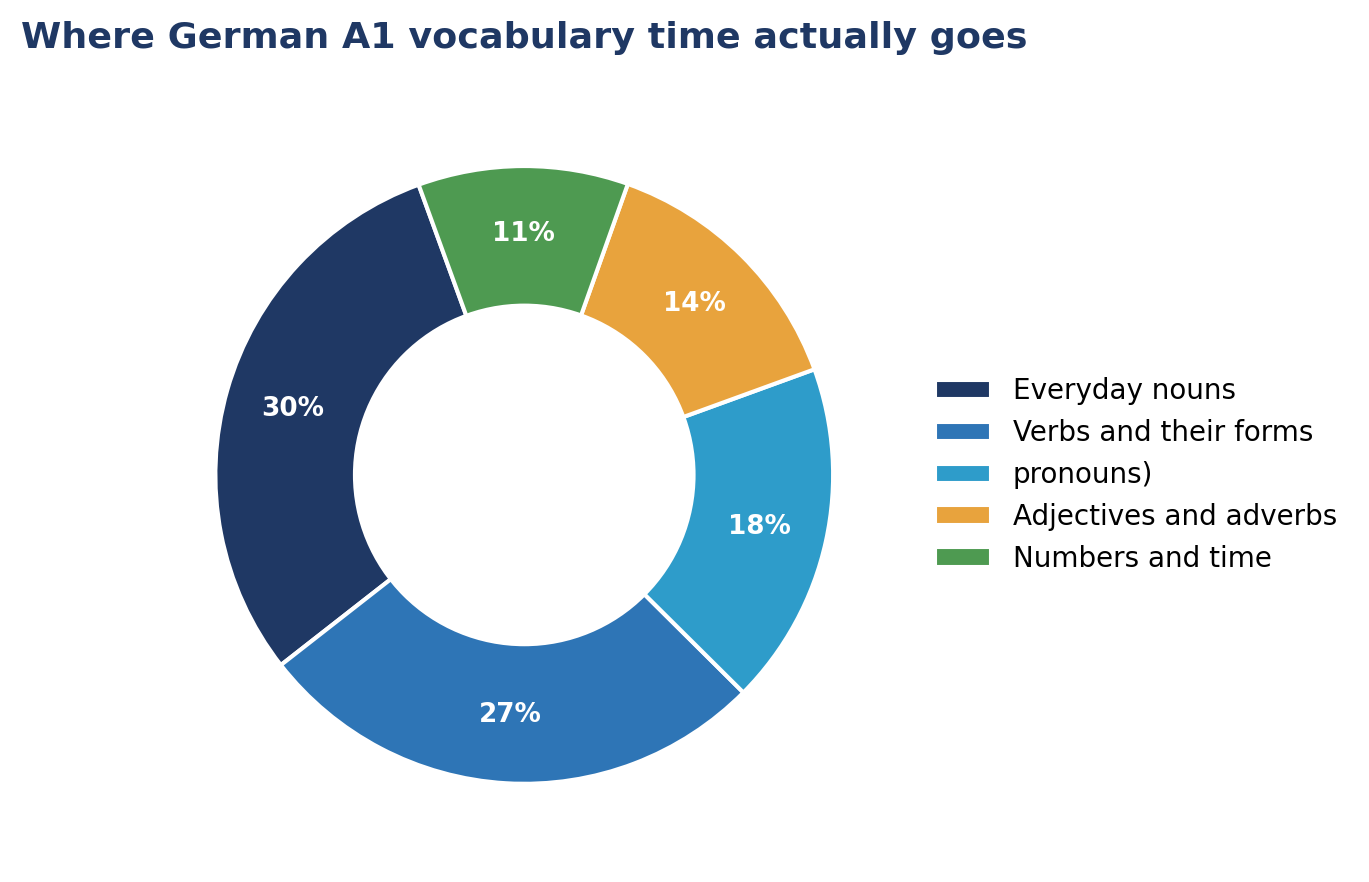
There is a lot of mythology here, so here is the distribution as it actually plays out in A1 exams.
The surprise for most learners is function words. Articles, prepositions, pronouns and conjunctions are only about 18% of the list but they carry perhaps 60% of the grammar marks. Beginners memorise Wohnung and Bahnhof and then lose points on der/die/das and in/an/auf. Learn the small words like they are the point, because they are.
The A1 Grammar Core — 25 Structures That Do All the Work
You do not need all of German grammar. You need this:
- Verbs: sein, haben, regular present tense, separable verbs (aufstehen → ich stehe auf), modal verbs, Perfekt with haben/sein
- Nouns: three genders, definite/indefinite articles, plural forms, accusative and dative changes
- Pronouns: nominative, accusative, dative, possessives
- Word order: verb-second in main clauses, yes/no inversion, W-questions, sentence bracket with modals
- Negation: nicht vs kein
- Prepositions: in, an, auf, mit, bei, nach, zu and time expressions
- Time: clock time, days, months, and simple temporal adverbs (heute, morgen, oft)
That is the entire skeleton. Everything else at A1 is vocabulary and repetition.
Learn the 25 structures once, with AI feedback checking your work
Grammar tables are free on the internet. Feedback is not. On a LanguageSkills.net German A1 course you write, speak, get AI-powered corrections, and fix the error the same week. Study at your own pace, any time.
See the German A1 course →Create a free accountWhich A1 Exam Should You Take?
Any of these is accepted by employers and universities as proof of beginner German. They differ in flavour, not difficulty.
For most international learners, Goethe-Zertifikat A1 is the default answer. It is the widest-recognised beginner certificate in the world and it is explicitly required for several German visa categories.
An 8-Week A1 Plan That Actually Fits a Busy Life
Two honest warnings. First, week 7 is where most self-study plans die — modal verbs plus the Perfekt tense arrive too fast when nobody has corrected your earlier gaps. Second, a practice exercises is not optional. Sitting a real paper is the only way to find out that your listening is weaker than your reading.
Where Self-Study Breaks Down at A1
Let's be specific, because vague warnings are useless.
A1 is small enough that you can self-teach it. It is also the level where your habits are formed, and bad habits compound. Fixing a wrong ü at A1 takes a day. Fixing it at B2 takes months.
Get the A1 skills, not just the A1 feeling
Our German A1 track includes guided lessons, AI voice tutor speaking practice, listening practice, and printable study materials. If you have 7 hours a week and three months, you have everything this level needs.
Start German A1 tonight →Create a free accountFrequently Asked Questions
How long does it take to reach German A1? Roughly 80–100 guided hours. At a realistic 7–8 hours per week that is about three months. At two hours per week, expect six to eight months.
Is A1 German enough to work in Germany? Not for most visa routes. Germany's skilled-worker and EU Blue Card pathways typically look for B1 or B2. A1 is a starting point and a visa step, not a career qualification.
Do I need to know grammar to pass A1? Yes — but only the 25 structures listed above. You need them actively, meaning you can produce them, not just recognise them.
What score do I need to pass Goethe A1? 60% overall, with all four skills assessed. Some visa purposes require a specific module score, so check your requirement before booking.
Can I reach A1 in one month? With intensive daily study (3–4 hours) and a structured course, yes — it is done in intensive programmes all the time. Solo and part-time, no.
Your Next Move
German A1 is not a wall, it is a doorway with a very specific width. Learn 650 words, master 25 structures, practise producing them out loud, sit one practice exercises, and you are through it.
The learners who make it are not the talented ones. They are the ones who had someone tell them, early and often, "close — say it like this instead."
From "Ich heiße" to "Ich spreche Deutsch"
Take the free placement check and start the A1 track this week. Course Pass holders get guided lessons, AI voice tutor speaking practice, listening practice, and printable study materials.
Claim your German A1 seat →Create a free accountReferences & Further Reading
- Goethe-Institut, Start Deutsch 1 examination guidelines and Wortliste for A1
- Council of Europe, CEFR Companion Volume, A1 descriptor set
- telc gGmbH, telc Deutsch A1 examination specifications
- ÖSD, ÖSD Zertifikat A1 exam regulations
- Bundesamt für Migration und Flüchtlinge (BAMF), language requirement guidance
- Deutsche Welle, Deutsch lernen — Nicos Weg A1