Something flips at B1. You stop translating in your head, order a coffee without rehearsing the sentence, and realise you understood a whole podcast segment about rent prices. German B1 is the level where the language stops being homework and starts being a tool.
This guide maps exactly what german B1 means, the grammar that finally clicks, and how long the climb really takes — no fairy tales.
What you will get from this guide
- A precise definition of the B1 level per the CEFR framework
- The grammar and vocabulary milestones that define intermediate German
- Realistic hour estimates and a week-by-week study structure
- Exam routes (Goethe, telc, ÖSD) and what each one asks of you
What German B1 Actually Means
The Common European Framework of Reference for Languages (CEFR) places B1 at the first stage of independent use. You are no longer a tourist clinging to phrasebook lines. You are a person who can cope.
The official descriptors say a B1 learner can deal with most situations arising while travelling in a German-speaking country, produce simple connected text on familiar topics, and describe experiences, dreams and opinions with reasons. That last part — opinions with reasons — is the real border. A2 describes. B1 argues.
The Grammar That Finally Clicks
A2 teaches you that verbs move. B1 teaches you where they land and why. Four structures carry most of the distance.
Alongside grammar sits vocabulary growth. Most B1 learners operate with roughly 2,400 to 3,000 active words. Passive recognition runs higher, often past 4,000. The trick is not memorising lists — it is meeting the same word in five different contexts until it stops feeling foreign.
How Long Does It Take to Reach German B1?
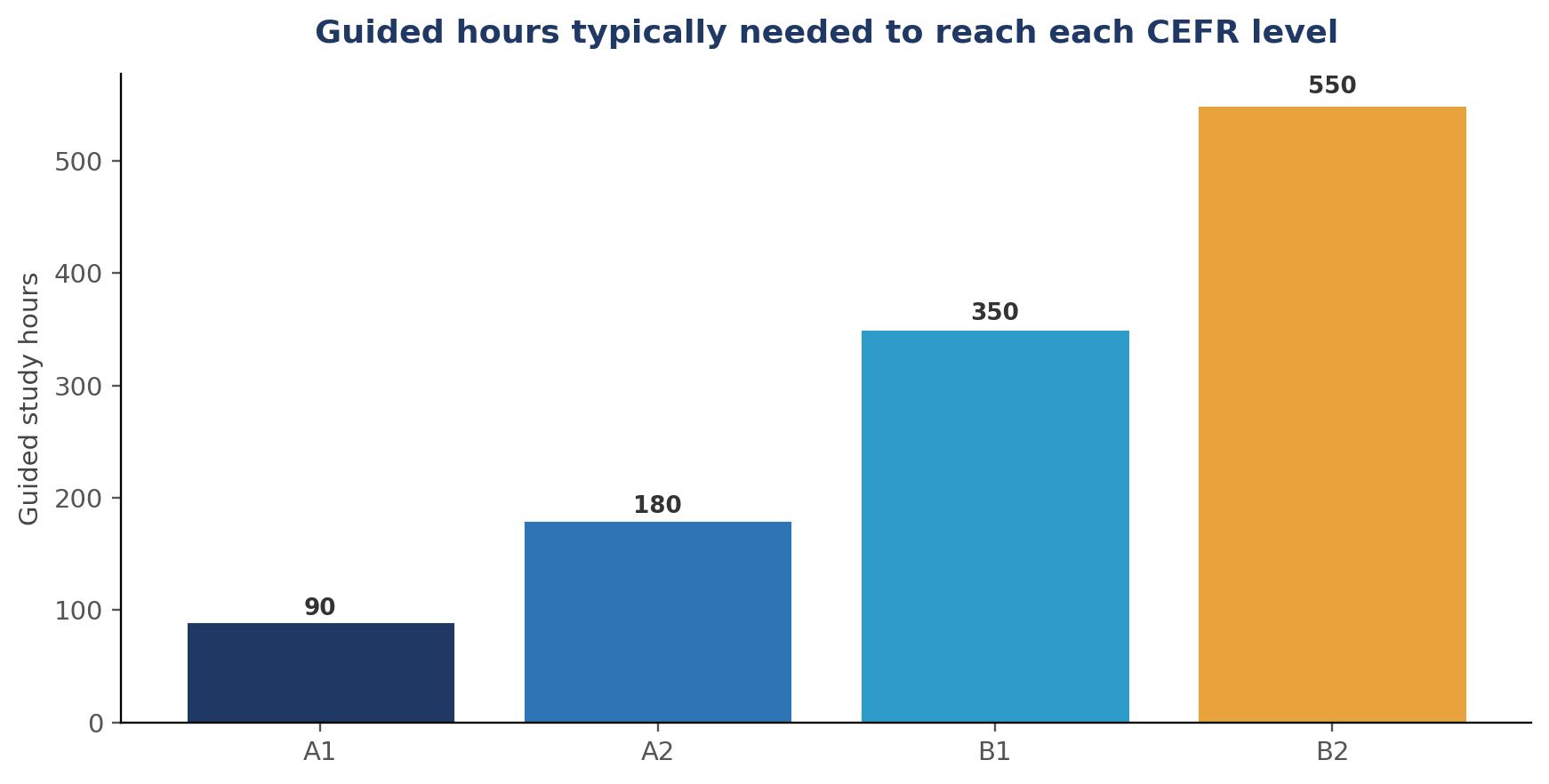
Honest answer: it depends on how many hours you actually sit in the language, not how many weeks pass. Course providers and CEFR-aligned planning routinely put B1 at around 350 to 400 guided hours from zero — roughly double the A2 investment.
The useful insight buried in that table: consistency beats intensity. Four hours spread over four days trains recall far better than one four-hour block on Sunday.
Stop circling A2 — get a plan that adapts to you
Textbooks cannot correct your word order in real time. A personal AI voice tutor can, and it knows exactly which B1 structures trip you up.
See the B1 course path →Create a free accountThe Four Pillars of B1 Study
Progress at this level is uneven by nature. You will write beautifully some weeks and forget the dative on a Tuesday. Four pillars keep you moving.
- Listening: Swap subtitled dramas for podcasts aimed at learners, then graduate to Deutsche Welle's Langsam gesprochene Nachrichten. Ten minutes daily beats an hour on Saturday.
- Speaking: Talk to a human. An instructor, a tandem partner, a patient colleague. The mouth learns what the eye cannot teach.
- Reading: Read one short news article a day. Underline every weil, obwohl and dass — you will start seeing the sentence bracket everywhere.
- Writing: Keep a five-line diary. One opinion, one reason, one example.
Exam Routes at B1
If you need paper proof — for a visa, a job, a residence permit — pick your exam deliberately. They are not interchangeable.
A realistic exam prep window is eight to twelve weeks on top of your B1 study, with at least two full mock papers written under timed conditions.
Walk into the exam room already knowing the format
Practice tells you what you scored. A personal AI voice tutor tells you why — and helps you fix it before test day.
Book your placement check →Create a free accountFrequently Asked Questions
Is B1 German enough to work in Germany? For many roles, yes — particularly in international teams, IT, hospitality and logistics. Regulated professions such as medicine or law usually demand B2 or higher. B1 German plus fluent English opens more doors than most learners expect.
How many words do I need for German B1? Aim for roughly 2,400 to 3,000 active words. The Goethe B1 wordlist sits in that band. Passive recognition is usually far higher, and that gap is normal.
Can I reach B1 in six months? With around 8 guided hours a week, six to nine months is a reasonable target. Intensive courses at 15+ hours a week can compress it to roughly five months, provided you are also living in the language.
Do I need an exam to be at B1? No. Many learners function comfortably at B1 without ever sitting a test. An exam becomes necessary when an institution asks for documented proof.
References & Further Reading
- Council of Europe — Common European Framework of Reference for Languages: https://www.coe.int/en/web/common-european-framework-reference-languages
- Goethe-Institut — Goethe-Zertifikat B1: https://www.goethe.de/en/spr/kup/prf/prf/gb1.html
- telc gGmbH — telc Deutsch B1: https://www.telc.net
- Deutsche Welle — Deutsch lernen (Nicos Weg, B1): https://learngerman.dw.com
- ÖSD — ÖSD Zertifikat B1: https://www.osd.at