You have a certificate that says B1. Then the Hausmeister rings your bell, says eleven words at speed, and you nod like a man who understood four of them.
Levels describe what you can do — not what a piece of paper claims. So let us walk the ladder honestly, rung by rung, with real-life scenes instead of adjectives.
What you will get from this guide
- A can-do description of A1 through B2 in plain English
- What each level unlocks at work, in admin and in daily life
- Honest hour estimates and how to test where you really are
The Ladder in One Look
The Common European Framework splits German into six levels. Four of them cover almost every learner's journey.
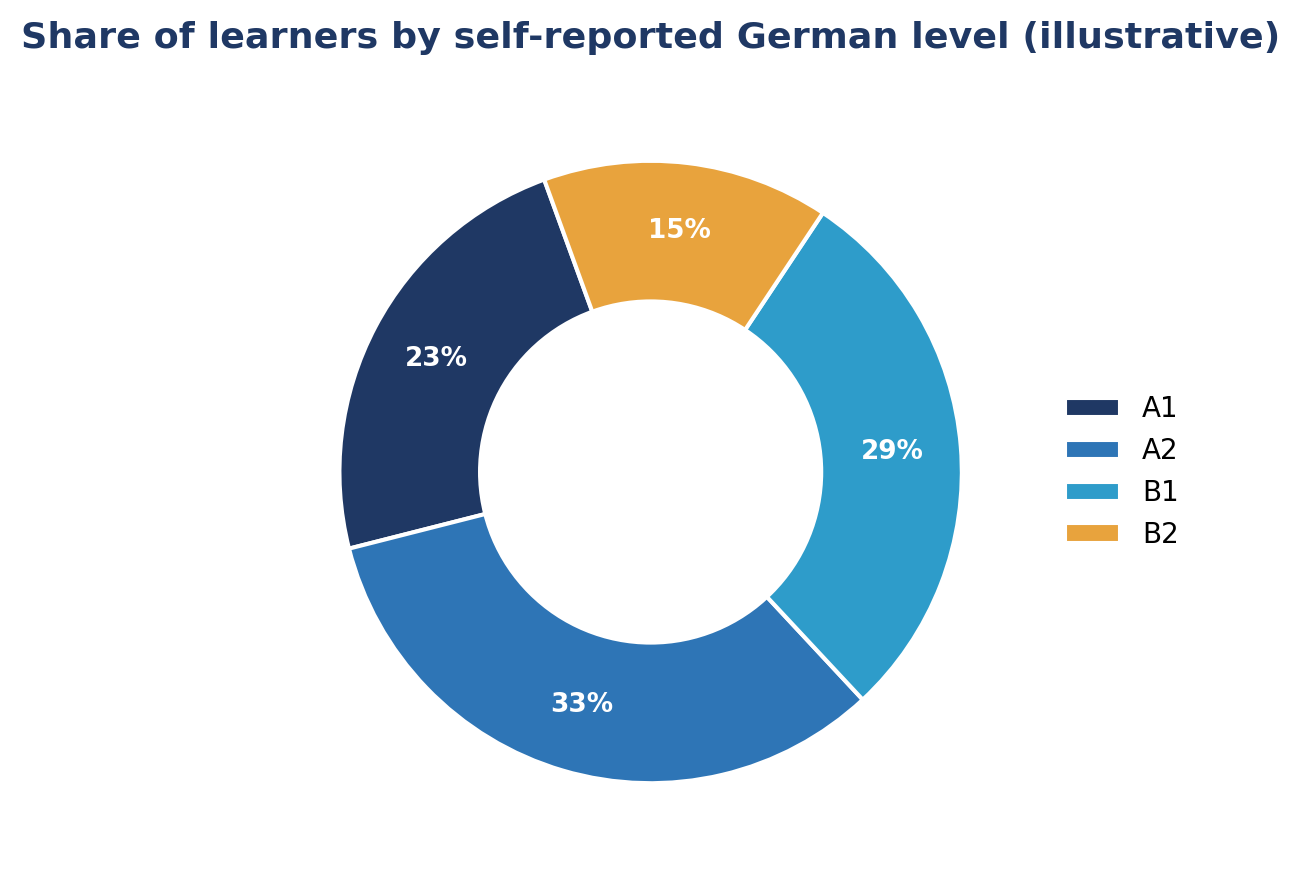
Most people overestimate their level by one rung. That gap is exactly why speaking practice matters more than more textbooks.
A1: Tourist German
At A1 you are not having conversations. You are firing rehearsed phrases and hoping they land.
A1 is a real achievement and a fragile one. Use it or lose it within weeks. Think of it as 80–100 guided hours of scaffolding.
A2: Errand German
A2 is where daily life becomes possible without English. Shops, trains, doctors, small talk with neighbours.
Beware the A2 trap. Many learners stall here for years because A2 is comfortable. Improvement stops feeling urgent, and urgency is what B1 demands.
B1: Real-Life German
B1 is the level people mean when they say "I speak German". You can survive an unexpected question.
B1 is what most employers mean by conversational, and it is the level most visas and naturalisation processes ask for. Approximately 350–400 guided hours gets you here.
Notice how the numbers thin out above B1. The crowd does not leave because B2 is impossible. It leaves because B1 feels good enough.
B2: Professional German
B2 is the working level. You can do your job in German, follow a meeting, and push back on a proposal without panicking.
Expect roughly 550–650 guided hours. The jump from B1 to B2 is the most demanding in the whole ladder, and it is mostly earned by input volume.
Find out which level you are actually at
Most learners guess wrong by a full rung. A self-paced AI voice tutor helps you find your true level — then you study the right things instead of repeating A2 forever.
Check your German level →Create a free accountSame Level, Different Realms
A single CEFR level hides wildly different abilities. This is the most useful table on the page.
That is why a learner can read Der Spiegel at B1 and still freeze on the phone. Skills develop unevenly, and your weakest channel decides your real comfort.
How to Test Where You Are
Do not trust the certificate from two years ago. Test yourself with real tasks.
The German exam families — Goethe-Zertifikat, telc, TestDaF and ÖSD — all publish their can-do descriptors and sample papers. The Goethe-Institut lists them level by level, and Deutsche Welle offers free graded courses if you want a structured self-check.
Move one rung up, on purpose
Levels are not moods — they are milestones with hour counts. Pick your target, get placed honestly, and let the AI voice tutor guide you up the ladder.
Start your German course →Create a free accountFrequently Asked Questions
What german level can-do means in practice? It means descriptions of what a learner can actually perform — order food, argue a point, write a report — rather than scores. The CEFR defines these as can-do statements for each of the six levels.
What level of German do I need to work in Germany? B2 is the practical threshold for most skilled professional roles, and many employers ask for it directly.
Is B1 German fluent? B1 is conversational but not yet fluent. You can hold unprepared conversations on familiar topics. Real comfort with speed and abstraction arrives around B2.
How many hours to go from B1 to B2? Roughly 200 extra guided hours, so around 550–650 total. Most learners take six to twelve months with consistent weekly study.
References & Further Reading
- Council of Europe — Common European Framework of Reference for Languages, can-do descriptors
- Goethe-Institut — level descriptions and free sample exam papers
- telc gGmbH — exam specifications and CEFR mapping
- TestDaF-Institut — university admission test information
- LanguageSkills.net — self-paced German courses with AI voice tutor and honest level placement