Three letters. One enormous distance. A1 means you can order a coffee. B2 means you can argue about the coffee in a business meeting, in the subjunctive, without sweating.
Everyone asks the same question: how long? Here is the honest answer, with the numbers attached.
What you will get from this guide
- Hour bands for each level, from A1 to B2
- What actually changes in your German at every stage
- Which exams prove each level
- A month-by-month plan and the plateaus to expect
What B2 Actually Means in German
B2 is the professional threshold. It is the level most German employers ask for, and the level where German stops being a project and becomes a tool.
The jump from B1 to B2 is the widest. It is not about new topics — it is about precision, speed and register.
The Hours Behind Each Level
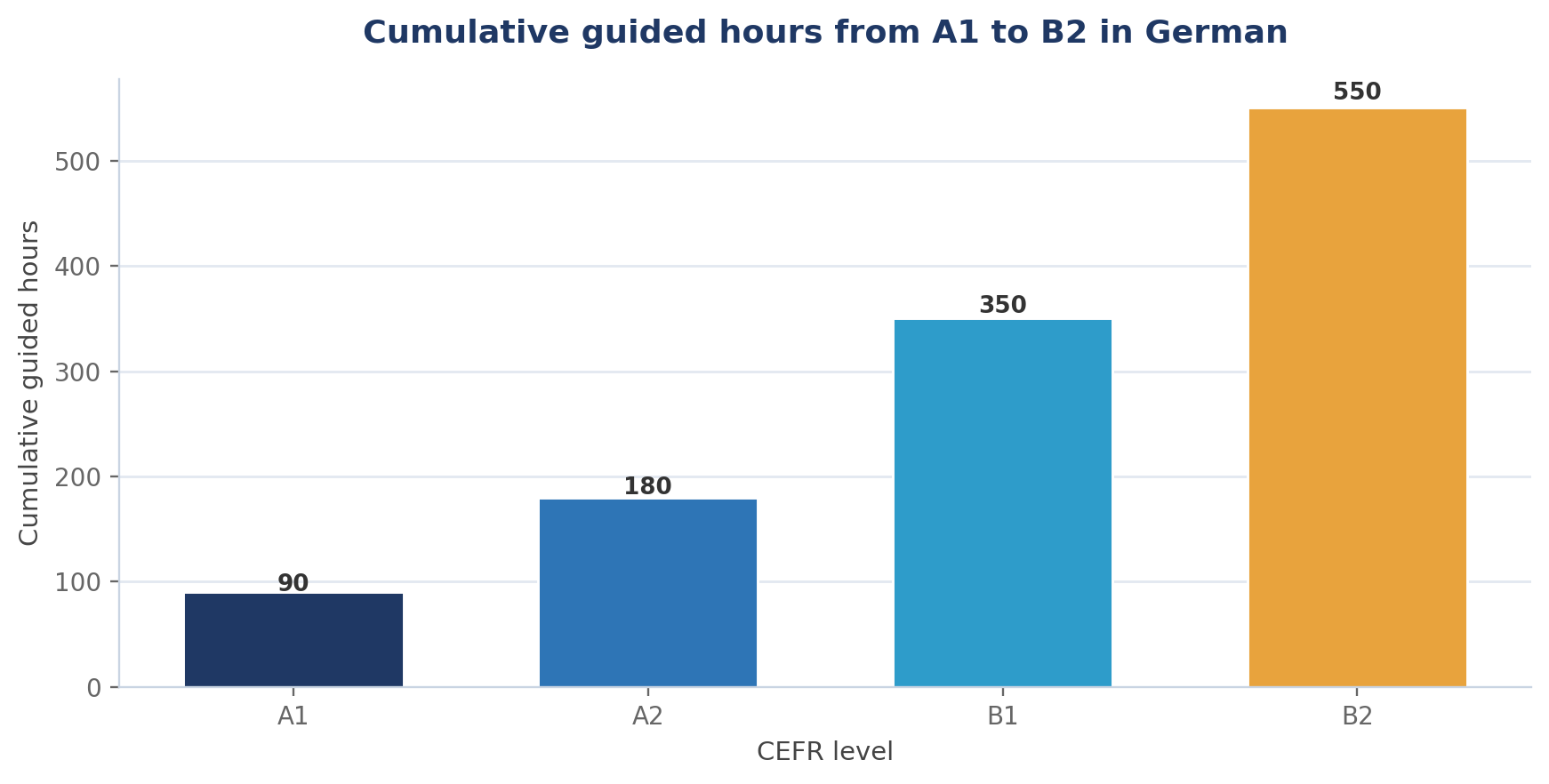
These are guided-hour estimates, and they assume you already speak another European language.
Add 30–50 percent if German is your first non-native language, your study is irregular, or your only exposure is a textbook.
Notice the shape. Getting to A2 is cheap. Getting from B1 to B2 costs almost as much as everything before it combined.
Stage by Stage: What to Learn and What to Drop
Each level has a different centre of gravity. Study the wrong thing and you stall.
At A2 and B1, grammar stops being a list and becomes a system you feel. That shift is the whole game.
The Exams That Prove Each Level
Nothing convinces a German employer faster than a certificate with an institute logo on it.
For nursing and care work in Germany, B1 or B2 is often legally required. For university admission, TestDaF or Goethe B2 or DSH is usually the target. Check the specific requirement before you book anything — the Goethe-Institut publishes the full exam catalogue by level.
The B1 to B2 Wall — and How to Break It
This is where most learners quit. Not at the beginning. At B1, where everything suddenly feels familiar and nothing feels automatic.
Three symptoms: you understand podcasts but not conversations. You know the word but not the article. You speak in sentences that are technically correct and somehow not German.
Fixes for the last one are hard to arrange alone. That is not a sales pitch, it is a fact about feedback loops.
Stuck at B1? You need a room, not another textbook.
The B1–B2 gap closes with pressure: fast speech, live correction, real disagreements. Our self-paced German lessons are built around exactly that — small groups, B2-focused speaking, weekly feedback.
See German B2 classes →Create a free accountA Realistic Month-by-Month Plan
Take the whole journey as four phases of roughly six months each.
Twenty-four months is realistic for one hour a day. Twelve months is realistic for two to three hours a day. Both are fine. Irregular study is the only option that reliably fails.
How to Keep Score Without Fooling Yourself
Test yourself every eight weeks with a fixed task: a three-minute monologue on a new topic, recorded. Keep the recordings. Improvement is inaudible week to week and obvious month to month.
Also track passive versus active vocabulary separately. Most learners know 3,000 words passively and can use 900 actively. Closing that gap is worth more at B2 than adding another 500 words you cannot place in a sentence.
Two years is fast. Let us make it faster.
Learners with a live teacher reach B2 in roughly the guided-hour band, while solo learners often overshoot it. Structured courses with weekly speaking put you in the first group.
Start at languageSkills →Create a free accountFrequently Asked Questions
How long does it take to go from A1 to B2 in German? Around 550 guided hours, which is roughly 18 to 24 months at one hour a day. Add 30 to 50 percent for irregular study or a first non-European native language.
Is B1 or B2 better for working in Germany? B2 is the standard for professional roles, especially in offices, healthcare and engineering. B1 is enough for many vocational positions and everyday life.
Can I skip B1 and go straight to B2? You can, but most learners who try hit a grammar wall. B1 builds the subordinate-clause and connector skills that B2 assumes you already own.
Which certificate should I take at B2? Goethe B2 and telc B2 are widely accepted. For university admission, TestDaF or DSH may be required instead — check your institution.
References & Further Reading
- Goethe-Institut — official CEFR exam levels, model tests and descriptors.
- telc — telc Deutsch B1–B2 Beruf and general German certificates.
- TestDaF-Institut — the university admission test for German.
- Council of Europe, CEFR Companion Volume — the reference scale behind A1 to B2.
- Deutsche Welle Nicos Weg — free CEFR-aligned course material.
Pick your level. Block the hours. Then start counting them.