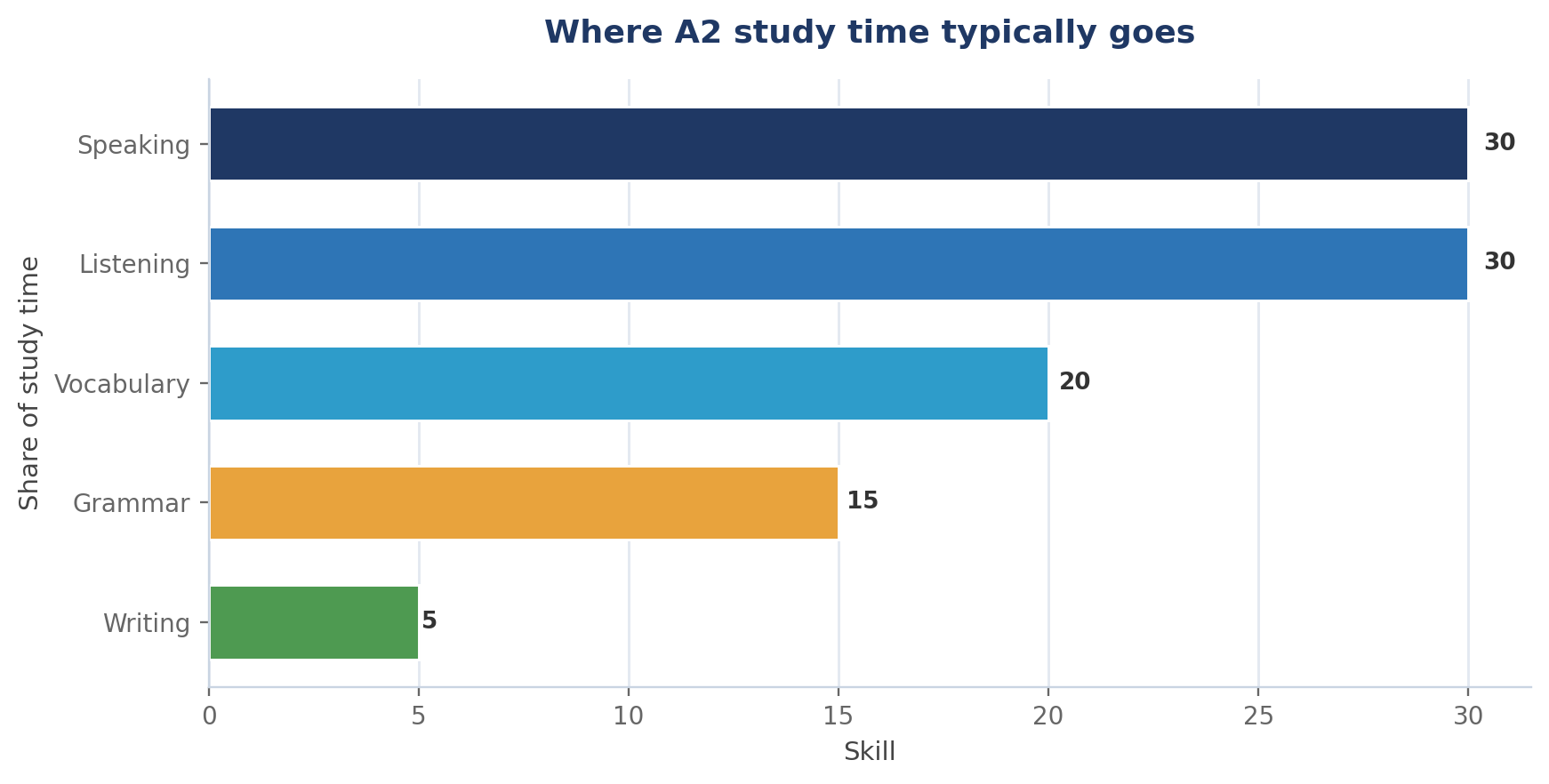
Picture the moment it clicks. You are in a bakery in Leipzig, and instead of pointing, you say it — Ich nehme zwei Brötchen, bitte — and the woman behind the counter answers at full speed, and you understand her. Not every word. Enough.
That is A2. Not fluent. Not impressive at a dinner party in Berlin. But genuinely functional, and far more useful than learners give it credit for. If you are sitting at A1 wondering what the next rung actually contains, this is the ladder.
What you will get from this guide
- Exactly what German A2 covers across reading, listening, speaking and writing
- The A2 grammar checklist and the vocabulary themes examiners test
- A realistic week-by-week route from A1 to A2, with hours attached
- The three real A2 exams, how they are scored, and how to pass first time
German A2 in One Sentence
A2 is the level where German stops being a phrasebook and becomes a language you can steer.
The Council of Europe's CEFR descriptor for A2 says you can understand sentences and frequently used expressions related to areas of immediate relevance, communicate in simple, routine tasks, and describe in simple terms aspects of your background, immediate environment and matters of immediate need.
Read that again, slowly, because it is a precise promise. Immediate relevance. Routine tasks. Simple terms. A2 is not the level of opinions about politics. It is the level of Tuesday.
A1 vs A2 vs B1: Where You Actually Are
Most learners misjudge their own level because they measure against B1 and feel small. Measure against the neighbouring rung instead.
If you can hold a two-minute exchange about your weekend without switching to English, you are probably already at A2 and simply need to prove it.
The A2 Grammar Checklist
This is the part people fear, and it is shorter than the fear suggests. A2 grammar is mostly a matter of finishing the case system and getting comfortable in the past.
Notice the theme. A2 is not about new concepts so much as applying known concepts without pausing to think. Recognition was A1's job. Retrieval is A2's.
Grammar you can use, not just recognize
The A2 gap is almost never understanding. It is speed under pressure, and that only comes from speaking regularly with feedback. Our German courses use a personal AI voice tutor that gives you speaking practice with instant feedback at exactly this level, and you study at your own pace, any time.
Find your A2 German course →Create a free accountWhat You Need to Know at A2: Vocabulary Themes
Vocabulary at A2 is deliberately domestic. The examiners test the world you actually live in, which is why cramming abstract nouns is a waste of your evenings.
Total active vocabulary at A2 sits in the 1,300 to 1,800 word range, with recognizably more available passively. Learn these in sentences, not in columns. Columns die in conversation.
How Long A1 to A2 Really Takes
Here is the arithmetic nobody puts on a course page. From zero, A2 is roughly 180 to 220 guided hours. From A1, you are looking at about 100 to 130 more.
The sweet spot for working adults is two to three guided hours a week plus twenty minutes of daily input. That is not a heroic schedule. It is a Tuesday schedule, and it lands you at A2 inside a year.
The Three Real A2 Exams Compared
German A2 certificates are offered by recognised institutions, and all three are mapped to the CEFR. They differ in flavour more than in difficulty.
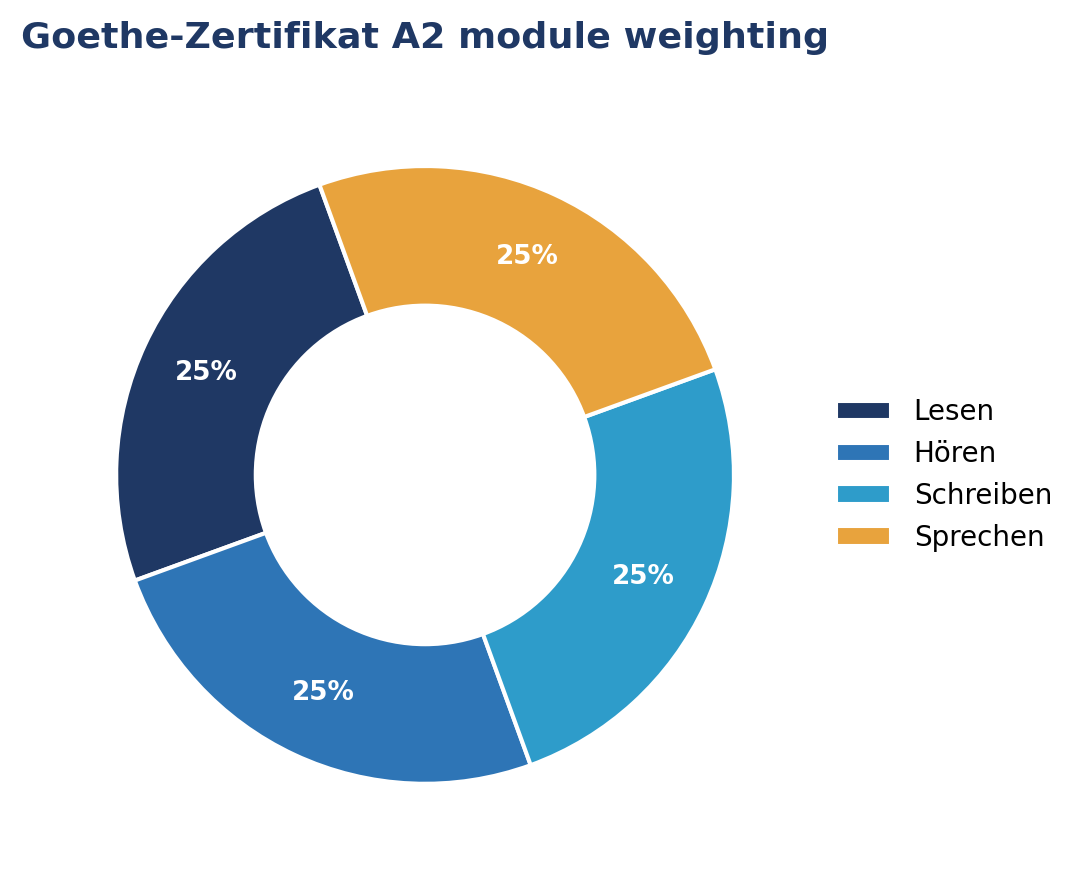
Two practical notes. First, all four skills must be passed or at least scored adequately — you cannot carry a weak speaking module with a strong reading score. Second, A2 certificates are usually not sufficient for university admission or for skilled-worker visas; those typically ask for B1 or B2, and you should verify requirements with the relevant authority rather than a forum.
From A1 to A2: A Twelve-Week Route
If you already have A1 and three hours a week to give, here is a plan that works without heroics.
Book the exam before week eleven. A date on the calendar is worth more than a resolution.
Build the skills the exam tests
Twelve weeks of guided lessons beats twelve months of drifting between apps. A personal AI voice tutor, structured lessons you take at your own pace, and speaking practice with instant feedback.
Start your A2 course plan →Create a free accountSix Mistakes That Stall A2 Learners
Every stalled learner I have seen is stuck on one of these. Most are stuck on the first two.
Notice that none of these are about talent. Every one is a scheduling or habit problem in disguise, which is excellent news, because habits are editable.
Self-Assessment: Are You A2 Yet?
Answer these honestly, out loud, without preparation. If you land four or more, you are A2.
If you got three or fewer, do not despair and do not restart from A1. Restart from the weakest row and drag it up. Level tests are not verdicts. They are shopping lists.
Your Next Move
German A2 is the level where the language starts paying rent. You can travel without pointing. You can handle admin in German, make an appointment, complain politely, and understand the answer. It is the first level that feels like freedom instead of homework.
The route is unglamorous and short. Speak from week one so the grammar has somewhere to live. Learn every noun with its article. Feed your ear daily, even for twenty minutes. And put a real exam date in the diary, because a deadline converts enthusiasm into fluency faster than any technique ever will.
A2 is not the summit. It is the first ledge where you can stand up, look around, and see that the climb was worth starting. Check the Goethe-Zertifikat A2 format so you know precisely what you are aiming at, then go get the ledge.
Frequently Asked Questions
What does German A2 mean exactly? A2 is the second of six CEFR levels, called elementary. You can handle routine exchanges, describe your background and immediate needs in simple terms, and understand common sentences about familiar topics. It sits between A1 survival phrases and B1 independent conversation.
How many hours does it take to reach German A2? Roughly 180 to 220 guided classroom hours from zero, or about 100 to 130 hours if you already have solid A1. Flexible learners studying two hours a week typically reach A2 in about a year.
Is A2 German enough to live in Germany? For daily life, yes, and it helps enormously. For skilled-worker visas, university study or many professional roles, authorities commonly require B1 or B2, sometimes with a specific certificate, so always confirm the exact requirement with the relevant office.
Which exam should I take for A2 German? The Goethe-Zertifikat A2 is the most widely recognised general certificate, telc Deutsch A2 suits job and integration contexts with its vocational variants, and the ÖSD certificate is common in Austria. All three map to the same CEFR level.
Can I go from A1 to A2 in three months? Yes, with around ten guided hours a week plus daily practice. At two hours weekly, expect five to six months. The grammar volume is modest, and speaking stamina is the usual bottleneck.
How many words do I need for A2 German? Around 1,300 to 1,800 active words covering home, work, shopping, health, travel and free time. More important than the count is instant retrieval of the most common two thousand.
References & Further Reading
- Goethe-Institut — Goethe-Zertifikat A2 structure, module weighting and exam regulations: https://www.goethe-institut.de/en/learn-german
- Council of Europe — CEFR global scale and level descriptors, including the A2 self-assessment statements: https://www.coe.int/en/web/common-european-framework-reference-languages
- telc — telc Deutsch A2, Telc A2 Beruf and the telc CEFR level overview: https://www.telc.net
- ÖSD — ÖSD Zertifikat A2 exam structure and regulations for Austria: https://www.osd.at
- Deutsche Welle — free structured German course materials at A1 and A2 with audio: https://learngerman.dw.com
- Goethe-Institut Wortliste A2 — official vocabulary list specifying the words expected at A2: https://www.goethe-institut.de