Most learners guess their level using the worst possible instrument: gut feeling. Gut feeling says B1. Gut feeling is usually A2 with a good accent.
The fix costs nothing. There are free placement tests built by serious institutions, and reading their results correctly takes about ten minutes. Let us do this properly.
What you will get from this guide
- Free, reputable placement tools and what each one measures
- What each CEFR level actually means in real-world tasks
- Which certificate matters for study, work or citizenship
- How to spot the two mistakes that make self-tests lie
Why Self-Testing Goes Wrong
Two errors wreck almost every self-assessment.
The first is confusing understanding with producing. You can follow a German podcast comfortably and still freeze when asked a question in return. Reception and production are separate skills, and a written test only measures part of the picture.
The second is testing on a good day. Levels are not peaks, they are floors. If you can manage a B1 conversation once, in a quiet room, with a patient partner, you are not yet B1. You are B1-ish.
Free Placement Tools Worth Your Time
These are real, free, and built by institutions that know what they are doing.
Use at least two. One written test plus one speaking assessment gives you a level you can trust.
What Each CEFR Level Actually Means
Here is the honest version, without can-do jargon.
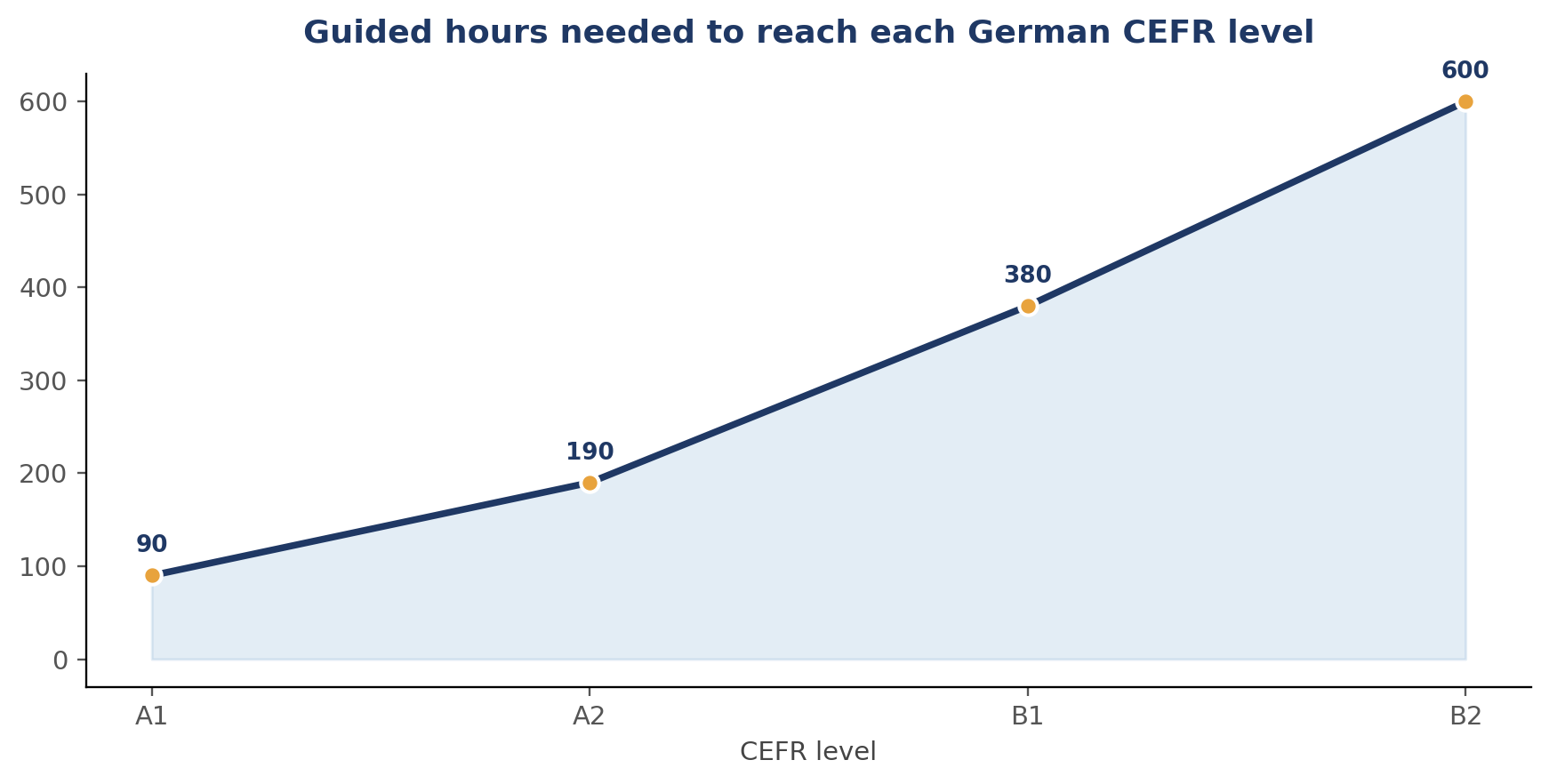
Notice the jump from B1 to B2 — roughly 220 hours. That is the wall most learners hit and blame themselves for. It is not you. It is the mathematics of the level.
A free test tells you where you are. An AI tutor gets you to the next level.
Our free-level assessment pairs you with an AI tutor who checks your speaking, not just your grammar, then builds a plan for the hours ahead.
Take the free German assessment →Create a free accountThe Certificates That Actually Matter
Free tests tell you your level. They do not prove it. If you need proof, you need an exam.
Requirements change and differ by country and authority. Always confirm with the specific university, employer or immigration office before you book an exam.
Compare the Certificates Side by Side
Goethe and telc cover the widest set of everyday and professional needs. TestDaF and DSH are specialised for higher education.
How to Run a Free Test Properly
Set aside twenty minutes, not two. Follow this sequence.
That last rule is important. Your true level is the lower of the two until they converge, because that is what will show up under pressure.
Fix the Gap Between Written and Spoken
Most learners test higher on paper than in speech. If that is you, the fix is not more vocabulary.
Twenty minutes of conversation practice with an AI tutor three times a week closes that gap faster than any app.
Find your level free. Then climb it with a plan.
Create a free account, take the placement assessment, and see exactly which level you belong in and how many guided hours stand between you and your goal.
Create your free account →Create a free accountFrequently Asked Questions
Are free online German tests accurate? The reputable ones are reasonably accurate for reading and listening, and less so for speaking. Use a free test to place yourself, then confirm with an AI tutor assessment before booking an exam.
How do I know if I am A2 or B1? The clean test is unplanned conversation. A2 handles routines and simple messages; B1 handles most daily situations and can explain an opinion with reasons. Ask yourself what you can do without preparation.
Do I need a certificate to study in Germany? Most universities require TestDaF, DSH, or an equivalent recognised certificate, usually at B2–C1. Requirements are set per institution, so check the specific programme.
How long does it take to move up one level? Roughly 150–220 guided hours between A2 and B2 for most adults. It varies with your first language, hours per week, and how much you speak.
References & Further Reading
- Goethe-Institut — free online placement test and the Goethe-Zertifikat A1–B2 exams.
- telc gGmbH — official telc Deutsch exam descriptions and free sample tests.
- TestDaF-Institut — TestDaF exam details and free orientation materials (including OnSET).
- Deutsche Welle Deutsch lernen — free graded courses and level placement test.
- Duden — standard German grammar and usage reference for self-study.
Take the free test today. Knowing your real level is the cheapest upgrade you will ever make.