Most learners don't fail at Japanese because the language is impossible. They fail because their study plan is a fantasy — three heroic hours on Sunday, then nothing until the guilt sets in on Thursday. The fix isn't more motivation. The fix is a japanese study routine so small, so repeatable, and so well-structured that skipping it feels weirder than doing it.
This guide hands you a complete daily routine: what to do in the morning, how to squeeze Japanese into a lunch break, what to nail before bed, and how to rotate skills across the week so nothing rusts. No heroics required. Just a japanese practice schedule that compounds.
Why Daily Beats Weekend Cramming
Memory research on spaced repetition — the principle behind tools like Anki — shows that retrieval spread across days beats the same total time crammed into one block. In plain English: twenty minutes daily outperforms three hours on Saturday. You meet each word more often, you forget less between meetings, and you never have to "re-learn" what you already paid for.
Consistency also protects your confidence. A learner who studies every day for ten minutes feels like a Japanese speaker. A learner who studies once a week feels like a tourist with a hobby. Identity matters, and identity is built by repetition.
The Three-Block Daily Routine
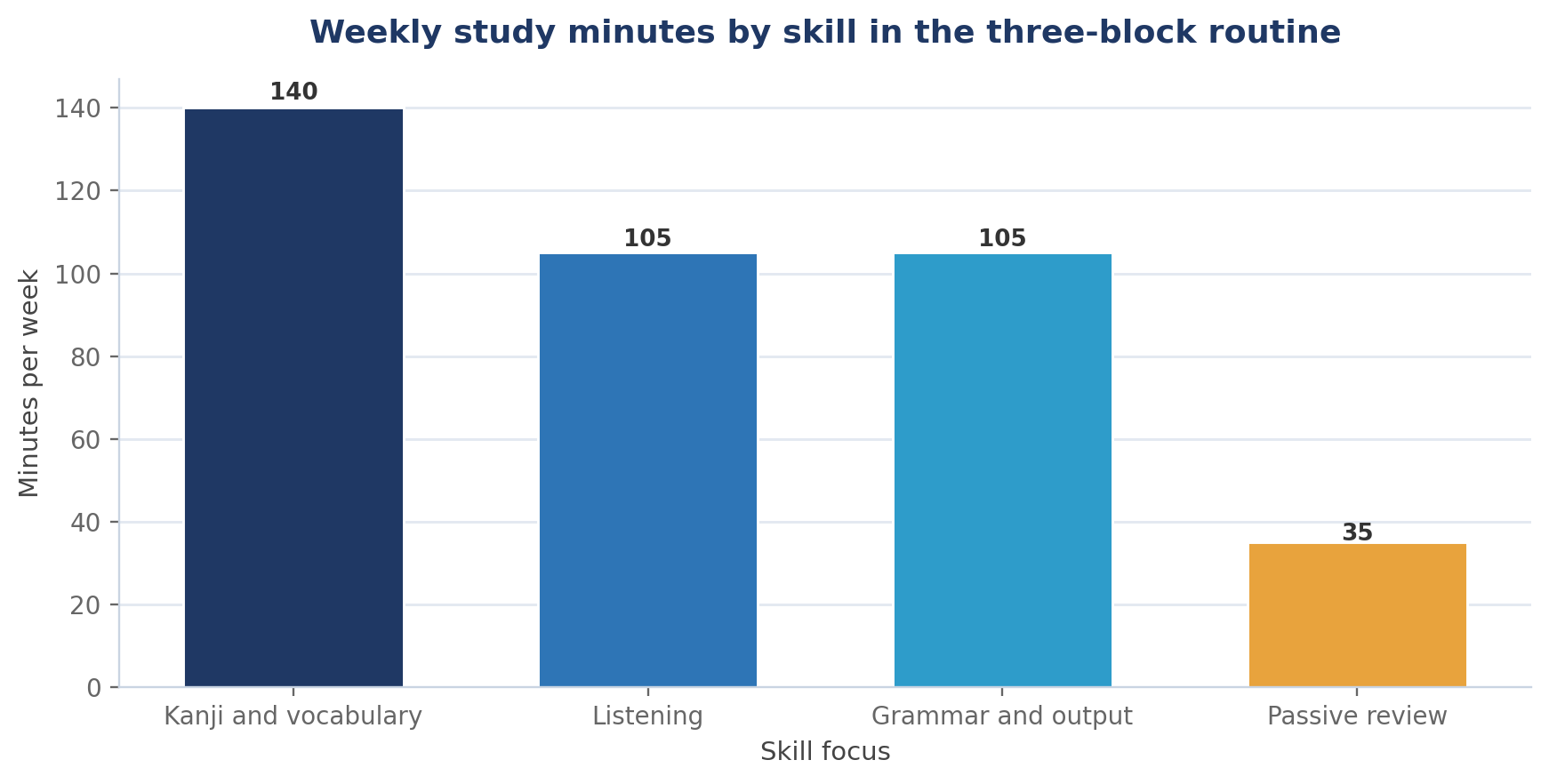
The magic number is three. Three short blocks spread across your day fit into real life and still hit every skill. Here's the shape.
That's roughly forty minutes of real work, plus whatever bonus you steal from waiting rooms. The point isn't the minutes. The point is that your brain touches Japanese three separate times before bed — and that's a japanese study plan your calendar won't fight you on.
Stop guessing and start following a proven path
Our Japanese course pass gives you structured lessons, spaced-review decks, and a clear level-by-level roadmap so your daily routine always has a next step. You bring twenty minutes a day; we'll bring the plan.
Unlock the Japanese Course Pass →Create a free accountThe Morning Block: A Kanji Routine That Sticks
Kanji is where routines go to die. People try to "learn" forty characters in a sitting, retain six, and quit. Flip the math: fewer characters, more days.
Write each new character by hand once, say its readings aloud, and attach one real word to it. Characters learned as isolated shapes evaporate; characters learned inside a word stick. Ten minutes, done, coffee still warm.
Midday: Train Your Ears in Fifteen Minutes
Listening is the skill learners skip because it feels passive. It isn't — if you do it actively. Pick one short clip, listen once without text, once with text, then shadow it out loud. Fifteen minutes of shadowing a native speaker will do more for your accent than an hour of silent textbook reading.
Evening: Grammar, Reading, and Ten Minutes of Output
Evening is your thinking block. Read one short paragraph, look up only the words that block meaning, then summarize it in two written sentences. That last step is the secret weapon: producing Japanese forces your brain to organize what it just absorbed.
The Weekly Rotation: Keep Every Skill Warm
Don't abandon flexibility — schedule it. Give each week a rotating emphasis so you never neglect speaking or writing for months.
Making the Routine Survive Real Life
A japanese study routine fails when it requires perfect conditions. Give yourself a floor: on terrible days, do flashcards only — five minutes counts. Track streaks somewhere visible. And protect a weekly review slot, because reviewing is studying.
If you're ready to turn scattered effort into a system with levels, checkpoints, and a finish line, create your free account and start with the placement test.
Your routine deserves a roadmap, not a pile of random resources
Learn Japanese consistently with guided lessons that tell you exactly what to study next, every single day. One pass unlocks every level, so your twenty minutes always move you forward.
Get Your Japanese Course Pass →Create a free accountFrequently Asked Questions
How long should my daily routine be? Experts and experienced learners generally point to 20–45 minutes a day as a sustainable sweet spot for steady progress. Consistency matters more than duration, so start at twenty minutes and expand only when the habit feels automatic.
Is it better to study in the morning or at night? Whichever time you'll actually repeat. Many learners report sharper recall in the morning and better focus at night, so the honest answer is to test both for two weeks and keep the one you never skip.
Can I learn Japanese with only fifteen minutes a day? Yes, though expect a slower timeline. Fifteen focused minutes daily still beats two hours once a week, because spaced practice recruits long-term memory far more efficiently.
How many kanji should I learn per day? Most steady learners handle 3–8 new characters daily while keeping reviews current. Pushing past that usually inflates your review queue and triggers burnout — trust the rotation, not the sprint.