Month four. The kanji notebook is open on page 61. It has been open on page 61 for nine days. Nothing is wrong with your brain.
Motivation is a mood, and moods are terrible project managers. What keeps people studying Japanese for years is duller and far more powerful: a system that survives your worst week. Here is how to build one — and how to stay motivated learning Japanese when the novelty finally wears off.
What you will get from this guide
- Why motivation fails and what replaces it
- The five plateaus that end most Japanese journeys, with fixes
- A weekly scoreboard that shows real progress, not vibes
Motivation Is Weather. Habits Are Climate.
Roughly 3.8 million people study Japanese at institutions outside Japan, according to the Japan Foundation's most recent global survey. Almost all of them started with a spark. The ones still reading manga in year three are not more passionate. They built a repeatable minimum.
Set the bar embarrassingly low. Ten minutes counts. Five flashcards count. A habit you can hit on your worst Tuesday is a habit that survives, and survival is the whole game.
Which Motivation Actually Lasts?
The pattern is clear: external deadlines fade, relationships and consequences hold. So build relationships with the language — a conversation partner, a study buddy, a group chat that notices your absence.
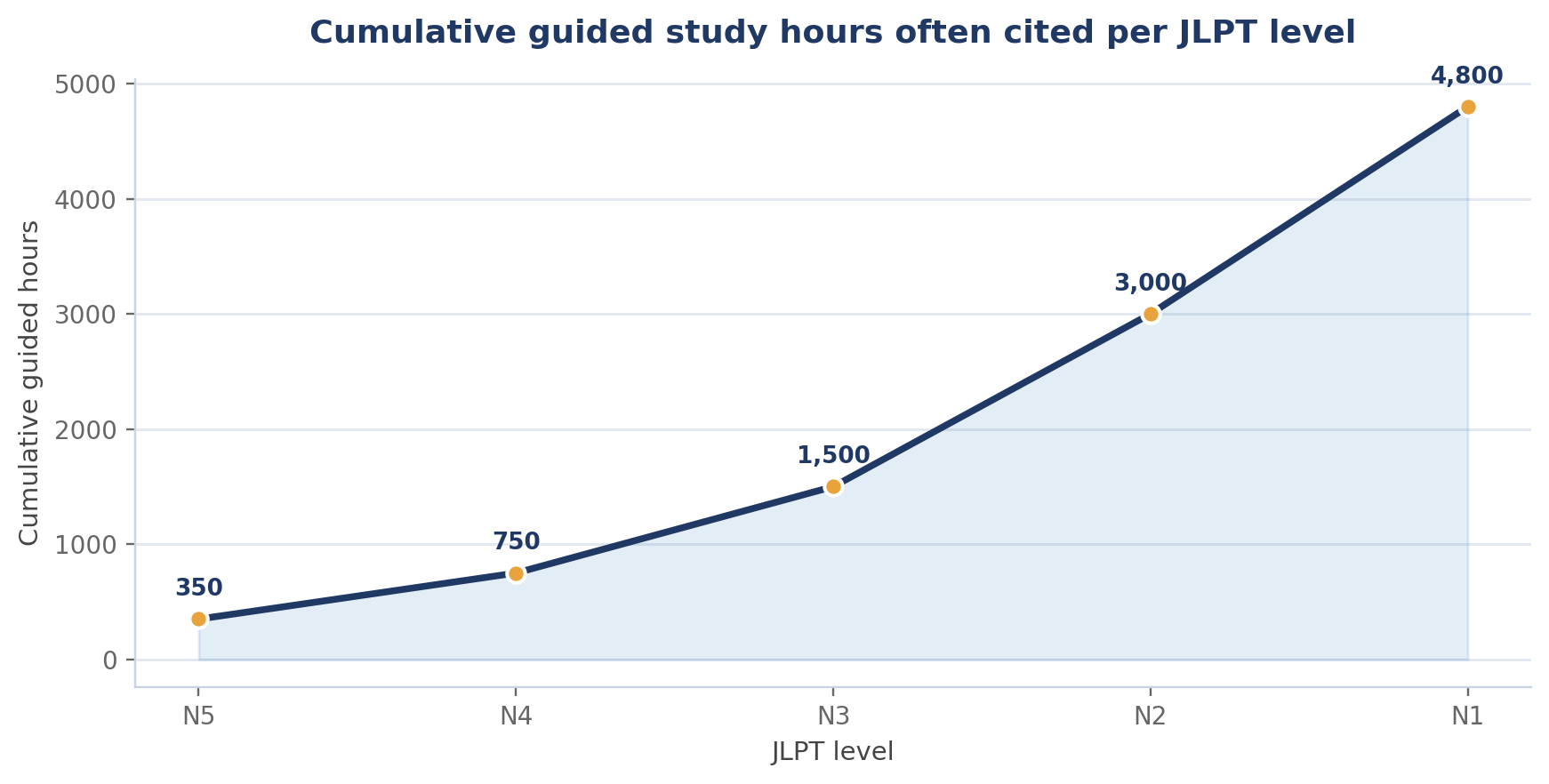
The Five Plateaus That Kill Progress
That fourth plateau is where most self-study plans quietly die. The distance between N4 and N3 is not twice N5 to N4 — it is several times larger, and it demands reading volume rather than more flashcards.
Delete the solo drift
The fastest motivation fix is a system that notices when you miss a week. A personal AI voice tutor gives you a structured lesson plan, speaking practice with feedback, and corrections that make progress visible again.
Start your Japanese course →Create a free accountDesign a Habit You Cannot Fail
The "never miss two" rule is worth more than any productivity app. One skipped day is noise. Two becomes a pattern, three becomes a story about yourself that you will repeat for years.
A Scoreboard That Shows Real Progress
Feelings lie. Numbers from your own log do not.
Re-listening to audio from two months ago is a magic trick. The clip that once sounded like static will suddenly be a sentence you understand, and that single moment outperforms every motivational quote ever printed.
Make Japanese Part of Your Ordinary Life
Change your phone language. Label objects on sticky notes. Read one page of a children's book aloud before bed. Follow Japanese accounts about a hobby you already love — cooking, trains, football, gaming. Interest you already have, delivered in the language, is free motivation with zero willpower required.
If you are preparing for the JLPT, align the routine with the exam: timed reading passages and listening practice at native speed, twice a week. The test does not reward effort, only accuracy under pressure.
When to Bring in Structured Feedback
Platespeak is the alarm. The day you think "I am not improving", you have already spent weeks working without feedback. That is not a discipline problem, it is an information problem.
A structured lesson with an AI voice tutor fixes it in one session: here is what you are actually doing wrong, here is your true level, here is the next rung. If you want a clear next step, create your free account and start a guided lesson — a clear next step is the strongest motivation there is.
Progress you can hear in six weeks
You will not remember a motivational speech. You will remember the day a fast Japanese sentence lands and you simply understand it. That day is engineered, not wished for.
Start your Japanese course →Create a free accountFrequently Asked Questions
How do I stay motivated when progress feels invisible? Test yourself against old material. Re-reading a text you struggled with, or re-listening to an old episode, makes progress visible in minutes.
What if I miss a whole week of study? Resume with ten minutes on day one. Do not try to "catch up" — that plan is how a missed week becomes a lost year.
Is it normal to lose motivation around six months? Very normal. It usually means you have left the honeymoon phase, not that you lack talent. Add structure and people at that exact point.
Can a course really improve motivation? Yes, mainly through structure and accountability. A self-paced course with a personal AI voice tutor converts intention into a regular routine, which is what most learners actually need.
References & Further Reading
- Japan Foundation — global survey of Japanese-language education: https://www.jpf.go.jp/e/
- JLPT official site (Japan Foundation / JEES) — exam levels and structure: https://www.jlpt.jp/e/
- NHK World Japan — free graded learner audio: https://www.nhk.or.jp/lesson/en/
- CEFR — self-assessment descriptors for realistic goal setting: https://www.coe.int/en/web/common-european-framework-reference-languages
- Agency for Cultural Affairs — jōyō kanji list for long-range planning: https://www.bunka.go.jp/