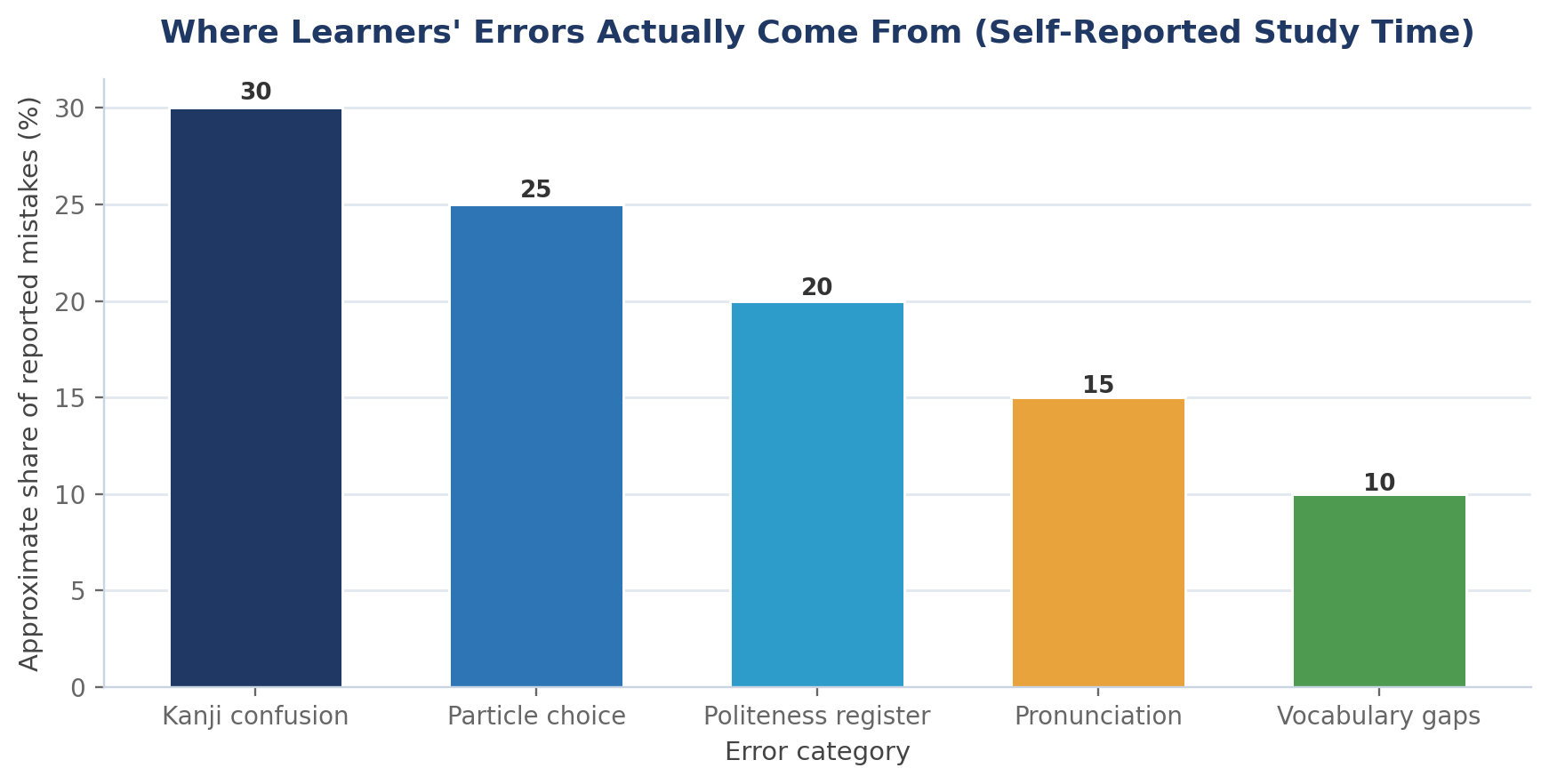
Every Japanese learner hits the same wall — and it rarely looks like a wall. It looks like "I studied for a year and still freeze when someone says sumimasen." Sound familiar? Good news: nearly all of the japanese learner mistakes that stall progress are predictable, catalogued, and fixable. You don't need more talent. You need fewer repeated errors. Let's hunt them down.
Mistake 1: Learning Kanji as Pictures, Not as Systems
The classic learning japanese mistake is treating every kanji as a unique doodle to memorize by brute force. That works for the first 100 and collapses at 300.
Kanji are built from components (radicals) that repeat constantly. Learn 200 well-chosen components and thousands of characters become recognizable patterns instead of random squiggles.
Avoid kanji mistakes by writing characters with their components named out loud: "water radical plus 青." Your brain stops seeing a mystery and starts seeing Lego.
Mistake 2: Skipping the Particles Because "They're Confusing"
Learners quietly decide particles (は, が, を, に, で) are advanced and postpone them. Then they speak in noun piles and wonder why nobody understands.
Here's the honest fix: japanese particle mistakes disappear when you read whole sentences aloud and consciously name what each particle does. Ten focused minutes daily beats one panicked grammar binge.
Fix Particles Fast, Not Eventually
Our Course Pass turns particle confusion into second nature with guided drills and instant feedback. Stop guessing and start building sentences that land correctly the first time.
Start learning Japanese →Create a free accountMistake 3: One Register for Every Human Being
Learners often learn casual Japanese from anime, then address their boss with it. Or they learn only polite です・ます and sound stiff with friends.
The skill isn't knowing one register — it's switching. Pick a character you'd never want to embarrass and rehearse their register deliberately.
Mistake 4: Pronunciation Drift Nobody Corrects
Most learners never get corrected on pitch accent, long vowels, or the ふ sound, so errors fossilize. Japanese pitch accent changes meaning — 箸 (chopsticks), 橋 (bridge), and 端 (edge) all read hashi with different pitches.
Record yourself. Compare. Repeat. It's unglamorous and unbelievably effective.
Mistake 5: Passive Input Forever
Watching Japanese shows with English subtitles is not study. It's entertainment wearing a study costume. The japanese study tips that actually move the needle always include output.
Mistake 6: Measuring Hours Instead of Errors
Time logged is vanity. Errors eliminated is progress. Track what you get wrong, not what you finish.
Mistake 7: Quitting the Boring Middle
The N4-to-N3 stretch is famously where learners vanish. It's not hard — it's slow. Avoiding japanese errors here means building a routine you can tolerate on a bad day, not a heroic one.
Keep sessions short, consistent, and slightly social. A study partner or a free account at LanguageSkills gives you accountability that willpower alone never will.
Stay Past the Middle, Finally
The Course Pass keeps you moving through the slow zone with structured milestones and real conversation practice. Trade plateaus for visible weekly progress — and never restart from zero again.
Get your course pass →Create a free accountThe 10-Minute Daily Fix Routine
Frequently Asked Questions
What is the biggest mistake Japanese learners make? Postponing particles and output. Learners hoard vocabulary passively, then discover they can't build a sentence. Start producing early, badly, and often.
Should I learn kanji before grammar? Learn them together. Kanji serves grammar and reading; grammar gives kanji context. Sequential learning wastes months you don't need to spend.
How do I stop confusing は and が? Read sentences where only one is possible, and say aloud what changes. は marks known topics, が introduces new or emphasized information.
Is pitch accent worth learning? Yes, especially from the start. Fixing fossilized pitch later costs far more effort than learning it correctly now.