You studied fifty words last night. This morning you could produce maybe six, and two of those were こんにちは and ありがとう. Nothing is broken — your memory is doing exactly what memory does, which is throw away anything that never came back to visit. The trick to remembering Japanese vocabulary is not more effort in one heroic session; it is building a system where words return at the right moments, in the right forms, with a story attached that your brain refuses to drop. That system is learnable, and today you get the whole blueprint.
Why Japanese Vocabulary Slips Away So Fast
Japanese stacks several difficulties on top of each other. There are three writing systems playing at once, pitch accent you cannot see on the page, and a huge stock of Sino-Japanese words that look and sound irritatingly similar: 図書館 and 美術館 and 映画館 march past like cousins at a wedding you cannot tell apart. Add polite and casual forms, and one "word" becomes four things to remember. That is why lists fail. A list gives your brain a single thread to hang meaning on, and single threads snap. Give a word multiple hooks — sound, image, sentence, feeling — and it starts to hold real weight.
The Three Layers of a Word You Actually Own
Vocabulary knowledge is not binary. You can recognise a word in a subtitle, fail to hear it in conversation, and have no chance of producing it politely to a stranger. Memorisation gets much easier once you decide which layer you are building today.
Spaced Repetition, the Honest Version
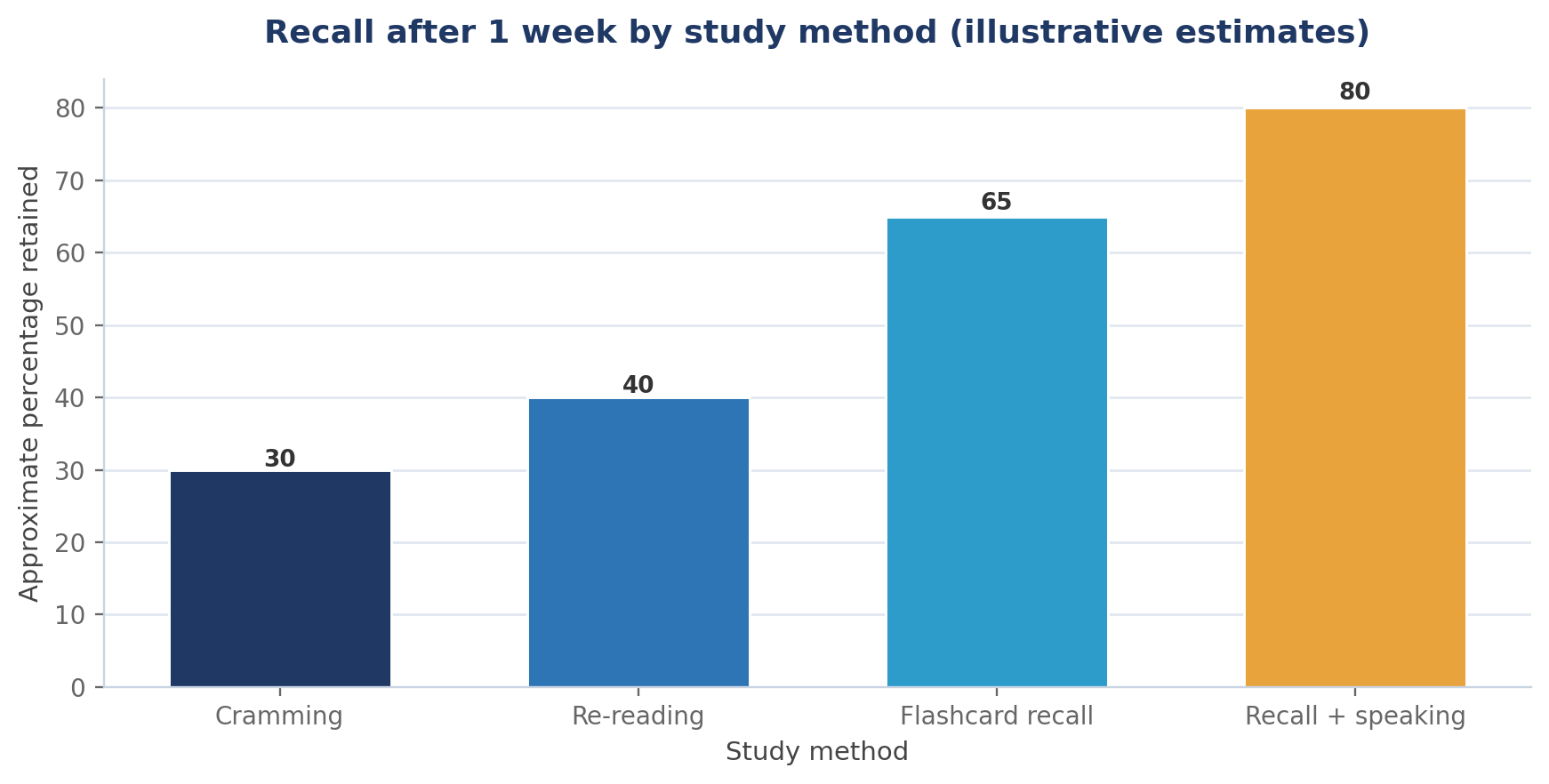
Spaced repetition works because of a stubborn quirk of memory: recall just before you would have forgotten strengthens the trace far more than recall while everything is fresh. Cepeda and colleagues showed that the optimal gap grows as the test gets further away, and Roediger and Karpicke found that retrieving information beats re-reading it for long-term retention. In practice that means five short reviews beat one long one.
If a word keeps failing, do not repeat it harder — change the cue. Swap the flashcard for a full sentence, add a gesture, or make the mnemonic weirder. A stuck item usually needs a new route in, not more traffic on the old one.
Flashcards That Earn Their Keep
The card is not the lesson; the card is the reminder. Keep fronts minimal so your brain must work for the answer, and always let the sentence set the scene.
Mnemonics for Kanji That Survive the Week
Bower and Clark found decades ago that weaving items into a story massively improves recall, and kanji are perfectly built for this because they are already pictures of something. You do not need accuracy from a historical linguist; you need a hook your own brain will not let go of.
Mnemonics stick faster when you say them out loud
A personal AI voice tutor catches the word you keep mispronouncing before it fossilises, and drills it into conversation the same week. Sign up and find the level where your vocabulary finally gets used.
Start learning with your AI voice tutor →Create a free accountContext Beats Lists Every Single Time
A word learned inside a sentence arrives with grammar, register, and rhythm attached, so recalling the sentence drags the word along with it. Reading graded material and watching shows with Japanese subtitles turns review into something you would do anyway.
A 30-Day Rhythm You Can Keep
Consistency beats intensity in every memory study ever run. Aim for a rhythm you can defend on a bad day.
Say It Out Loud — That's the Shortcut
Speaking is the cheat code because it forces retrieval, grammar, and pronunciation into one motion, and it exposes the words you only think you know. You need something that answers, corrects, and pushes the pace. A structured self-paced course gives you a routine your memory can rely on.
Turn forgotten words into automatic ones
Guided lessons put every word you study into a real exchange, so recall happens under pressure instead of on a quiet screen. See how a Course Pass works.
Start self-paced Japanese lessons →Create a free accountFrequently Asked Questions
How many Japanese words should I learn per day? Most learners handle 8–15 new words comfortably alongside reviews; go higher only if retention stays above roughly 80% on your own checks.
Is spaced repetition enough to speak Japanese? No. Spacing builds recognition and recall, but production needs active output, which is why regular speaking practice matters.
Do I need to learn kanji to remember vocabulary? Not every word, but kanji gives you a second channel for recall and makes related words easier to guess.
Are mnemonics childish? Only if you make boring ones. Weird, vivid, personal images are exactly what the research on story-based memorisation rewards.
References & Further Reading
- Cepeda et al., "Spacing effects in learning: a temporal ridgeline of optimal retention" (2008)
- Roediger & Karpicke, "Test-Enhanced Learning" (2006)
- Bower & Clark, "Narrative stories as mediators for serial learning" (1969)
- The Japan Foundation: Japanese-language education resources
- Tofugu: a guide to learning kanji