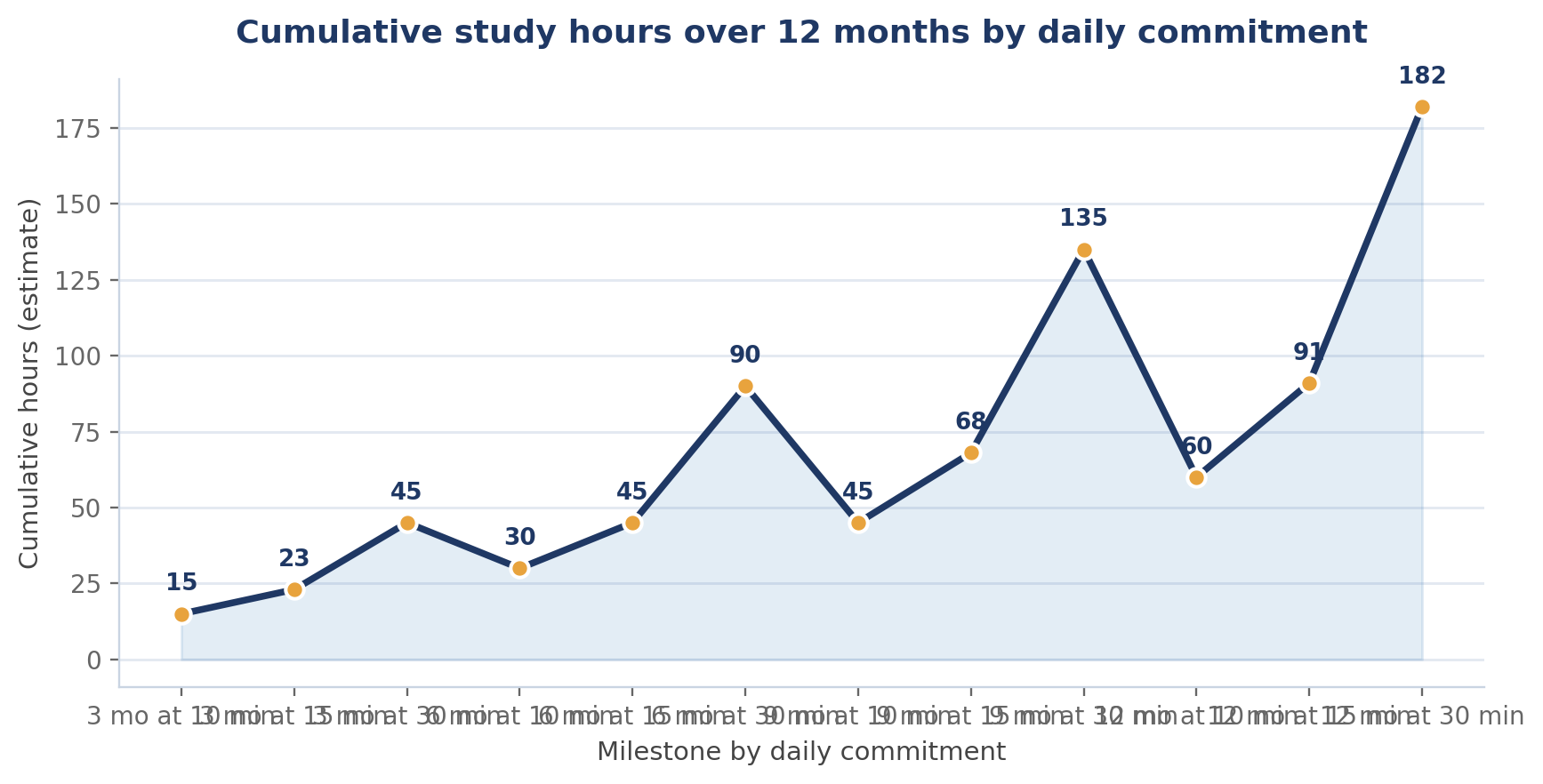
Fifteen minutes a day is 91 hours a year. Ninety-one hours is roughly the distance between knowing zero kana and holding a simple conversation.
Now the other number. Zero minutes a day is zero. Not a little, not "on weekends" — zero, because the habit is what generates the hours, not the other way round.
What you will get from this guide
- The three-part habit mechanism that makes daily study automatic
- A minimum-viable day for weeks when everything goes wrong
- A weekly rotation so practice never turns into a chore
Why Motivation Is the Wrong Fuel
Motivation is weather. It arrives, it disappears, it changes forecast halfway through Tuesday.
Habits are architecture. They run when you are tired, bored and slightly annoyed, which is exactly when language learning actually happens for most people.
Three parts make a habit stick: a cue you cannot miss, an action small enough to be non-negotiable, and a reward you feel immediately. Miss any one and the habit becomes a decision — and decisions get postponed.
Step 1: Anchor to Something You Already Do
The technique is called habit stacking, and it works because you are borrowing an existing circuit instead of building a new one.
Pick one anchor. One. The person who stacks five new behaviours on day one is usually the person who quits on day eleven.
Step 2: Define Your Minimum-Viable Day
This is the single most useful idea in this article.
Your goal is daily, and daily means a bad day still counts. So define a version so small that illness, deadlines and drama cannot kill it.
Bronze days keep the chain alive. A chain of bronze days beats a sporadic heroic Sunday every single month.
Step 3: Rotate So Nothing Goes Stale
Sameness is the quiet killer. Variety inside a fixed structure keeps a habit alive without making it chaotic.
The structure never changes. The content does. That is the trick.
Look at the bottom line against the top. Thirty minutes a day is triple the volume — but fifteen minutes daily beats thirty minutes on four days a week, every time.
The Four Habit Killers
Most quitters do not lose to difficulty. They lose to one of these four patterns.
The two-day rule is the most powerful sentence here. Missing once is normal. Missing twice is a new habit.
Track It, But Track the Right Thing
Do not track feelings. Track behaviour, because behaviour is measurable and feelings argue.
That monthly recording is the emotional engine. In week one you sound like a tourist. In month six you will hear the difference and want to keep going.
What Daily Study Cannot Do Alone
A habit builds volume. Volume alone does not correct errors.
You can drill vocabulary for a year and still guess wrong on particles, because no app hears the difference between your は and your が. Pronunciation drifts silently, and polite versus casual register stays a mystery.
This is where a personal AI voice tutor changes the curve. Structured lessons with speaking practice and AI feedback give your habit a compass: what to fix, what to ignore, and what to practise more of.
Give your daily habit a tutor's ear
Self-paced Japanese lessons with a personal AI voice tutor turn your solo practice into visible progress, with speaking practice and AI feedback on pitch, particles and register.
See Japanese courses →Create a free accountA Realistic Twelve-Week Launch
Do not start at full speed. Build up so the habit feels unremarkable before it feels ambitious.
Twelve weeks, roughly 30 hours logged. That is the foundation every later level is built on.
Frequently Asked Questions
How many minutes a day do I need for Japanese? Fifteen minutes daily is a working minimum for progress, and thirty accelerates it. Consistency matters far more than session length.
Is it okay to skip a day? Once, yes. Never twice. The two-day rule prevents a single missed session from becoming a month-long absence.
Should I study every skill every day? No. Rotate by day and keep one anchor habit fixed. Trying to cover everything daily leads to burnout within weeks.
How long until a daily habit feels automatic? Usually six to ten weeks of unchanging cue and time. Novelty slows it; consistency speeds it up.
Your habit deserves a destination
Get a level-matched Japanese plan (A1 to B2) with a personal AI voice tutor, speaking practice with AI feedback and a schedule built around real life.
Build your Japanese plan →Create a free accountReferences & Further Reading
- The Japan Foundation — official JLPT levels, test sections and study-hour guidance: https://www.jlpt.jp/e/
- Japan Foundation Japanese-Language Institute — Minato, self-study courses and level checks: https://minato-jf.jp
- The Japan Foundation — JF Standard for Japanese-Language Education: https://www.jfstandard.jpf.go.jp/
- The Japan Foundation — Survey Report on Japanese-Language Education Abroad: https://www.jpf.go.jp/e/project/japanese/survey/result/
- LanguageSkills.net — self-paced Japanese courses (A1 to B2) with a personal AI voice tutor: https://languageskills.net/register