Ask ten people and you will get one confident answer: "Children, obviously. Their brains are sponges."
It is the most repeated claim in language learning, and it is half true — which is the most dangerous kind of true. Because the half that is false is the half that stops adults from starting.
Here is what the evidence actually says about the best age to learn German.
What you will get from this guide
- What the critical period really covers (and what it does not)
- How children and adults each win at different parts of German
- A start-now plan for ages 3, 13, 30 and 60
- The one factor that beats age every single time
The Myth: Only Children Can Learn a Language
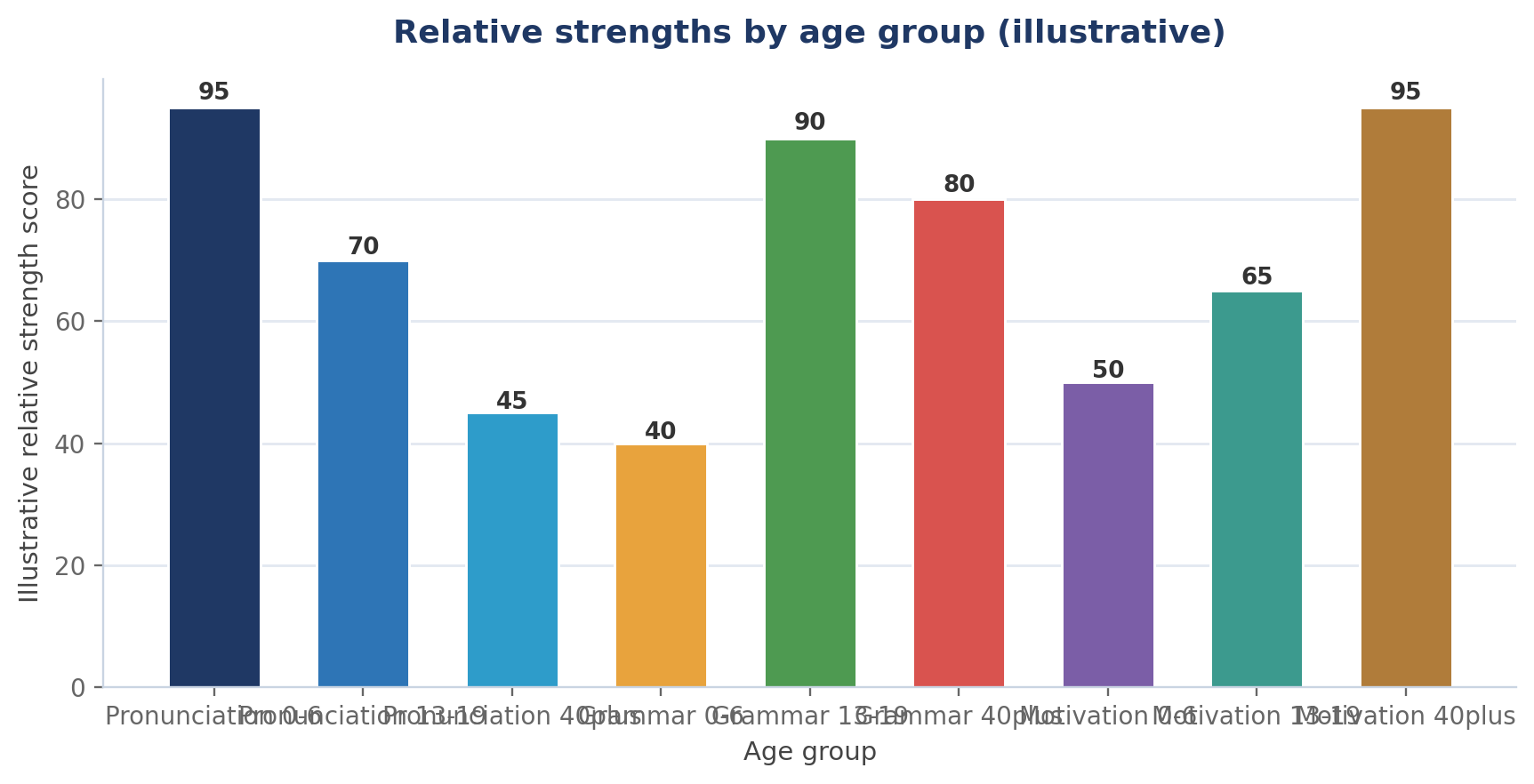
The "sponge" idea comes from a real finding: there does appear to be a sensitive period for acquiring a native-like accent and intuitive grammar. Learners who start very young usually end up sounding native. Learners who start later usually do not.
But sounding native is not the same as speaking fluently. Adults have a huge, unglamorous advantage: they already know how language works. They have a first language full of nouns, verbs, tenses and questions. German is not a new concept — it is a new version of a concept they own.
What Actually Changes With Age
Read that table again and notice: there is no row where the advantage column is empty.
What Research Says About a Critical Period
The most-cited modern study is Hartshorne, Tenenbaum and Pinker (2018), published in Cognition. Analysing nearly 670,000 English learners, they found that the ability to reach native-like grammar proficiency declines sharply if learning begins after roughly age 17.
That sounds like bad news for adults. It is not, for two reasons. First, "native-like" is an extreme bar almost no learner needs. Second, the study measures grammar attainment, not usefulness, and certainly not whether learning German is worthwhile.
The pattern is consistent: younger starters have a ceiling advantage. Older starters have a speed advantage. Both reach usable German.
The Real Variable Nobody Talks About
Contact hours. Not age. Not talent. Not IQ.
A six-year-old in a German playgroup hears the language for hundreds of hours a year without trying. An adult with thirty minutes a week hears far less — and then blames their age. The child is not more gifted. The child is more exposed.
Exposure beats birthdays. Every time.
Start at whatever age you are today
The best time to begin was years ago. The second best is this week. Create a free account, try a guided lesson with your personal AI voice tutor, and see how your brain takes to it at its current age.
Create your free account →Create a free accountStarting German at Each Age
Ages 3–6. Songs, stories, colours, animals. No grammar, no worksheets, no pressure. The goal is a pleasant association with the sound of German. Fifteen minutes a day of play beats an hour of drilling.
Ages 7–12. Structured but playful. Numbers, greetings, small dialogues, simple reading. Kids this age tolerate repetition beautifully. Use it — repetition is how pronunciation sets.
Ages 13–19. Peak grammar years. Full sentence structures, cases, exam preparation. Teenagers can handle abstract rules faster than any other band, and their memory is at its lifetime best.
Ages 20–39. The strategy years. Targeted vocabulary, exam deadlines, spaced repetition, real conversation. You will not out-accent a six-year-old, and you do not need to.
Ages 40+. Genuinely underrated. Adults in this band often outperform younger learners on retention because their motivation is concrete: a job, a move, a partner, grandchildren, travel.
Do Children Learn Better? The Honest Answer
For accent: mostly yes. For grammar speed in the first year: often no — adults typically progress faster early on. For long-term ultimate attainment: children who start young and keep going usually go further.
Notice the qualifier and keep going. A child who starts French at five and stops at seven has a lovely memory and no language. Continuity matters more than the starting line.
How to Start This Week, At Your Age
Pick your contact hours and defend them. Schedule a self-paced lesson so it sits in the calendar, not in your intentions. Learn phrases rather than isolated words so your first sentences arrive early. Read aloud for ten minutes a day — it trains pronunciation, grammar and rhythm at once.
And drop the sentence "I'm too old." You are not too old. You are simply not yet practised.
Try a guided lesson before you decide anything
Age tells you where your strengths sit. It does not tell you what is possible. Start a self-paced lesson, hear real German from your personal AI voice tutor, and judge for yourself.
Claim your free account →Create a free accountFrequently Asked Questions
What is the best age to learn German? There is no single best age. Younger learners have an edge in pronunciation and long-term accent, while teenagers and adults often learn grammar faster in the early stages. Contact hours and consistency matter more than age.
Is it too late to learn German at 40 or 50? No. Adults routinely reach B1 and B2 German, especially when motivated by work, relocation or family. Research on the critical period concerns native-like levels, not functional fluency.
Can a child learn German from videos alone? Videos help, but children need interaction to build real language. Songs, games and conversations with a caregiver produce far better results than passive screen time.
How many hours a week should a child study German? Short, frequent sessions work best — around 15 to 20 minutes a day for young children, rising to 30–45 minutes for teenagers. Consistency matters far more than session length.
References & Further Reading
- Hartshorne, J., Tenenbaum, J., & Pinker, S. (2018), "A critical period for second language acquisition," Cognition.
- Johnson, J., & Newport, E. (1989), "Critical period effects in second language learning," Cognitive Psychology.
- Bialystok, E. (2001), Bilingualism in Development: Language, Literacy, and Cognition, Cambridge University Press.
- Goethe-Institut, German courses for children and young learners, goethe.de.
- Council of Europe, Common European Framework of Reference for Languages (CEFR), coe.int.