Your three-year-old just said "Ich will das nicht" to your mother, and your heart did a somersault. Then she turned to her friend and said the same thing in English, and your heart did a second one. Raising a bilingual child in German and English is a beautiful, chaotic, entirely doable project — but only if you stop waiting for it to happen and start engineering it.
What you will get from this guide
- The four family strategies that actually produce fluent bilinguals
- Realistic milestone windows for German-English children
- How many hours of German your child truly needs per week
- Scripts for the days your child refuses to speak German at all
The Myth That Needs Dying First
There is no such thing as a child who "soaks up languages like a sponge." Children are extraordinary language learners, yes. But they learn what they hear, in the quantities they hear it, from people who matter to them. A child who hears German only at Sunday brunch will speak brunch German. Fluency is a function of input hours, not talent.
That is the single most useful fact you can hold onto. Your child is not gifted or ungifted. Your child is exposed or underexposed.
The Four Family Strategies
Most bilingual families run on one of four systems. None is magically correct — the right one is the one your household can actually sustain for ten years.
The uncomfortable truth: OPOL is the most researched and the most romanticised, and it fails constantly when the minority-language parent is the one who works sixty hours a week. Pick the system that survives your real calendar, not your ideal one.
How Much German Does a Child Actually Need?
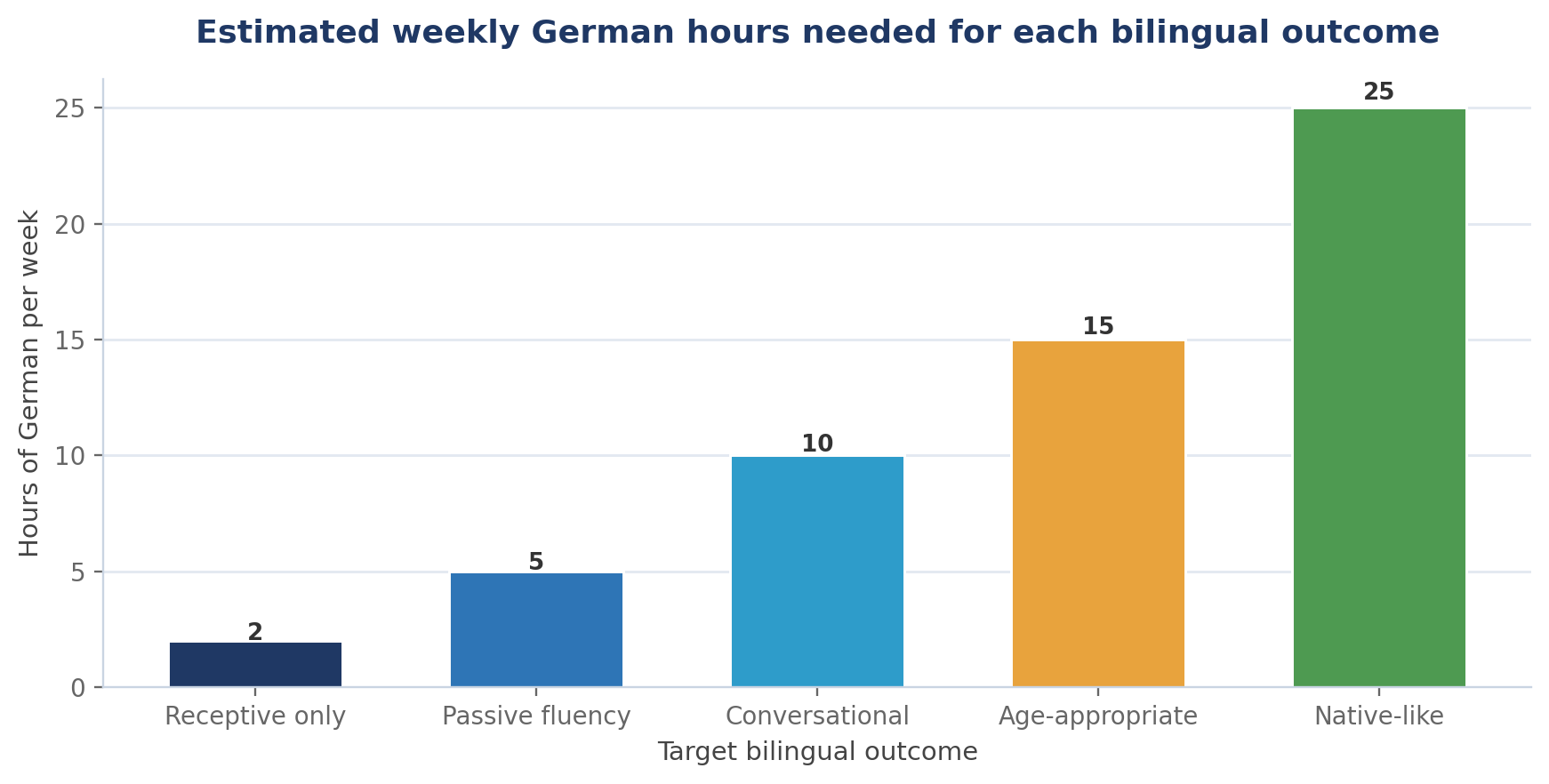
Here is where parents get sandbagged. A weekly one-hour kids' class is lovely. It is also roughly 1.5% of a child's waking language exposure. You cannot drip-feed a language into fluency.
Those bands are planning estimates drawn from the general bilingual-input literature, not guarantees for any individual child. Notice how many hours the top rows demand. That is the work.
The Milestone Map — and When to Relax
Bilingual children often hit single-language milestones slightly later in each language while hitting the same total vocabulary. This spooks parents who only compare to monolingual cousins.
Mixing languages inside a sentence is not confusion. It is a bilingual child using the words they have. The German word arrived first, so it got used. Correct the sentence, never the child.
Feeding the Beast Without Burning Out
Screens are not the enemy; silent screens are. A German cartoon your child watches alone is worth a fraction of the same cartoon watched with you narrating. The multiplier is a human who wants a response.
Live conversation is the one thing you cannot fake. Books, songs and audio stack beautifully around it, but they will not outsource the job. If you are not a native German speaker yourself, structured self-paced practice with an AI voice tutor — a course, guided lessons, speaking practice with feedback — is the cheapest fluency per hour you will ever buy.
Sometimes the missing ingredient is a fluent adult, not a better app
You can read every bilingual parenting book on the shelf and still be the only German voice in the room. A personal AI voice tutor gives your child structured, self-paced German practice — and gives you the scripts and vocabulary to keep the language alive between sessions.
Start a free account →Create a free accountThe Six-Year-Old Who Answers in English
It happens to nearly everyone. Somewhere between four and seven, your child's school language becomes the cool language, and German becomes the language of a parent who nags.
Do not turn German into a punishment. Three moves work better than force:
- Give German a job. Cooking, board games, one specific bedtime ritual. Language attached to a fun activity survives; language attached to an order does not.
- Change the cast. A new teacher, a cousin, a German-speaking friend's family. Children who "won't speak German to Mum" will happily do it for someone new.
- Buy the bribe honestly. German audiobooks and screen time available only in German. Not elegant. Extremely effective.
What Parents Get Wrong Most Often
Keeping It Alive Past Age Ten
The window does not slam shut at seven. It narrows, slowly, and it narrows fastest in the language that stops getting interesting. Around ten, interest beats instruction. German football, German YouTube, German books your child chose themselves, a German-speaking pen pal — these carry fluency where worksheets cannot.
Build the German voice your family is missing
You have the plan, the hours and the scripts. What you need now is structured, self-paced German practice, plus a clear path from first phrases to real conversation. That is exactly what a German course pass gives you — for you, your child, or both at once.
See German courses →Create a free accountFrequently Asked Questions
Will my child get confused by two languages? No. Bilingual children mix languages because they are drawing on two vocabularies, not because they are confused. Mixing usually fades as vocabulary grows in both languages.
Should I start German at birth or wait until school age? Earlier gives more total input hours and better pronunciation odds. Later is not a disaster, but expect more deliberate practice and less passive absorption.
My child understands German but refuses to speak it. Is that normal? Extremely common, especially between four and eight. It is called a receptive phase. Keep high-quality input flowing and create situations where German has a genuine purpose.
Can my child become fluent if I am not a German speaker? Yes, with deliberate design. You become the organiser rather than the source: structured self-paced lessons with an AI voice tutor, native-speaking carers, German media, and German-only rituals. The hours still have to come from somewhere.
References & Further Reading
- Grosjean, F. Bilingual: Life and Reality. Harvard University Press, 2010.
- American Speech-Language-Hearing Association. "Bilingual Service Delivery" and learning-two-languages guidance, asha.org.
- Goethe-Institut. "German for children and young people" programme information, goethe.de.
- European Commission. Key Data on Teaching Languages at School in Europe, Eurydice report.
- Council of Europe. Common European Framework of Reference for Languages: Companion Volume, 2020.