Children do not learn languages by studying them. They learn by wanting something badly enough to ask for it — and play is the engine that creates that wanting. Give a four-year-old a reason to shout Ich sehe was! and German arrives without a single flashcard.
Here is a bank of games that work, sorted by age, with the German phrases your child will actually say. Most need nothing you do not already own.
What you will get from this guide
- Games by age band, from toddler to tween
- The exact German phrases to use during each game
- Songs, shows and books with real German-language sources
- A simple weekly rhythm that fits family life
Start With the Rule That Makes It All Work
Speak German during the game, then stop when the game ends. Start with English and the game will feel like a lesson in disguise. Tie the language to the play and children accept it as part of the rules — the same way they accept that you must not peek in hide-and-seek.
Ages 2 to 4: Movement and Sound
Toddlers cannot manage rules but can manage their bodies. Front-load verbs and body parts.
The Fingerspiel tradition is a gift here. Little rhymes with hand movements give toddlers the melody of German before they produce a single word, and they absorb accent almost passively.
Ages 5 to 7: Memory, Matching and Guessing
This is the golden age for vocabulary games, because children at this stage love the satisfaction of a matched pair or a right answer.
Simon sagt is the teacher's favourite for a reason. Children must decode the instruction before they can move, so listening does real work.
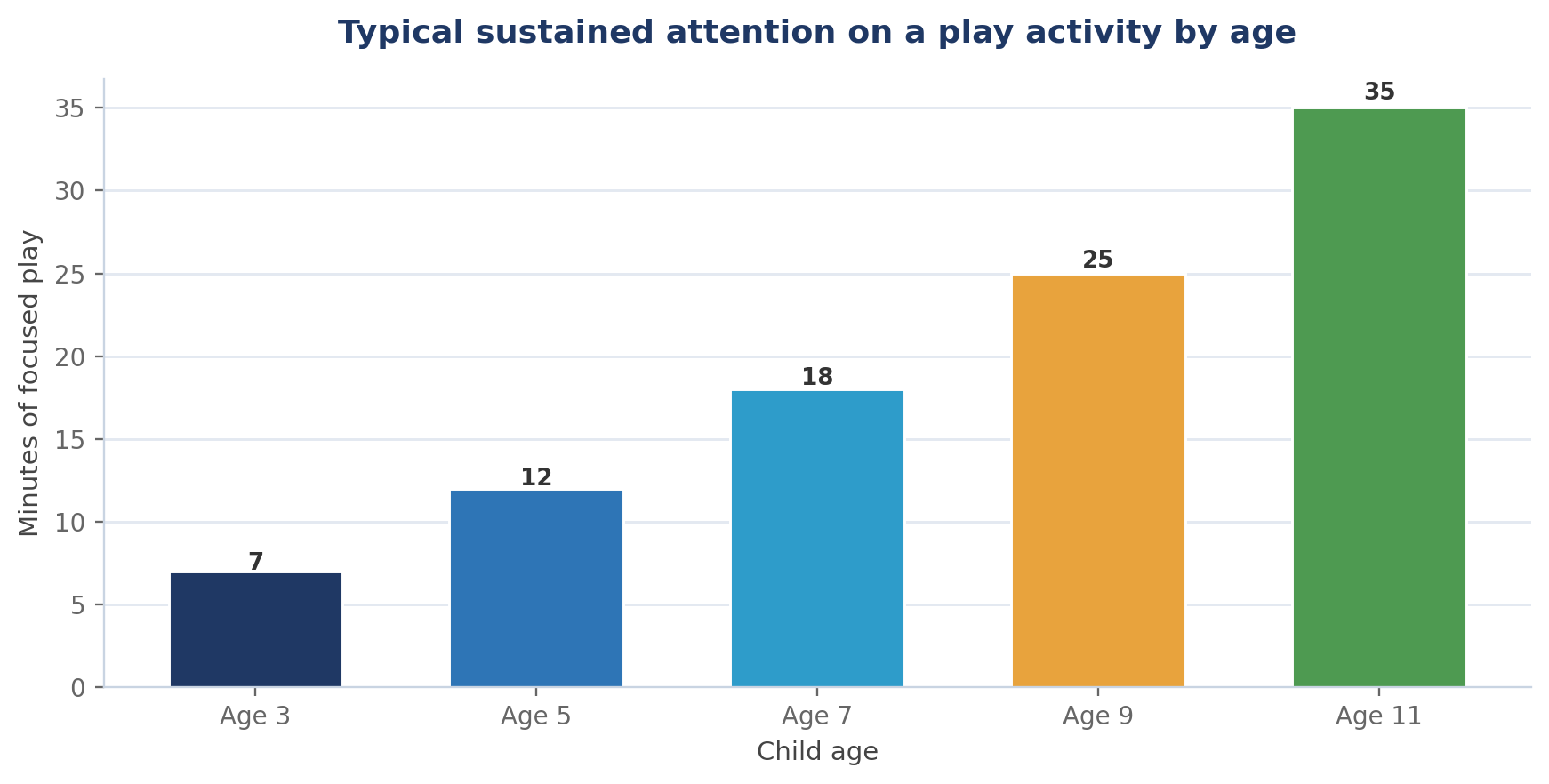
Look at the age-three bar. Seven minutes is not failure — it is the ceiling. Design rounds to finish before attention does, so the game ends with a win.
Play at home, practise with your AI voice tutor
Our kids' German course is built on songs, games and story time, guided by a personal AI voice tutor at your child's own pace. Start with a free account and try it before you commit a cent.
Create a free account →Create a free accountAges 8 to 11: Words With Stakes
Older children want competition and cleverness. Give them both.
Stadt Land Fluss is worth a special mention. Germans grow up with it, it needs only paper, and it scales from a seven-year-old's simple categories to a teenager's brutal ones. Choose the letter S and watch the vocabulary pour out.
Songs and Shows: The Passive Engine
Games wake children up; songs and shows do the quiet work in the background. German children's programming is genuinely excellent, and a surprising amount of it is free and officially produced.
Songs with actions beat songs without them. Backe, backe Kuchen has a whole baking routine built into the words, and children copy the movements long before they can say the lines.
The Weekly Rhythm
You do not need a curriculum. You need one game, one song, and one story, on repeat.
The weekend row is the sneaky one. Counting eggs, naming colours of socks, asking who wants Milch oder Wasser — daily routines carry more vocabulary than any worksheet, and nobody has to sit down.
Make German the family's inside joke
Self-paced lessons with a patient AI voice tutor, and games children genuinely ask to repeat. Start free to see how your child responds.
Try a kids' course →Create a free accountFrequently Asked Questions
At what age should a child start German? Any age works. Under six, focus on songs, rhymes and play. From seven, add simple reading and games with rules. Consistency across years matters more than an early start.
What if I do not speak German myself? You can still run most of these games with a phrase list written on a card, and audio sources like Die Sendung mit der Maus provide the native model. A self-paced AI voice tutor fills the gap you cannot cover alone.
How much screen time is reasonable for language learning? Treat German shows as part of normal screen time rather than an extra allowance. Short, repeated episodes in the target language beat long passive sessions.
Will my child get confused learning two languages? No. Bilingual children occasionally mix languages in a sentence, which is normal and temporary. The long-term cognitive and academic benefits are well documented.
References & Further Reading
- Goethe-Institut — early language learning materials, including kindergarten-level programmes
- ARD — Die Sendung mit der Maus and Wissen macht Ah!, official broadcaster pages
- Deutsche Welle — German children's and beginner learning content
- Klett and Hueber — German picture book and children's workbook catalogues
- Council of Europe — CEFR descriptors adapted for young learners
Start with a free account at languageskills.net/register and let play do the teaching.