My neighbour's six-year-old corrected me last month. I said der Butter and she looked up from her drawing with the weary patience of a small professor and said, die Butter. Then she went back to her dinosaur.
She is not a prodigy. She is simply a child, and children are language sponges with an unfair advantage: they do not care about being wrong. That is the entire secret, and it is almost unreasonably powerful.
If you want to teach german to kids, the first thing to accept is that you are not building a small exam candidate. You are building a relationship between a child and a language. Do that well and the grammar arrives later, mostly by itself.
What this guide gives you
- Age-by-age expectations, so you stop measuring a five-year-old by adult standards
- A daily 15-minute routine you can actually keep up
- Games, songs and books that work without a textbook
- Honest guidance on when a parent should hand over to a teacher
The One Rule That Outweighs Everything
Make German feel like play, not like homework. That is it. That is the whole strategy.
Every mistake parents make flows from breaking that rule. Flashcards at the dinner table. Quizzing a tired eight-year-old. Turning a beautiful thing into a chore with a score attached. The moment German becomes the thing that happens instead of the fun thing, you have lost, and you will lose for years.
Children acquire language through repetition, warmth and ridiculousness. Not through drilling. Save the drilling for adults, who at least have the compensation of being able to drink coffee.
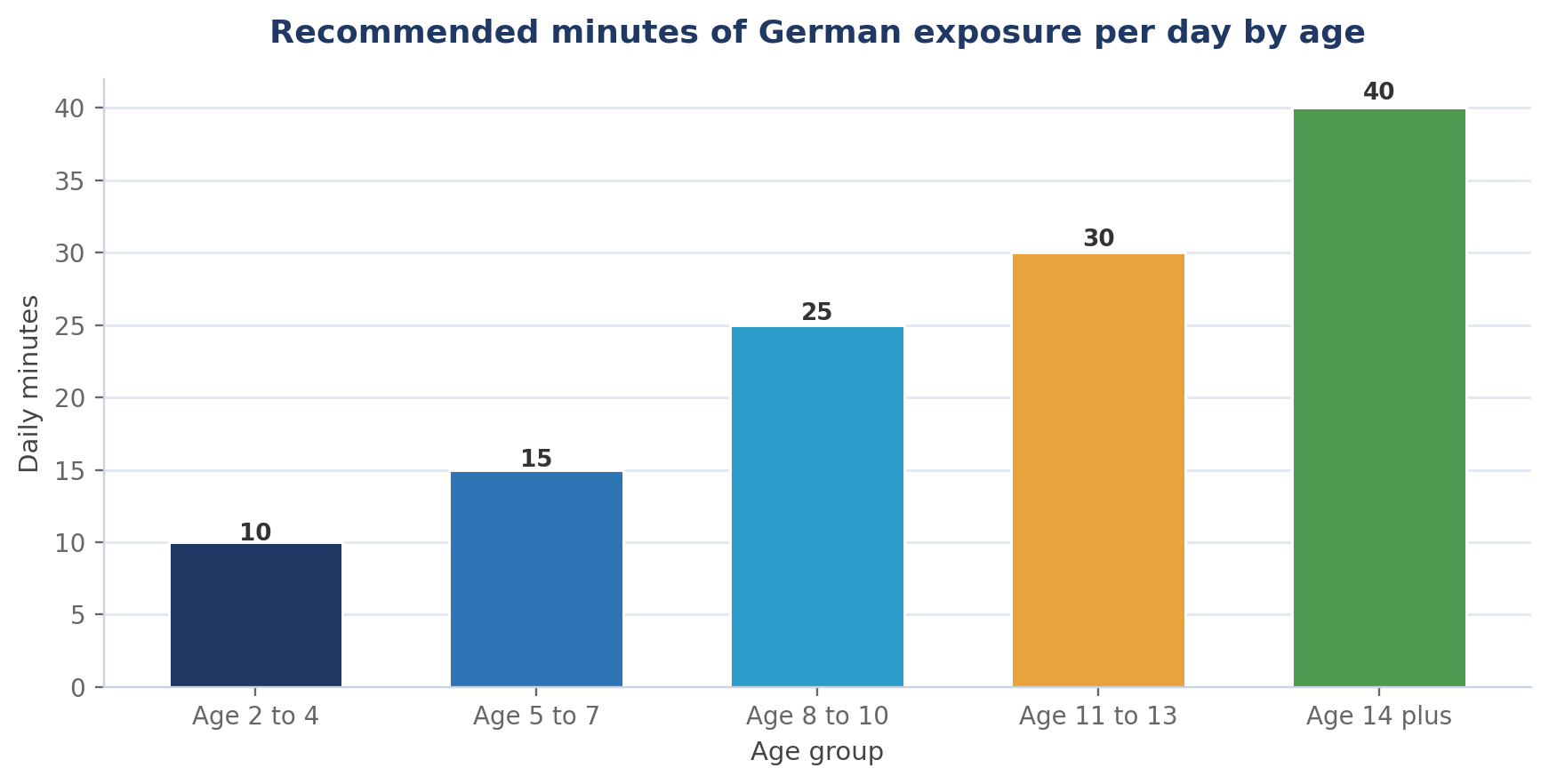
Notice the numbers are small. That is deliberate. A consistent ten minutes beats an ambitious hour that happens twice and then never again.
What to Expect at Each Age
Parents get anxious because they compare their child to a fictitious bilingual cousin. Here is a more honest map.
The most common parental error is expecting production before comprehension. Children understand for months before they speak. That silence is not failure. It is the reservoir filling.
The 15-Minute Daily Routine
You need a routine, not a curriculum. Something small, repeatable and slightly silly.
Sunday is the crown jewel. One hour where the whole household speaks only German, badly, cheerfully, with hands and pointing. It works even if you are not fluent yourself.
Games That Actually Work
Children learn through the body and through laughter. So use both.
Do not correct every mistake inside a game. Correct one thing, once, gently, and keep the game moving. Fluency dies in an interrupted sentence.
Songs, Books and Screens
Your three raw materials. Choose them the way you would choose food for a child, for quality rather than quantity.
A useful trick: put German audio on during car journeys. Captive audience, no screens, and children absorb far more than they let on.
Try a real lesson before you commit
You can do a great deal at home, but children light up when someone outside the family speaks German to them. Create a free account to try age-appropriate self-paced lessons with an AI voice tutor and get a level recommendation.
Create a free account →Create a free accountWhen a Parent Should Hand Over
You can carry the first years beautifully. At some point, though, you hit a wall, and pretending otherwise wastes your child's best window.
That last one stings and it is universal. Children often refuse to perform in front of their own parents, and thrive instantly with a stranger. It is not rejection. It is privacy.
Do Kids Need Exams?
Not at five. Probably yes at fourteen.
The Goethe-Institut offers German exams for young learners, including the FIT series aimed at school-age children and teenagers. For families aiming at school admission, bilingual certificates or future study in Germany, these give something no amount of home practice provides: an independent, external measure.
Nine-year-olds do not need certificates. They need to believe German is fun. Never trade the second for the first.
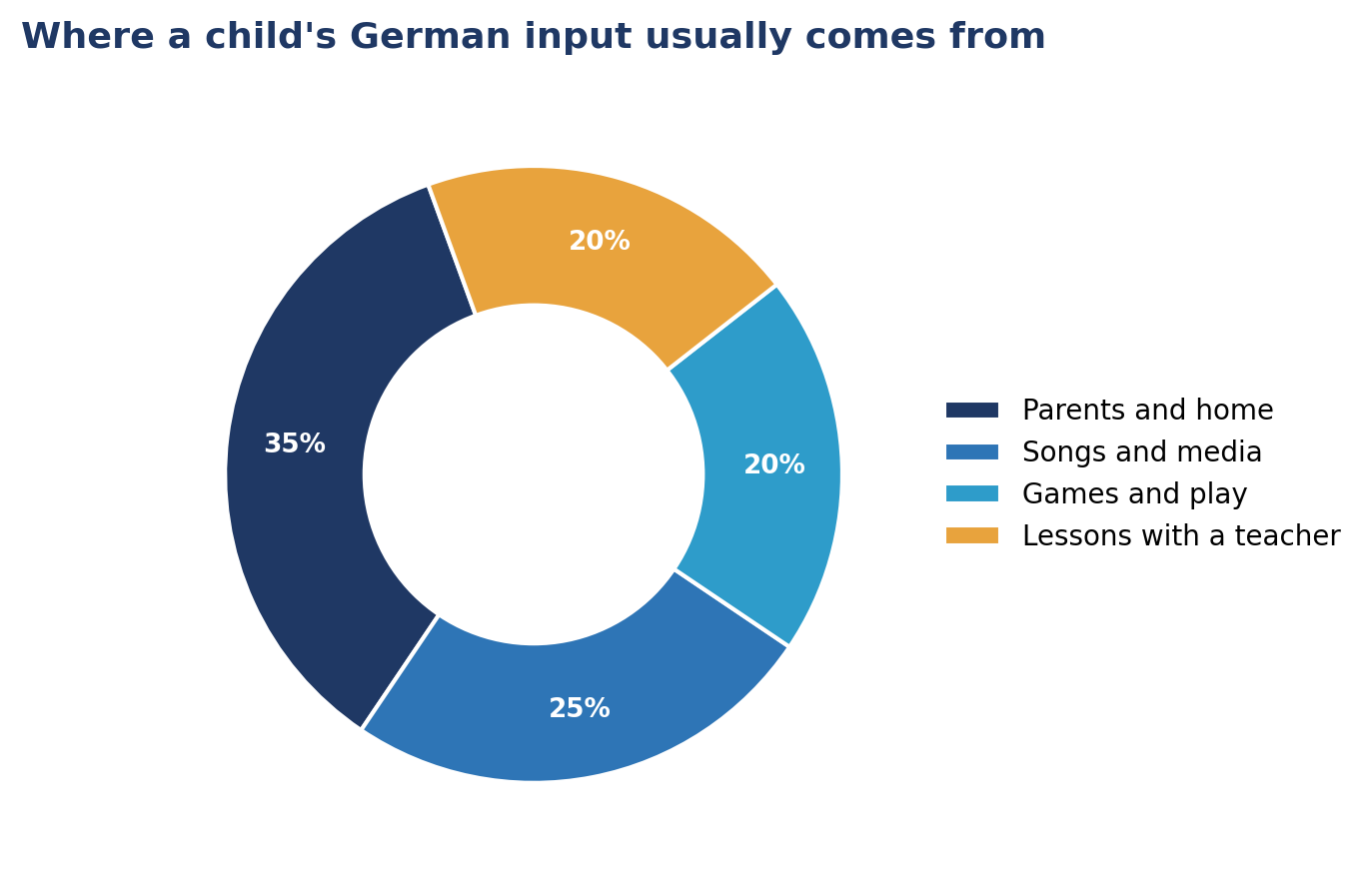
Home and media do the bulk of the work. Lessons are a fifth of the input but often the part that keeps everything else honest.
Mistakes That Cost Years
Learn from other families' expensive lessons.
The rule of one language, one person helps enormously. If one parent always speaks German and the other always speaks English, children map the languages cleanly and stop translating in their heads.
A Thirty-Day Starting Plan
If you have been meaning to begin, begin badly and begin now.
Thirty days. Four small habits. That is a foundation, and it is dramatically more than most families manage in a year of good intentions.
Give your child a reason to speak
At home, the audience is you. With a personal AI voice tutor, your child gets structured speaking practice and feedback at their own pace, and that changes everything. Start free and see which level fits your child.
Start free →Create a free accountFrequently Asked Questions
Can I teach German to my child if I am not fluent myself? Yes, at least for the first years. Songs, books and routines work with basic German. Once your child wants to write or hold real conversations, an AI tutor should take over.
What age is best to start teaching a child German? Earlier is easier, but never too late. Ages two to seven acquire sounds almost effortlessly, while ages eight and above can still reach high fluency with structured lessons.
How long should a German session be for a young child? Ten to fifteen minutes daily for children under eight. Short and frequent beats long and rare, because attention spans and habit formation both favour small doses.
Will my child get confused learning German and English at once? Not if the structure is clear. Children handle two languages comfortably when each language has a consistent context, such as one parent, one language.
Should my child use a German learning app? As a supplement, yes. As the main method, no. Apps lack the human interaction that drives real conversational ability in children.
How do I keep a child motivated long enough to become fluent? Protect the fun. Games, songs and silly voices sustain years of learning. Correction without warmth ends the process in weeks.
References & Further Reading
- Goethe-Institut — German courses and exams for children and young people: https://www.goethe.de/en/spr/kur.html
- Goethe-Institut — FIT exams for young learners: https://www.goethe.de/en/spr/prf.html
- Deutsche Welle — children's German content, including Deutschtrainer: https://learngerman.dw.com/en/overview
- Council of Europe — CEFR and language learning for younger learners: https://www.coe.int/en/web/common-european-framework-reference-languages
- Duden — German spelling and grammar reference for parents: https://www.duden.de/
- telc gGmbH — language certificates and school-related exams: https://www.telc.net/en/