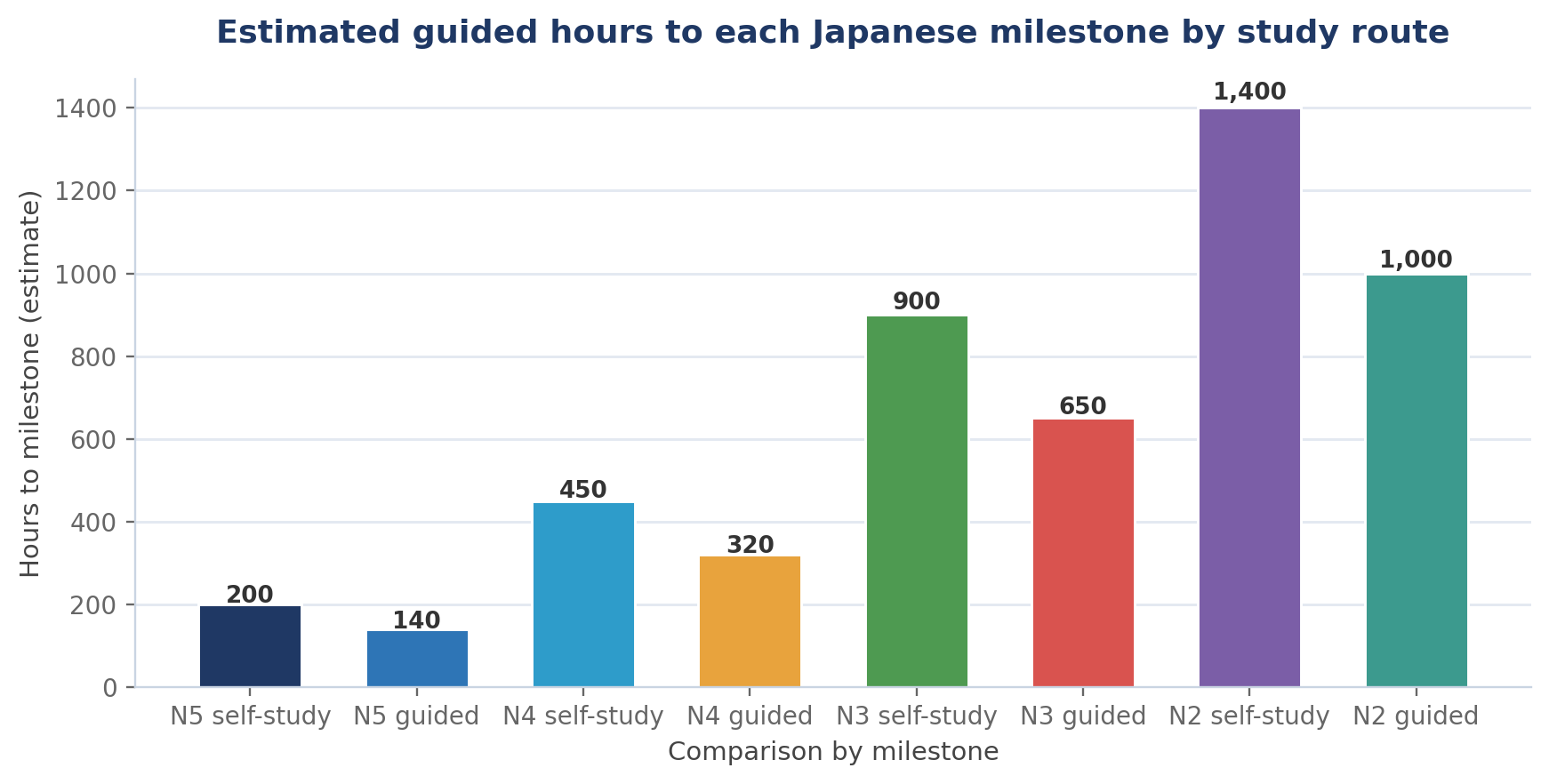
Japanese has a reputation problem. The internet says you can learn it alone with free videos. The internet is technically right and practically cruel.
Here is the blunt version: self-study is not a hobby, it is a discipline test that most people fail slowly, without noticing. A guided course is not a magic wand, it is a schedule with a personal AI voice tutor attached. Both can work. Only one of them survives a bad week.
What you will get from this guide
- A side-by-side comparison of cost, speed and survival rates
- The two learner profiles where self-study genuinely wins
- A hybrid model that fixes the weaknesses of both
The Two Routes, Stripped Down
Self-study means you build the curriculum, find the materials, mark your own work, and decide when to quit. Guided study means a structured, self-paced course does the planning for you.
That last row is the whole argument. Self-study rarely announces its own death.
Where Self-Study Genuinely Wins
Let me be fair, because the pros are real.
Self-study is superb for reading. Kana drilling, kanji spaced repetition, graded readers, and massive input all work beautifully at your own pace, at midnight, in pyjamas, without paying anyone.
If your goal is reading manga and passing a written test, self-study can carry you a long way.
Where Self-Study Quietly Fails
Now the part the free-video channels never film.
Japanese is hard in the specific places where nobody can check your work. Pitch accent, particle choice, casual versus polite register, and the small habits that make output sound natural rather than assembled.
The brutal one is pronunciation. There is no algorithm in your phone that will tell you your つ sounds like a す. A teacher hears it in five seconds.
The Cost Question, Honestly Answered
People compare a course price with a stack of free apps and conclude the course is expensive. That comparison hides the real cost: the year you spend restarting.
If your time is worth anything, an unfinished self-study year is the most expensive option on this table.
Which Type of Learner Are You?
Take this honestly. Most people overestimate their independence the way they overestimate their gym attendance.
The first hundred hours matter more than the next thousand. Habits set early are hard to unlearn.
The Hybrid Model That Beats Both
You do not have to pick a tribe. The strongest learners run a hybrid: guided AI-tutor lessons for speaking, feedback and grammar logic, solo work for kanji and volume input.
That is about ten focused hours a week. Two of them are guided AI-tutor sessions, and they are the two that keep the other eight from drifting off course.
Keep the freedom, add the accountability
Self-paced Japanese lessons with a personal AI voice tutor you can pair with your own kanji routine — speaking practice with real correction, from the first lesson.
Compare Japanese course plans →Create a free accountWhat a Good Guided Course Must Include
Not all courses earn the price. Judge by these five things before you pay for anything.
If a course fails two of these, your money is buying structure and nothing else. Structure alone you can find free.
Frequently Asked Questions
Can I learn Japanese entirely alone? Yes, especially for reading. Most self-taught learners stall at speaking and pronunciation, which is exactly where outside feedback is irreplaceable.
Is a guided course worth the money? It is worth it when it includes speaking practice with AI feedback, corrected work and clear level targets. Otherwise the value collapses to a schedule.
How long until I reach N5 by each route? Roughly 4–6 months in a structured course and 6–12 months self-study for a typical learner. Total hours matter more than the calendar.
Should I self-study kanji while taking a course? Absolutely. Kanji benefits from daily solo repetition, while conversation benefits from guided speaking practice.
Stop restarting your Japanese every spring
Get a level-matched plan, speaking practice with AI feedback and study materials that keep you on track.
Start your Japanese course →Create a free accountReferences & Further Reading
- The Japan Foundation — official JLPT level descriptions, test sections and annual results: https://www.jlpt.jp/e/
- The Japan Foundation — JF Standard for Japanese-Language Education, used for level mapping: https://www.jfstandard.jpf.go.jp/
- The Japan Foundation — Survey Report on Japanese-Language Education Abroad: https://www.jpf.go.jp/e/project/japanese/survey/result/
- Japan Foundation Japanese-Language Institute — free learning resources and Minato platform: https://minato-jf.jp
- LanguageSkills.net — self-paced Japanese courses (A1–B2) and level placement: https://languageskills.net/register