Count the money first. Two years of apps, textbooks and good intentions can cost €300 and deliver a polite tourist. Two hundred hours of structured study can cost more and deliver someone who reads a menu, holds a meeting and passes N4.
So is a Japanese course worth it? It depends on one number: what an hour of yours is worth — and what happens when nobody corrects you.
What you will get from this guide
- Real cost-per-hour maths for every route to fluency
- What free tools genuinely cannot teach
- A verdict table by learner profile: pay, self-study, or wait
- The eight questions that separate a good course from an expensive one
The Cost Per Hour, Honestly
Prices vary by country and platform, but the shape of the market is stable. Compare what an hour actually buys.
Free is not zero-cost. If your hour is worth €20, a free app that teaches you half as fast is the most expensive option on the list.
What Free Tools Cannot Do
Free resources are extraordinary at input. They are structurally bad at output.
That last row is the killer. An error you repeat for a year becomes your accent. Correction is not a luxury feature; it is preventive medicine.
Hours to N4 by Route
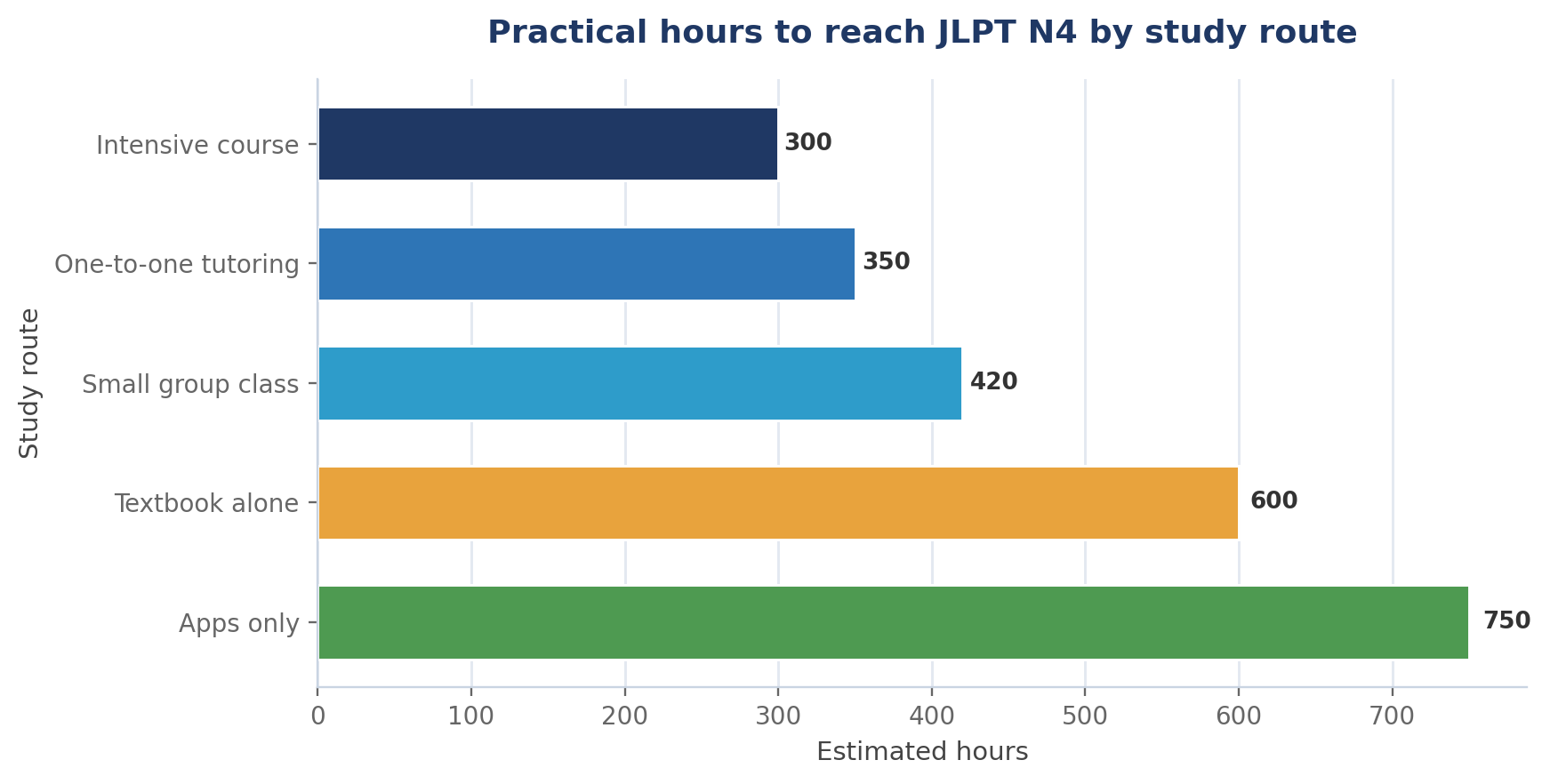
Same destination, wildly different clocks. Figures below are practical study hours to reach a comfortable N4, blending class time and homework.
Read it as a multiplier, not a verdict. Apps-only learners do reach N4. They just spend roughly twice the hours doing it, and most quit at month seven.
You are paying in hours either way
Every month without feedback is a month of rehearsing the same mistakes. A personal AI voice tutor cuts the loop: it gives you speaking practice with feedback, helps you fix your particles and gets you speaking before you feel ready.
Compare Japanese course plans →Create a free accountWhere a Course Actually Pays You Back
Forget the price tag. Ask where the money returns.
The honest rule: pay for correction and accountability, not for content. Content is free now. Nobody corrects you for free.
The Eight Questions to Ask a Course
Before you pay, interrogate the provider. These questions expose most of the market.
A course that answers all eight cleanly is rare, and usually good. A course that deflects all eight is selling video, not teaching.
Timing It: When to Pay
Start free, prove the habit, then buy when you hit a wall. The wall usually arrives at three points.
Most learners who quit Japanese quit at one of those four points. That is the exact moment a paid course stops being a cost and starts being damage control.
The Verdict for 2026
The free ecosystem has never been better, and it has never been enough. The Japan Foundation's own resources, including Marugoto and Erin's Challenge, and the official JLPT level descriptions tell you exactly what to learn. They do not tell you what you keep getting wrong.
So: yes, pay — but pay for structured feedback. Pay for guided lessons and speaking practice with AI feedback. Choose a regular study habit and treat it like a train you cannot miss. That single commitment outperforms any spreadsheet of app subscriptions.
If you are two months from a deadline, or you have plateaued for six months, the maths is already decided. See how a self-paced AI-tutor course maps to your level and stop paying in wasted hours instead.
Pay for correction. Keep the results.
A personal AI voice tutor, guided lessons, speaking practice with feedback and printable study materials. Try a placement check first — then decide with a real level, not a guess.
Start your Japanese course →Create a free accountFrequently Asked Questions
Is a Japanese course really worth the money? If you study more than three hours a week and have a goal with a date, yes — you are buying correction and accountability, which free tools cannot supply. Below that, start free and build the habit first.
Can I get to N3 without paying for anything? Plenty of people do it, usually in two to three years. The trade is hours: self-study routes run roughly 40–70% longer, and the drop-out rate is the real cost.
How much should a good online Japanese course cost? Self-paced AI-tutor courses typically sit at €8–25 per hour. Below €8 per hour you are usually buying content without feedback, not speaking practice.
Should I pay for a course before I know my level? Never. Take a placement test first. Starting in a class below your level wastes money and kills motivation faster than no class at all.
References & Further Reading
- Japan Foundation: Japanese-language education resources, Marugoto and Erin's Challenge
- Japan Foundation: periodic Survey Report on Japanese-Language Education Abroad, learner and institution data
- Japan Foundation and JEES: JLPT official level descriptions and sample questions
- NHK World Japan: Easy Japanese and News Web Easy, free graded listening resources
- Council of Europe: Common European Framework of Reference for Languages, guided learning hours