The app streak says 418 days. Green checkmarks everywhere. Then a Japanese person asks a simple question and you freeze, mouth open, zero words arriving.
That is the exact moment learners start searching for the best way to learn Japanese — app or course. Here is the blunt comparison, including the parts app marketing will never show you.
What you will get from this guide
- What apps genuinely do better than any classroom
- Where courses win, and where they quietly fail
- A hybrid weekly routine that uses both without wasting money
What Apps Are Genuinely Brilliant At
Give credit where it is due. Apps nail three things.
Repetition, on demand. Spaced repetition systems put a kanji in front of you at the exact moment your memory is about to drop it. Try scheduling that by hand with paper flashcards.
Friction removal. Five minutes on a train, no commute, no camera, no embarrassment. Consistency is the hardest part of Japanese, and apps make consistency almost free.
Volume of input. Kana drills, listening clips, sentence mining, graded readers — all of it flows through your phone. The Japan Foundation and JLPT frameworks both assume hundreds of hours of exposure; apps deliver those hours cheaply.
Where Apps Hit the Wall
Recognition is not production. You can know three thousand words and still be unable to assemble one sentence at conversational speed.
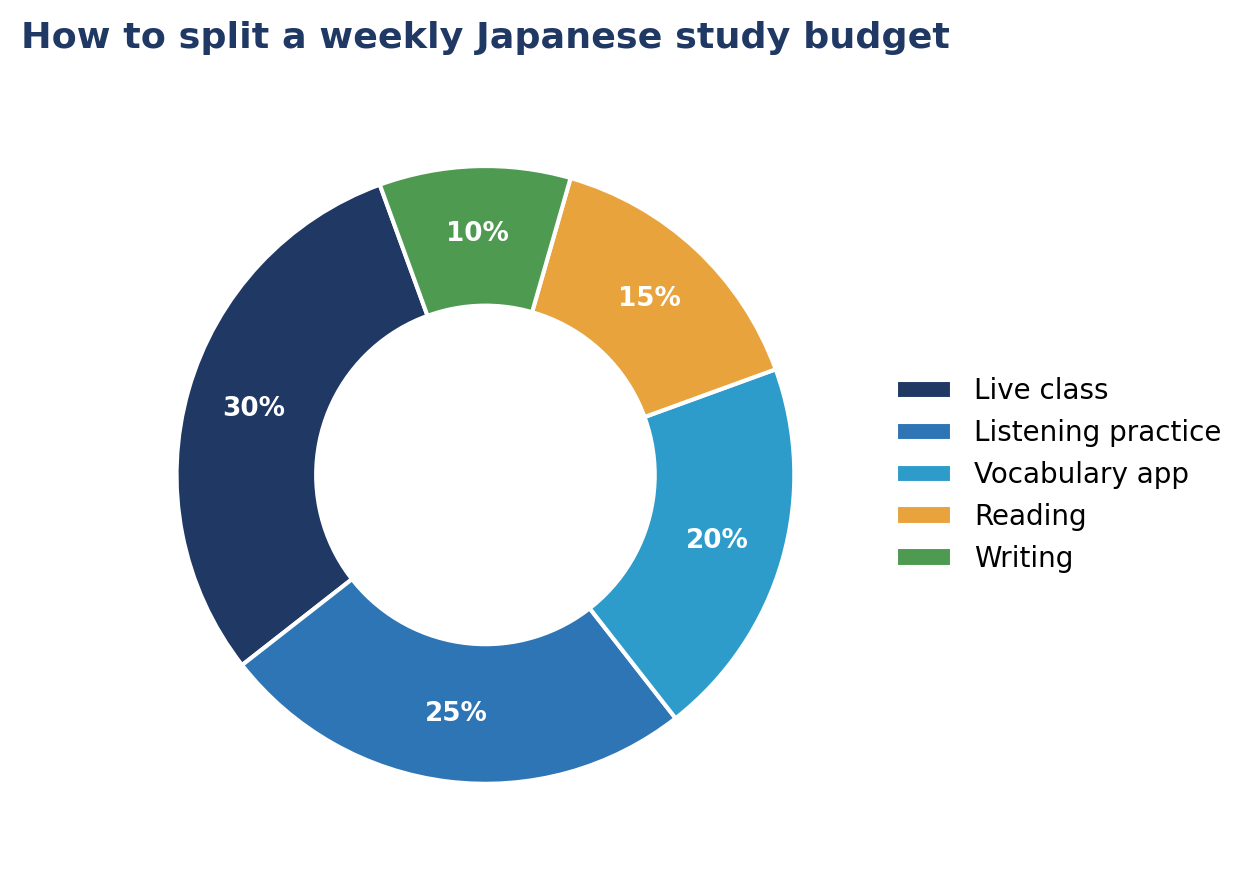
The missing 30% that makes everything else work
Your app already handles vocabulary. What it cannot do is listen to you, correct your pitch, and force you to answer in two seconds flat. That is precisely what a personal AI voice tutor does.
Try the AI voice tutor →Create a free accountThe Comparison Nobody Prints on the App Store
Neither column is the answer. The mistake is choosing one column and calling it a strategy.
The Kanji Climb, Honestly
The Japanese government sets the jōyō list at 2136 characters, and no app shortcut removes that distance. What an app can do is make the daily reps painless. What it cannot do is stop you from memorising readings you pronounce wrong forever.
A Hybrid Week That Actually Moves
Notice the shape: the app does the volume, the AI tutor does the correction. That is the entire argument in one table.
Which Should You Actually Buy?
Buy the app. It is cheap and it works. Then spend your real money where the app is structurally blind: speaking, listening under speed, pitch, and the confidence to be wrong in front of the AI tutor.
If you are studying for the JLPT, exam-style questions and timed listening are worth more than another thousand vocabulary cards. If you want to hold a conversation, structured speaking practice with AI feedback helps. You can create your free account and try a lesson before deciding anything.
Keep the app. Add the AI voice tutor.
Your streak is not wasted — it built your word bank. Now let the AI voice tutor turn that bank into sentences you can actually say out loud, under real time pressure.
Start your Japanese course →Create a free accountFrequently Asked Questions
Can I reach JLPT N3 with apps alone? Some dedicated learners do, mostly through heavy reading and listening practice. Most hit a wall around N4 because passive recognition does not build production.
Is a course worth the money if apps are nearly free? Yes, if you value speaking and correction. One hour of targeted feedback can fix habits that months of solo drilling embed permanently.
How long do I need to study daily? Twenty to forty focused minutes daily beats a four-hour weekend cram every single time. Add one or two AI tutor sessions a week.
Do I need to learn kanji by hand? Handwriting improves recognition and memory, though digital life mostly needs reading. Write the first few hundred, then read relentlessly.
References & Further Reading
- Japan Foundation — Japanese-language education abroad and learner support: https://www.jpf.go.jp/e/
- JLPT official site (Japan Foundation / JEES) — levels, sections and scoring: https://www.jlpt.jp/e/
- Agency for Cultural Affairs — jōyō kanji list (2136 characters): https://www.bunka.go.jp/
- NHK World Japan — free learner audio and video: https://www.nhk.or.jp/lesson/en/
- CEFR — level framework used to map course outcomes: https://www.coe.int/en/web/common-european-framework-reference-languages