You want to speak Japanese. The clock is ticking, the textbooks are heavy, and two loud camps are screaming at you from opposite sides of the internet. Camp one: an AI Japanese tutor is cheap, always awake, endlessly patient, and it never judges your accent. Camp two: traditional classes are structured, human, credentialed, and they drag you across the finish line when motivation dies. So who wins? Here is the honest, unglamorous truth — and the answer is going to make both camps a little uncomfortable.
What an AI Japanese Tutor Actually Gives You
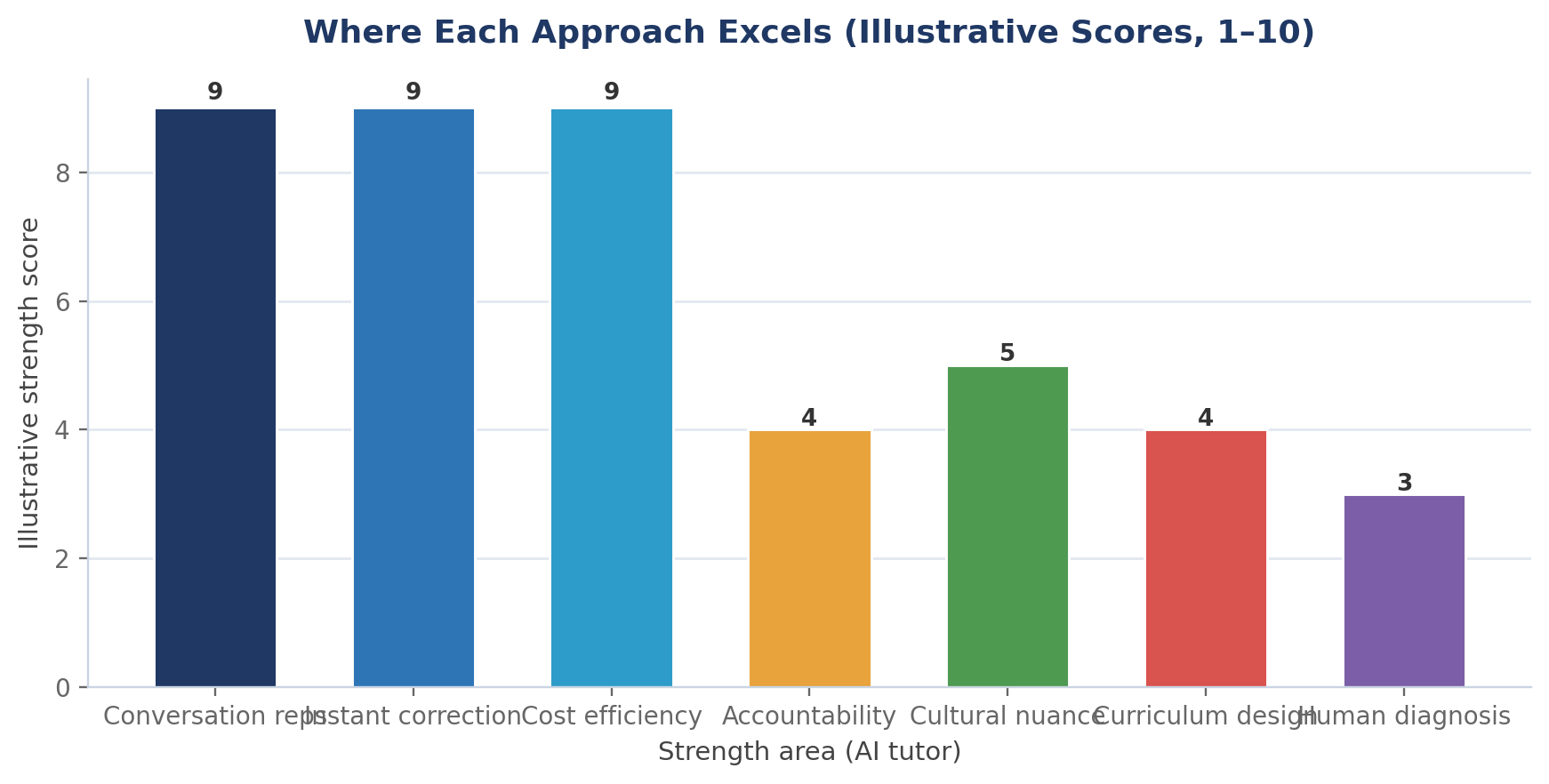
The single most important variable in language learning is volume of reps. Someone who produces 500 spoken sentences a week beats someone who produces 20, every time. A conversational AI partner hands you that volume for the price of a coffee, at 2 a.m., with zero social friction. You can ask the same question nine times, get corrected nine times, and never once feel embarrassed.
That frictionlessness matters more than people admit. Many learners stall for months because they are afraid of looking foolish in front of a teacher and eleven classmates. Remove the audience and you remove the stall.
What AI does not do on its own: hold you accountable, sequence a curriculum, or explain why a native speaker would find your sentence bizarre rather than merely ungrammatical.
What Traditional Classes Still Do Better
an AI tutor does three things software struggles with. First, diagnosis: a good teacher hears that your particle is wrong and also that you are translating from English word-for-word — and fixes the root cause. Second, sequencing: proper classes follow progressions mapped to frameworks like the ACTFL Proficiency Guidelines, so you never wander into material you are not ready for. Third, accountability: a scheduled class with peers is a commitment device, and commitment devices are why people finish things.
Japan's own benchmark, the JLPT, tests reading and listening comprehension rather than production, which quietly rewards classroom drilling. Meanwhile, the Japan Foundation's survey of Japanese-language education abroad shows the field keeps expanding worldwide — meaning more classrooms, but also more competition for the best teachers' time.
Treat that chart as a thinking tool, not a study. It is a deliberately simple visual, included to make the trade-off obvious.
Stop choosing between cheap and structured
Get guided lessons plus unlimited AI conversation practice in one place, so you never trade reps for curriculum again. Your first week will tell you more than a month of scrolling comparison threads.
Start your Japanese course pass →Create a free accountThe Honest Cost and Time Comparison
Nobody should give you fake dollar figures, because pricing changes constantly and varies wildly by city. What does not change is the shape of the trade-off: traditional instruction charges a premium for human judgment, and AI charges almost nothing for raw repetition. Where they differ most is the hidden cost — the opportunity cost of a fixed schedule.
The smartest learners I have watched do not pick a side. They stack. They use AI for daily Japanese conversation practice and a human class or tutor for weekly calibration. If you want a structured path that blends both, create your free account and start with the guided track before you book anything live.
Who Should Choose Which
Japanese is widely classed as a demanding language for English speakers — the U.S. State Department's foreign language training groups it with the hardest categories. That difficulty estimate is a reason to maximize reps, not a reason to wait for the perfect teacher.
Speaking of retention, the research on spaced practice — summarized in Cepeda and colleagues' meta-analysis on distributed practice — consistently favors short, frequent sessions over rare marathons. That is the strongest argument for the AI side: it makes frequency easy.
Frequency is the whole game
Short daily conversations beat heroic weekend cramming, and a course pass makes daily practice the path of least resistance. Build the habit once and Japanese stops being a project and becomes a routine.
Get your Japanese course pass →Create a free accountFrequently Asked Questions
Can an AI tutor replace a real Japanese teacher? For repetition and confidence, often yes. For diagnosis of deep habits and for exam strategy, no — and pretending otherwise is how learners plateau.
Are traditional classes worth the money? They are worth it when you need structure, credentials, or accountability you genuinely will not supply yourself. Otherwise, start cheap and add a teacher once you know your weak spots.
Which is faster for learning Japanese? The honest answer is that neither wins on method; frequency wins. Whichever option you will actually use five times a week is the faster one.
Do I need to pick one? No. Most successful learners combine a guided course, daily AI conversation, and occasional human feedback — the hybrid path is the default for good reason.