A Japanese job interview is not a friendly chat that happens to be in Japanese. It is a structured ceremony with a script, a scoring sheet, and a room full of unwritten rules about bowing, seating, and how humble you should sound about your own achievements. Candidates with brilliant CVs lose offers over a single casual ですよね, and candidates with average experience win them by sounding like someone the team can already imagine working beside. Get the language and the manners right, and your ability finally gets the hearing it deserves.
What Japanese Employers Are Actually Judging
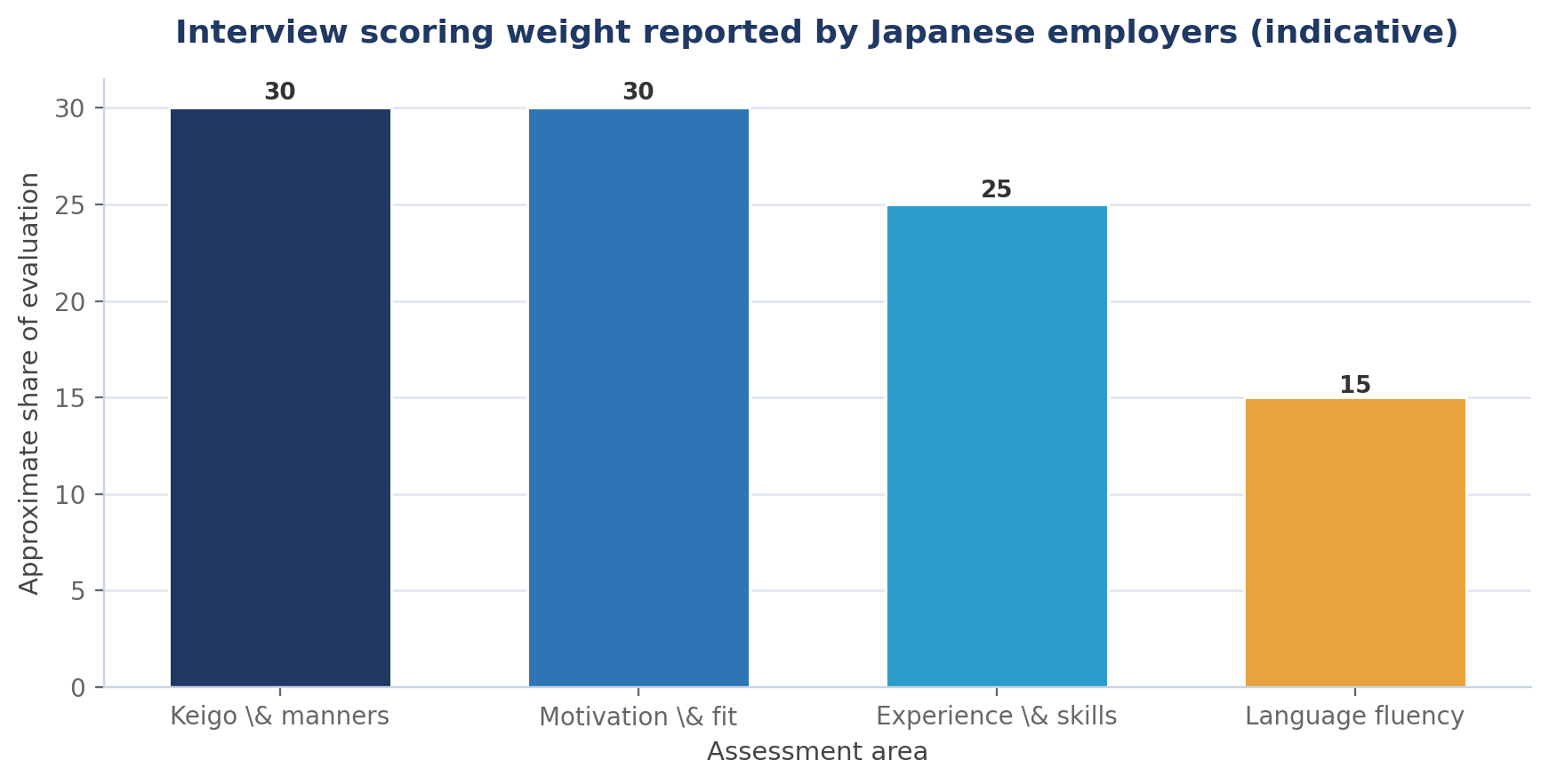
Interviewers at Japanese companies typically score three things: whether you can communicate politely under pressure, whether you will fit the team's rhythm, and whether your story explains why you want this company rather than any company. Technical skill is usually a gate you already passed. The interview is about trust — so 敬語 accuracy, punctuality, and a coherent 志望動機 carry disproportionate weight.
The Interview Flow From Door to Exit
The structure is remarkably consistent, and knowing it removes half the anxiety.
Common Japanese Interview Questions
These are the ones that appear again and again across industries.
Model Answers You Can Adapt
Never memorise scripts word for word — memorised Japanese collapses the moment a follow-up lands. Memorise the skeleton, then practise variations out loud.
Say 御社 (onsha) when speaking to the company in person and 貴社 (kisha) in writing. Mixing them up is one of the fastest ways to signal that your keigo came from a textbook and stayed there.
Rehearse your answers with an AI voice tutor that corrects keigo
Your AI voice tutor hears the polite form that slipped, drills your 自己紹介 until it flows, and gives you speaking practice with feedback until the pressure feels ordinary. Book a free level check and build the version of you that walks in calm.
Rehearse with your AI voice tutor →Create a free accountManners That Decide the Outcome
Business manners are scored as heavily as vocabulary, and they are entirely learnable.
Before-Interview Checklist
Answers in the Interview, Fluency in the Room
The gap between candidates is rarely talent. It is reps — saying the answer aloud to something that will stop you mid-sentence and fix the register. Self-paced AI voice lessons give you exactly that, plus the cultural detail you cannot absorb from a phrasebook, so the interview stops feeling like an exam and starts feeling like a conversation you have already had.
Walk in speaking the keigo interviewers expect
Every lesson pairs you with an AI voice tutor that corrects pronunciation, politeness level, and phrasing in real time. Your Course Pass covers business role-play, résumé language, and speaking practice with feedback.
Prepare for your interview →Create a free accountFrequently Asked Questions
How long before an interview should I start preparing? Two to three weeks of focused practice is realistic for an intermediate learner; the 自己紹介 and motivation answers need the most repetitions.
Do I need perfect keigo to pass? No, but you must control the polite register consistently. Small mistakes are forgiven; dropping into casual Japanese is not.
Is a Japanese-language CV required? Many employers ask for a 履歴書 in Japanese format with a photo, even when the interview itself is partly in English.
Can I ask about salary in the first interview? Usually better to wait until a later round or an offer; first-round questions should focus on the role, team, and expectations.