Japanese phone calls are the final boss of business Japanese. There is no face to read, no context to lean on, and an entire etiquette system running invisibly in the background. Native speakers themselves admit that phone Japanese is harder than meeting Japanese.
The good news: it is almost entirely formulaic. A business call follows a script, and once you learn the script, you can sound professional on the first ring.
What you will get from this guide
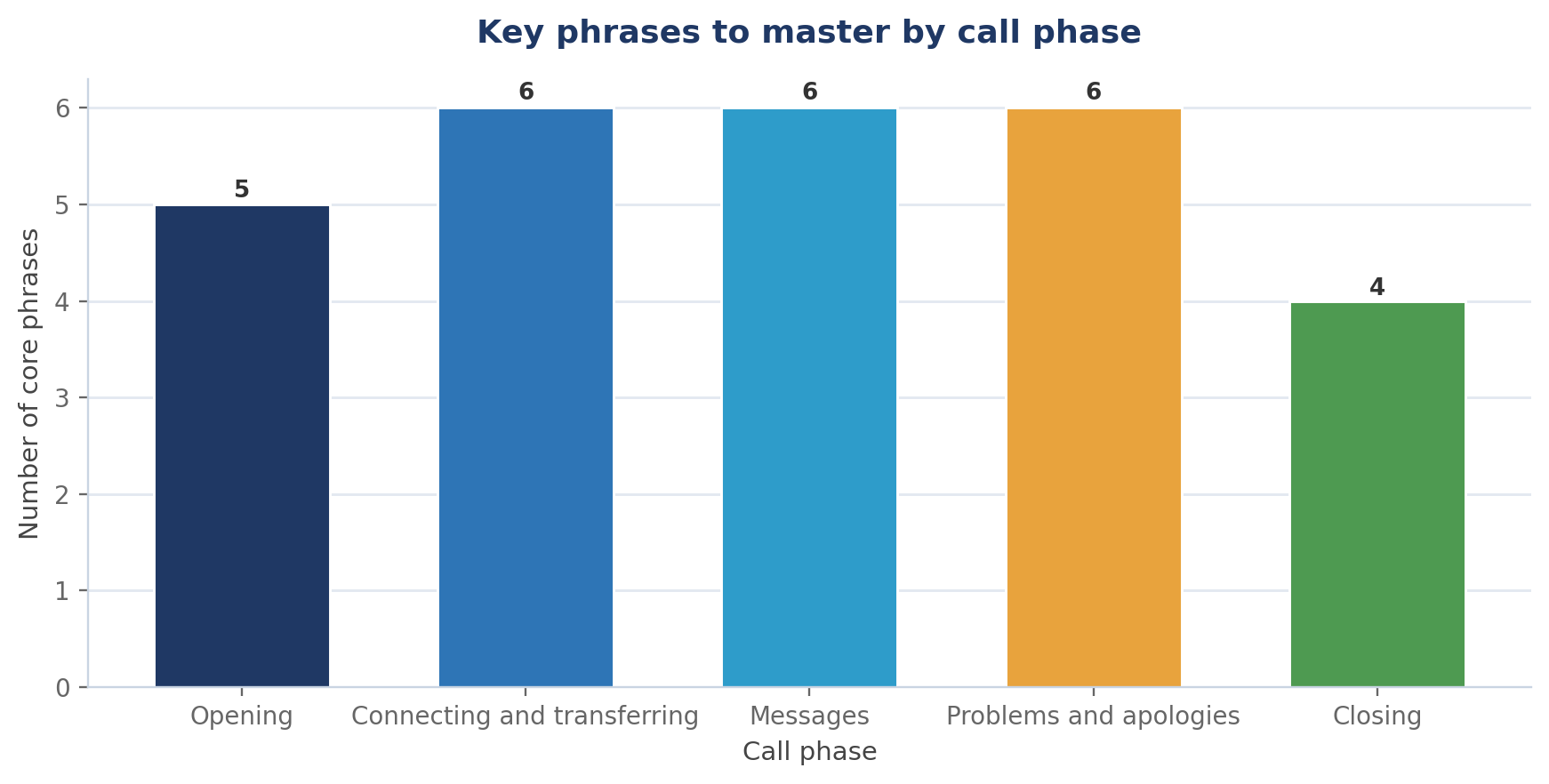
- The five phases of a Japanese business call, with the phrases for each
- The keigo patterns you need, and the ones you can skip
- The manners that matter more than grammar
- The mistakes that instantly mark you as an outsider
Why phone Japanese is genuinely harder
The saving grace is that everyone expects the formulas. Saying the correct phrase in the correct slot matters far more than fluency.
Phase 1: opening the call
お世話になっております is the handshake of Japanese business calls. Use it on every call, in both directions, and you have already cleared the first hurdle.
Phase 2: connecting and transferring
Note the direction of politeness. When you refer to your own colleague, you use humble language. When you refer to the caller's colleague, you use honorific language. Mixing these up is the most common keigo error on the phone.
Phase 3: taking and leaving a message
かしこまりました is the workhorse acknowledgement. It sounds more professional than わかりました and belongs in every business call.
Practise real business calls, not textbook dialogues
Phone Japanese only becomes usable when someone actually speaks it back to you, at speed, with you unable to see their face. A personal AI voice tutor recreates exactly that pressure, safely, at your own pace.
Learn business Japanese with an AI voice tutor →Create a free accountPhase 4: problems and apologies
Buying time is a legitimate skill. 少々お時間をいただけますか is not a failure — it is exactly what a Japanese professional says while checking a detail.
Phase 5: closing the call
The classic sequence is ありがとうございました。失礼いたします。 Say it, wait for the other person to hang up, then hang up. In Japanese business culture, the caller does not hang up first.
Manners that outrank grammar
Reviewing your grammar will never fix a call where you hung up first. These habits do.
Common mistakes and their fixes
That last one is worth repeating. Silence on a phone call is the only truly unrecoverable mistake. Any phrase, even an imperfect one, keeps the conversation alive.
Turn these formulas into automatic reflexes
A list of phrases is a start; using them while someone talks over a bad phone line is a skill. Guided AI voice lessons drill business scripts out loud until they arrive without thinking.
Start business Japanese training →Create a free accountFrequently Asked Questions
Is phone Japanese harder than in-person Japanese? Most learners find it harder at first, because there is no visual context and the formulas are fixed. With practice it becomes one of the most predictable business skills.
Do I need full keigo to make a business call? You need the core opening, transit and closing formulas plus humble language for your own side. Perfect keigo is a long project; the scripts come first.
What is the polite way to say "I don't understand" on the phone? 恐れ入りますが、もう一度お願いできますか — or 電波が悪いようで、もう一度お願いできますか if the line is poor.
Should I hang up first in Japan? No. Wait for the other party, especially a client, to end the call. It is a small gesture that is noticed.
References & Further Reading
- Japan Foundation — Japanese-language learning resources
- Japan Foundation — JF Japanese e-Learning Minato
- NHK — NHK World Japanese lessons for business and daily life
- Council of Europe — CEFR descriptors for spoken production and interaction
- Japan Foundation — Survey on Japanese-language education worldwide