You checked the grammar twice. The keigo looked fine. Then you hit send and remembered you opened with ご苦労様です — a phrase that politely pats your boss on the head. A japanese business email is not a translation problem. It is a ritual with rails, and once you can see the rails, the whole thing becomes almost mechanical.
What you will get from this guide
- The five-part anatomy of a Japanese business email
- The four keigo registers and when each one fires
- Copy-ready phrases for greetings, requests and closings
- The mistakes that instantly out you as a beginner
The Anatomy of a Japanese Business Email
English email strips formality out. Japanese email builds it in layers, and the layers run top to bottom in a fixed order. Miss a layer and the message reads like a text from 1780.
The subject line is doing more work than you think. A blank 件名 or a vague "お世話になっております" forces the reader to open your mail to find out what it is. Japanese offices sort on subject lines. Put the topic in 【】brackets and the date if a meeting is involved.
Keigo in Four Registers, Not One
New learners treat keigo as a single polite dial. It is four dials, and using the wrong one is worse than using none.
Inside an email, sonkeigo and kenjōgo travel as a pair. You humble your own action and raise theirs in the same sentence: 私が資料を拝見し、山田様にご確認いただけますでしょうか. Learning the pair as a unit is the shortcut.
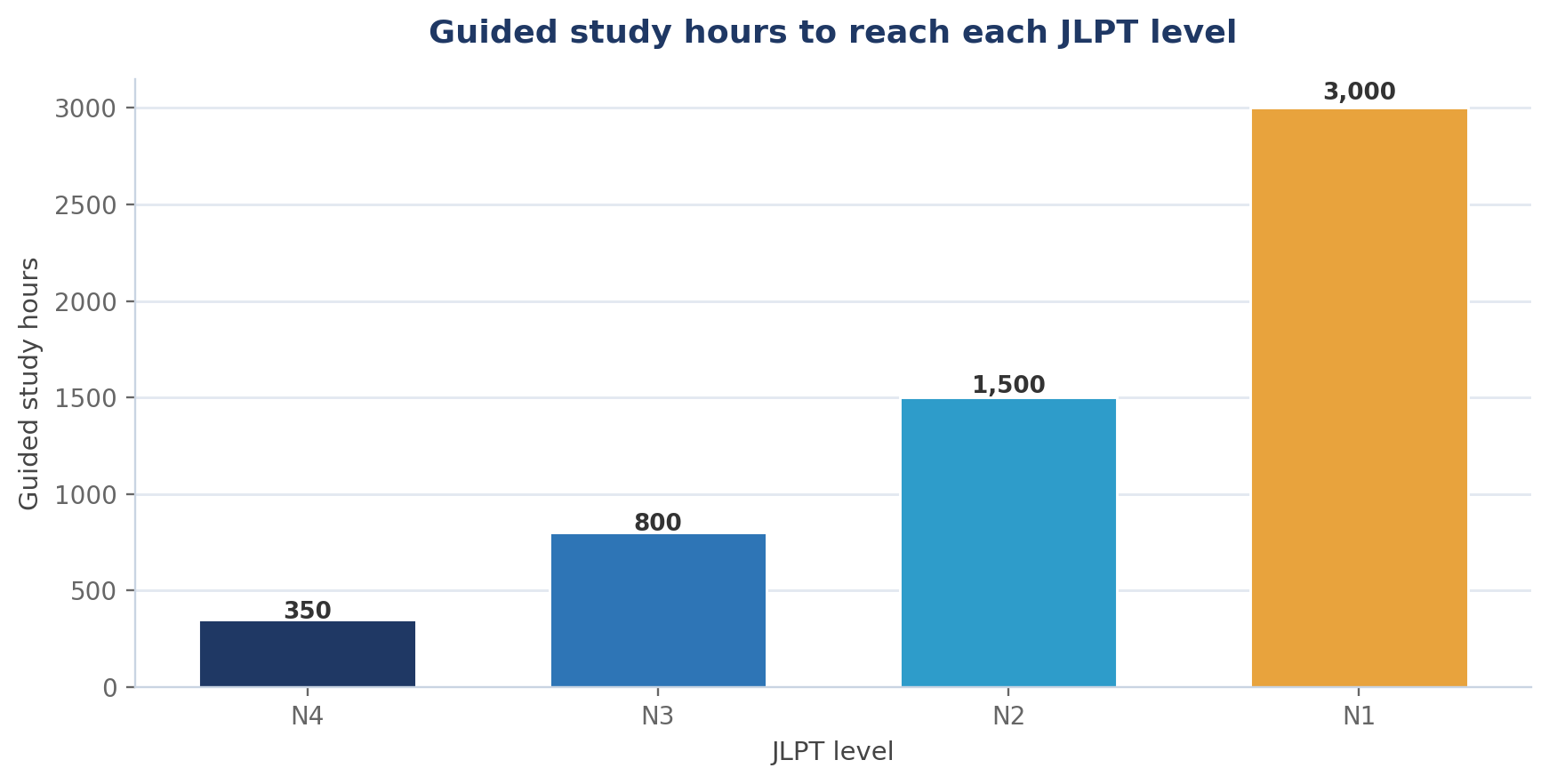
That curve explains the frustration. Prose is reachable fast; keigo lives in the N2 stretch where the vocabulary starts behaving differently depending on who is reading it.
Stop guessing which humble verb goes where
A personal AI voice tutor walks you through real business scenarios — introductions, apologies, deadline emails — until the keigo pair fires without thinking. Study at your own pace, any time, with AI feedback on your own drafts.
See the Japanese course →Create a free accountThe Honorific Prefix Rule Behind お and ご
Two prefixes cover most of your email. Read the word, guess its family, and if it is katakana, leave it bare.
Phrases That Do the Work
Keep these six in a scratch file. Ninety percent of your email is these six plus the nouns of your own job.
Copy-Ready Template
Here is the skeleton you can reuse. Swap the brackets, keep the bones.
The pre-close line is the one learners skip. It carries the apology for the imposition, and skipping it can make a polite request feel like an order.
Mistakes That Cost You Credibility
Practice Until It Is Muscle
Read your draft once, then delete the greetings and read the body alone. If the body still sounds respectful, you are done. If it only sounds respectful because of the opening ritual, the keigo has not arrived yet — and that gap closes with repetition, not with memorized lists.
Train on your own real inbox
Bring your actual drafts and get line-by-line AI feedback from your personal voice tutor. That is the fastest way to move keigo from theory into reflex.
Start with a free account →Create a free accountFrequently Asked Questions
Do I need perfect keigo before I can send a Japanese business email? No. Use です/ます with the six safe phrases above and you will be understood politely. Advanced keigo raises the ceiling, but it is not the entry ticket.
Is お疲れ様です acceptable in an email opener? Yes, inside a company or between close partners. With a new client, いつもお世話になっております is the safer default.
How short should a Japanese business email be? As short as the ritual allows. One topic, one request, five to eight sentences. Long emails in Japanese read as unfocused rather than diligent.
Can I write the email in English and translate it? For internal notes, yes. For client-facing mail, the structure matters more than the vocabulary, and translation tools flatten the ritual. Draft it in Japanese from the template.
References & Further Reading
- Japan Foundation — Marugoto: Japanese Language and Culture, CEFR-aligned course series with business modules
- Japan Foundation — JF Japanese e-Learning Minato, free and paid courses by level
- JLPT official site, level descriptions and sample questions
- NHK World-Japan — Easy Japanese, audio courses and phrase lists
- National Institute for Japanese Language and Linguistics — Ninjal, research on honorific usage