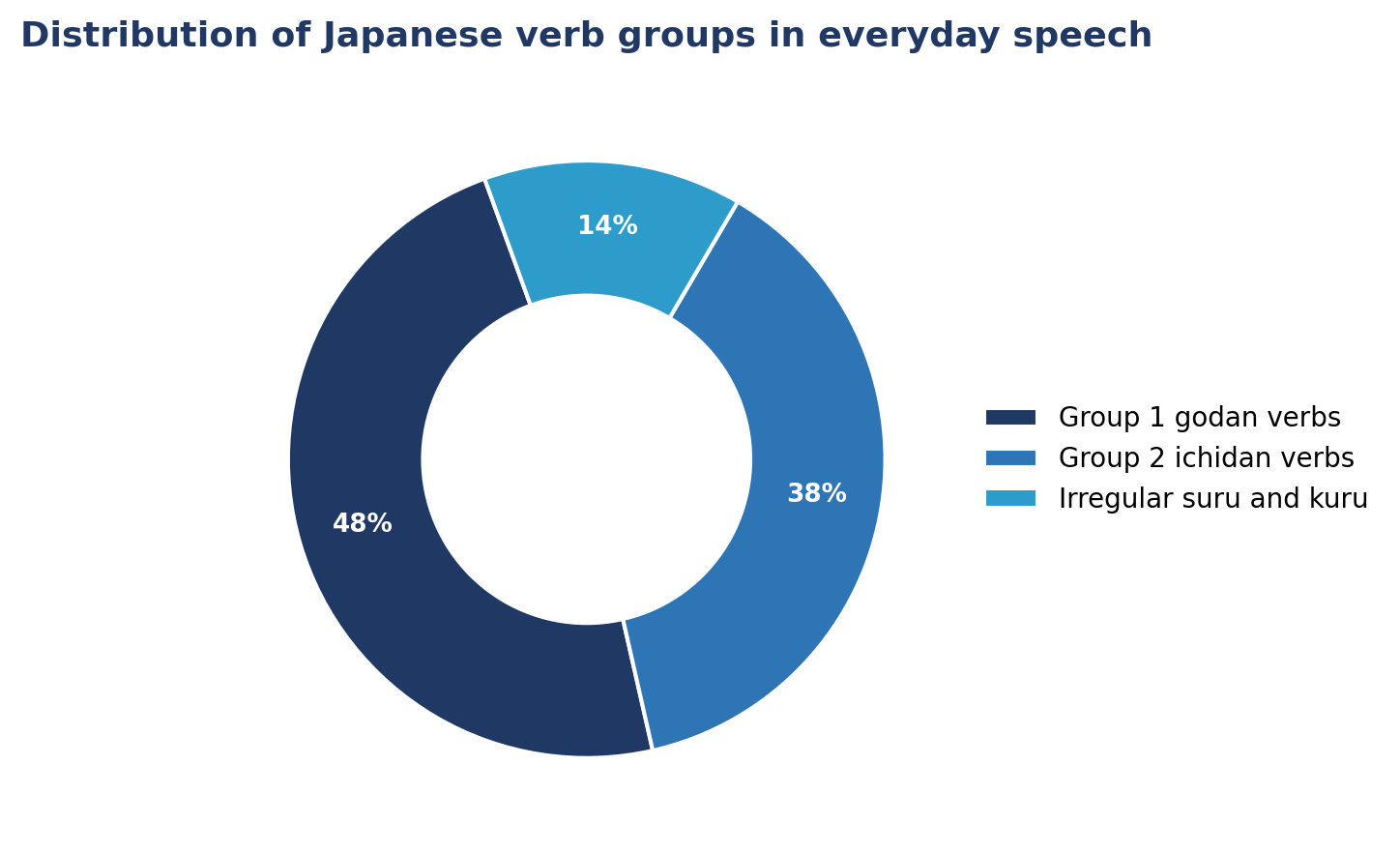
Japanese verb conjugation has a reputation for being complicated. It is not complicated — it is grouped, and almost every error a beginner makes comes from putting a verb in the wrong group.
Once you know which of the three groups a verb belongs to, its forms build mechanically: dictionary form, negative, past, te-form, potential, conditional. The difficulty is entirely in that first identification step, plus a short list of verbs that look like one group and behave like another.
Here is the full system, the exceptions worth memorising, and the conjugation table that covers every form you need at beginner and intermediate level.
The Three Groups
Group 1 is the largest and the one with the sound shifts. Group 2 is the easiest to conjugate but the hardest to identify, because many group 1 verbs also end in る.
How Group 1 Works: The Five Stems
Group 1 verbs change their final syllable to a different vowel row, and each row produces a different grammatical form. Learn the rows and you have every form.
That table is the single most useful thing to memorise in Japanese grammar. Six verbs in each row and you can produce every standard form for the whole group.
How Group 2 Works: Drop and Attach
Group 2 has one rule: remove る and attach the ending.
No sound changes, no exceptions. This is why misidentifying a group 1 verb as group 2 is expensive: the resulting form sounds plausible and is completely wrong.
The Two Irregulars Deserve Their Own Week
する and 来る are the two most frequent verbs in Japanese, and they are irregular in almost every form.
Note the potential of する: it is not すられる but できる, a completely different verb. That is worth memorising as a pair, because できる appears constantly.
One Verb Breaks Even Group 1
行く is the exception worth learning immediately, because it is in the top five most-used verbs. Every other group 1 verb follows the standard sound-change pattern without exception.
The Complete Sound-Change Table for Group 1
Two details in that table trip learners up. The う-ending negative is わない, not あない — 買う becomes 買わない. And ある follows the る row for the te-form (あって) but has its own polite negative, ありません, which is worth learning as a fixed form.
Get the groups right in the first week
Group mistakes fossilise fast and are tedious to fix later. Our Japanese Course Pass drills conjugation with a personal AI voice tutor that catches a misgrouped verb the moment you say it. Explore the Japanese Course Pass →
Start the Japanese course →Create a free accountHow to Identify a Group in Two Seconds
The exception list is short and worth memorising outright: 帰る, 入る, 走る, 切る, 知る, 要る, 限る. Everything else follows the rule.
A Ten-Day Conjugation Routine
Day eight is where the skill actually forms. Naming the group for forty verbs, without conjugating them, converts identification into a reflex — and once identification is automatic, conjugation follows without conscious thought.
From rules to reflex, with an AI tutor correcting you
Conjugation is learned fastest in speech. Our Japanese Course Pass pairs the grammar with self-paced speaking practice and a level-based curriculum from the first lesson. Start your Japanese Course Pass →
Start the Japanese course →Create a free accountFrequently Asked Questions
How many verb groups are there in Japanese? Three: group 1 or godan verbs with five stems, group 2 or ichidan verbs that drop る, and group 3, the two irregular verbs する and 来る.
How do I know if a verb is group 1 or group 2? If it ends in -eru or -iru it is usually group 2, but check the exception list — verbs like 帰る, 入る and 走る are group 1 despite their endings.
Which group should I learn first? Group 2 and the two irregulars first, because they are the most regular and the most frequent. Group 1 then takes the longest but follows a fixed pattern.
Do I need to memorise every conjugation table? No. Memorise the five stems for group 1 and the drop-る rule for group 2, and you can build any form you need.