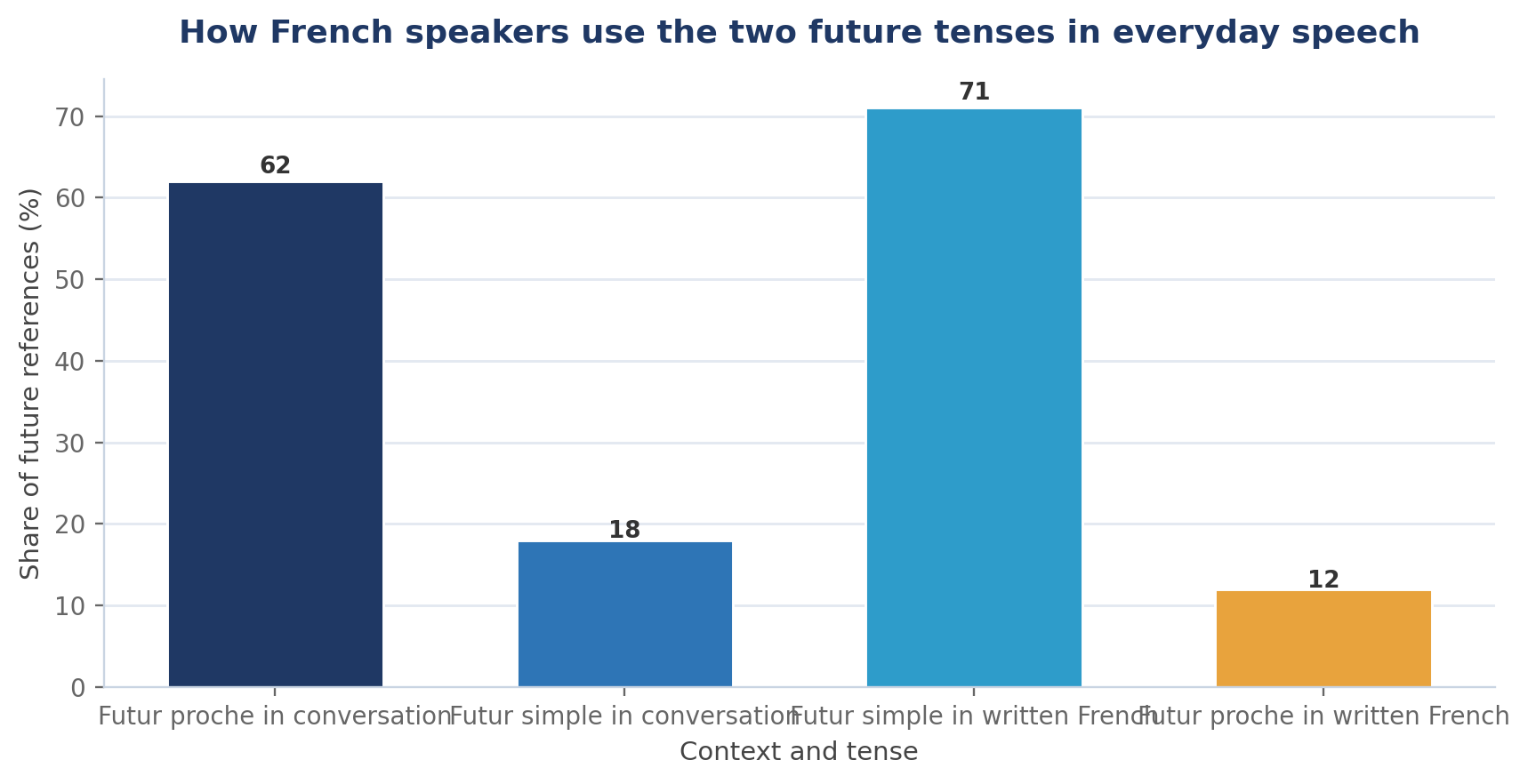
Here is a sentence that will surprise many intermediate learners: Je vais partir demain and Je partirai demain mean almost exactly the same thing. Both are correct. Both are future. And choosing between them is not a grammar question — it is a question of how close the future feels.
French has two everyday futures, and the good news is that one of them is the easiest structure in the entire language. Learn that one first, and you can talk about the future this afternoon.
What you will get from this guide
- The futur proche — the future you will use most
- The futur simple — how to form it, endings and stems
- The irregular stems worth memorising
- When to choose each one
- The tense that surprises learners: the future perfect
The futur proche: the future you will actually use
Take the present tense of aller and add an infinitive. That is the whole rule.
No new endings. No irregular stems. No exceptions. And because aller contains the sense of movement, the futur proche carries a natural feeling of imminence — something about to happen.
Use it for plans already decided, events about to occur, and almost everything in casual conversation.
The futur simple: one stem, six endings
The futur simple is used in writing, formal speech, and for futures that feel distant or uncertain. And once you know the pattern, it is remarkably tidy.
For regular verbs, take the infinitive and add the endings. For -re verbs, drop the final e first.
Notice that the endings — -ai, -as, -a, -ons, -ez, -ont — are the same for every verb in the language. Learn six endings and you have the whole system.
A practical warning: the je form (-ai) and the passé composé first person (-é) sound nearly identical. Je parlerai (I will speak) and j'ai parlé (I spoke) differ mainly in the vowel length you will hear natives distinguish and textbooks rarely explain.
The irregular stems worth memorising
Around twenty verbs have irregular futur simple stems — but the endings never change.
Memorise these ten and you cover the overwhelming majority of what you will actually say. The rest follow the regular pattern.
Which future should you choose?
The futur proche is the future of your diary. The futur simple is the future of your letters.
Ready to turn reading into real French? Start your self-paced course today.
Start the French course →Create a free accountLearn the future by using it, not by reading about it
Rules are cheap; production is what sticks. With a personal AI voice tutor, your tense choice is heard in real time and corrected before the habit sets — the shortest route from "I understand" to "I say it without thinking".
Button: See the live French Course Pass →
The future perfect: something learners rarely meet
The futur antérieur expresses an action completed before a future moment. It is formed with the future of avoir or être plus a past participle.
Notice the structure in the first example: after quand, French uses a future tense where English uses the present. When I finish becomes quand j'aurai fini. That single rule marks a learner who has genuinely absorbed French time logic.
Five mistakes that keep the future tense hard
The fifth is the most common and the most limiting. The futur proche is available on day one of French study, and learners who avoid it end up describing their plans in the present tense for months.
How to practise the future properly
The weather forecast is the perfect listening exercise: it is overwhelmingly future-tense, spoken fast, and repeated daily with a limited vocabulary.
Ready to turn reading into real French? Start your self-paced course today.
Start the French course →Create a free accountStart with a free account — no card needed
Create a free languageskills.net account to try guided French practice and see how the two futures behave in real conversation. Upgrade to the course pass only when you are ready for the full guided lessons.
Button: Create your free account →
Frequently Asked Questions
**What is the difference between the futur proche and the futur simple?** The futur proche (aller + infinitive) covers imminent and casual plans; the futur simple covers distant, formal or uncertain futures. In speech, the futur proche is far more common.
Which French future should I learn first? The futur proche. It requires no new endings and is available from your first week of study.
**Are there many irregular forms in the futur simple?** Around twenty verbs have irregular stems, but the endings never change. Ten of those cover most everyday usage.
**Why does French use a future tense after quand?** French expresses future time from a future viewpoint. When I finish becomes quand j'aurai fini, using the future perfect rather than the present.
References & Further Reading
- Académie française — French grammar guidance and usage
- France Éducation international — DELF and DALF levels and grammar scope
- TV5Monde — Apprendre le français: exercises by level
- RFI — Journal en français facile, daily slow-news audio
- Council of Europe — CEFR levels and descriptors