A four-year-old cannot conjugate être. She also does not need to. What she needs is to hear tu es prêt? fifty times before breakfast, until the phrase fits her like a pair of shoes.
That is the entire trick. Children learn French the way they learned their first language: through repetition, play and a person who keeps showing up. Grammar comes later, and it comes easily.
What you will get from this guide
- What works at each age, from toddler to teenager
- Games, songs and routines that need zero French on your part
- Honest time expectations, week by week
- How to know when a child needs an AI tutor
The One Rule That Beats Every Method
Speak French in short, real bursts. Not lessons. Bursts.
"À table!" "On y va?" "Bravo!" Ten seconds here, ten seconds there, twenty times a day. A child who hears 3,000 tiny French moments a month learns faster than one who sits through a ninety-minute class on Saturday.
You are not teaching a subject. You are building a habit of listening.
What Each Age Can Actually Do
Kids are not small adults. Push the wrong thing at the wrong age and you get tears and a lifelong grudge against the language.
The 8–10 band is the sweet spot for structured practice. Younger children absorb sounds; older children absorb systems. Meet them where they are.
Five Zero-Prep French Games
You do not need fluent French for any of these. You need thirty seconds and a sense of fun.
Play each one four or five times in a week. Repetition is not boring to a child. It is comfort.
Songs and Rhymes: The Cheapest French Teacher Alive
Melody carries pronunciation. A child who sings Frère Jacques has already practised nasal vowels more than most adult beginners manage in a year.
Play one song at bath time, another in the car. Rotate every two weeks so nothing goes stale. The RFI Savoirs archive has free kid-friendly audio if you want more variety.
Want a French voice that is not yours?
Children copy accents effortlessly — but only from a model. A personal AI voice tutor gives your child a consistent pronunciation model, songs and games, at your child's own pace, without you needing to speak a word of it yourself.
Create a free account →Create a free accountBuild a French Corner in Your Home
Rituals beat willpower. Give French a specific place and time, and it stops being a chore.
Five small moments. That is under forty minutes a day and every one of them feels like play.
Realistic Progress: What to Expect, and When
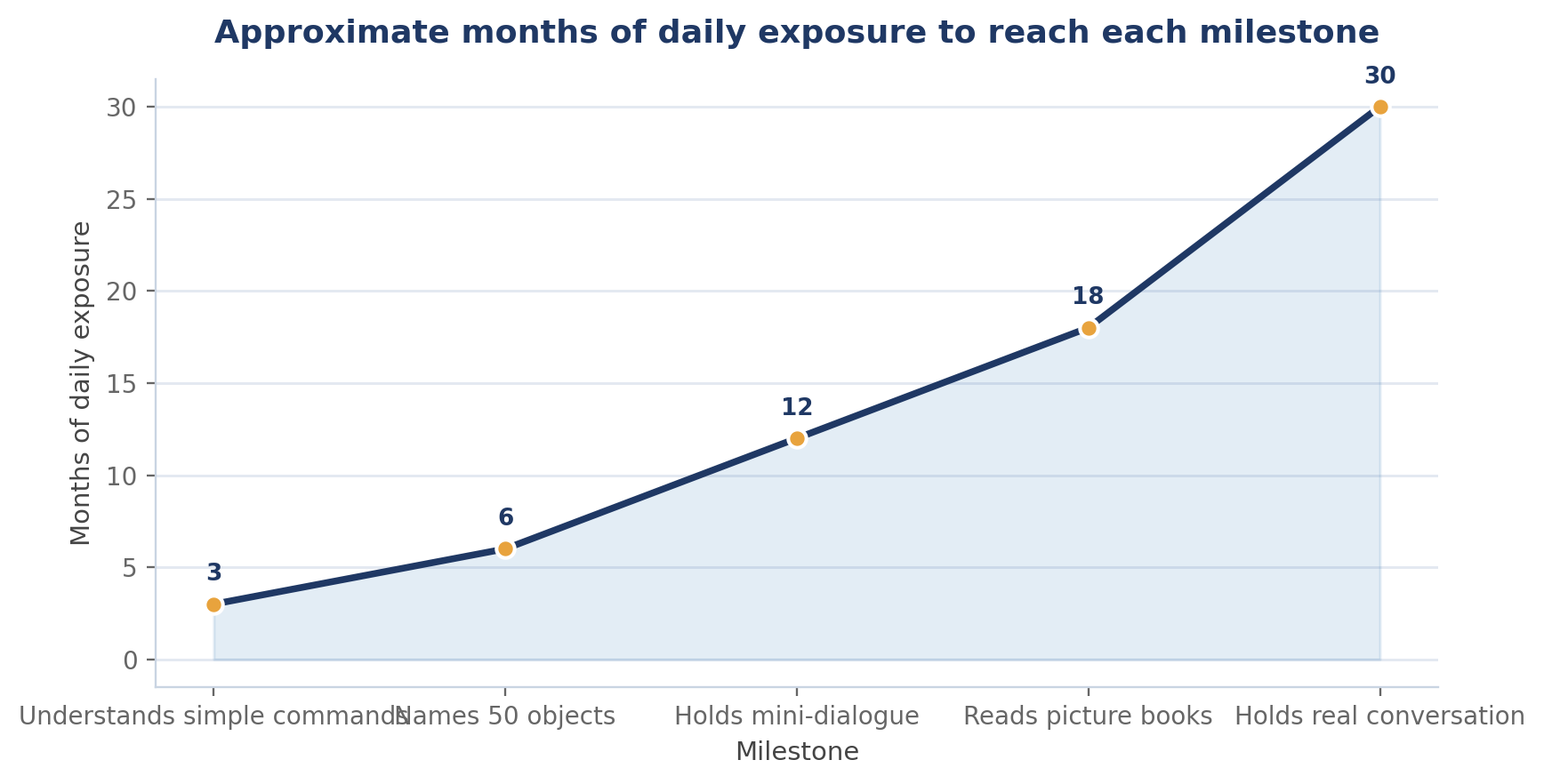
A child with fifteen minutes of French a day progresses on a different curve than an adult. Faster ears, slower grammar.
Notice the last bar. Real conversation takes years, and that is normal. Bilingual children are not built in a summer. They are built by parents who never made it feel like homework.
When to Bring In an AI tutor
Some things a parent cannot supply. Pronunciation models are the big one, and so is the social pressure of speaking to someone who does not already understand your child's English.
Bring in a teacher when: your child starts asking questions you cannot answer, when motivation dips around age eight, or when you want exam preparation for the DELF Prim.
The Alliance Française network runs children's courses in most major cities. Combined with your home rituals, that is a complete system.
The Mistakes That Kill Momentum
Do not correct every error. Do not translate everything. Do not test.
A child says j'ai allé instead of je suis allé. You say it back correctly in your reply and move on. Ten exposures later the form fixes itself. Correction on the spot teaches a child that speaking is dangerous.
Other traps: buying expensive materials before establishing a routine, switching methods every month, and quitting after a three-week plateau. Plateaus are part of the shape.
Give your child a teacher who makes French feel like play.
Our self-paced French courses for kids pair games and songs with a personal AI voice tutor — a consistent pronunciation model you can rely on at home. Start free, then upgrade when your child starts asking for more.
Explore French courses →Create a free accountFrequently Asked Questions
What age should a child start learning French? Any age works, but the sweet spot for picking up a native-like accent is before roughly age ten. Under five, keep it playful: songs and commands only.
Do I need to speak French myself to teach my child? No. Songs, videos and games carry most of the load. When your child outgrows your French — usually around age eight — that is the moment to add a structured course with an AI voice tutor.
How long does it take for a child to speak French? With fifteen minutes a day, expect simple commands in about three months and short conversations after two to three years of consistent exposure.
Is a French app enough for children? Apps build vocabulary well but rarely build conversation. Children need something that answers them back, which is why structured lessons with an AI voice tutor matter from around age seven.
References & Further Reading
- Alliance Française — children's French courses and the DELF Prim exam pathway.
- RFI Savoirs — free French audio, including resources designed for young learners.
- TV5Monde Apprendre le français — video exercises graded by CEFR level.
- Institut français — cultural programmes and children's French media.
- Council of Europe, CEFR Companion Volume — the reference scale behind DELF Prim levels A1.1 to A2.
Start tomorrow morning. Count the spoons.