Your four-year-old understands everything you say in French. She just answers in English. Every time. With a small, knowing smile.
That is not failure. That is the single most common stage in bilingual family life — and it has an answer.
What you will get from this guide
- The four family language strategies, and which one fits yours
- How much French exposure a child actually needs, by age
- What to do when your child answers in English
- Realistic expectations about milestones, mixing and delays
What bilingual really means for a child
Bilingualism is not a perfectly balanced switchboard. It is a moving balance. Your child's two languages will trade places depending on school, friends, screens and who is in the room.
Some children arrive at school with stronger English. Some spend two years stronger in French. Both are normal, and neither predicts the outcome at eighteen.
The only variable that reliably matters is how much real French your child hears and needs to use.
Pick a family strategy, then hold it
Four approaches work. The one that fails is confusion — a household where nobody knows which language is supposed to happen when.
Consistency beats intensity. A parent who manages twenty focused French minutes daily will out-teach a household that swings between enthusiastic French weekends and months of English.
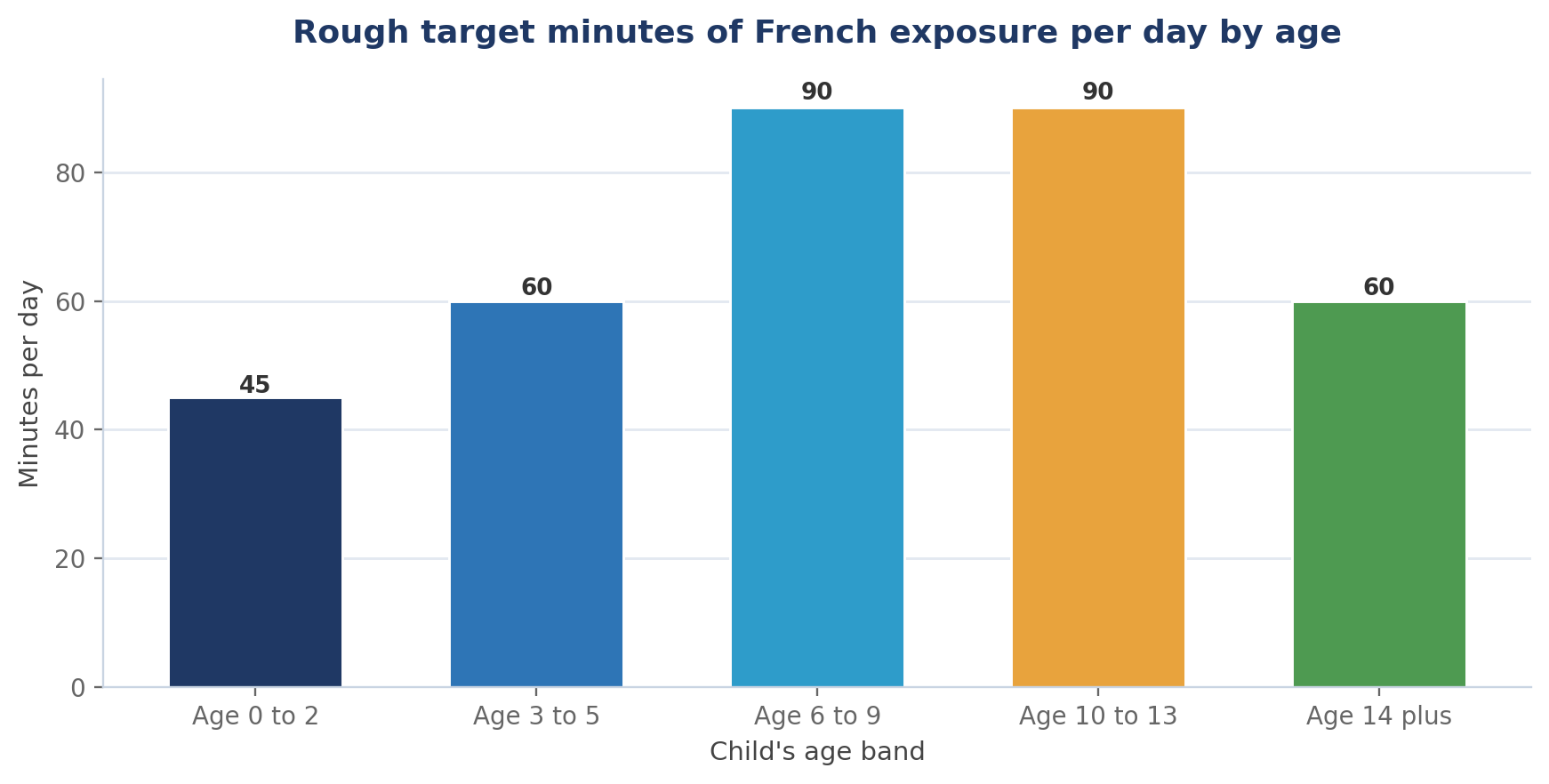
Exposure by age: what each stage needs
The transition around six to nine is decisive. Until then, French is emotional and playful. After that, it must become useful — something your child does for their own reasons.
When your child answers in English
Do not punish it. Do not make French a test. Receptive bilingualism — understanding without speaking — is a normal, stable phase.
Instead:
The moment French becomes a chore with a grade attached, children learn to avoid it. The moment it becomes a route to something they want, they use it.
Myths worth discarding
If you have any genuine concern about speech or hearing, see a speech and language professional. That advice beats anything on the internet, this article included.
Build your own French as you build theirs
Ready to turn reading into real French? Start your self-paced course today.
Start the French course →Create a free accountChildren follow the adults around them. A free account lets you try self-paced lessons with a personal AI voice tutor, then upgrade when you want a structured course. Button: Create your free account →
Making French genuinely useful
Books on the shelf are not enough. French has to be attached to things your child already loves.
Travel and real people do more than any app. One week in France where your child must ask for bread has a strange way of unlocking a year of vocabulary.
The Alliance Française and local Institut français branches run children's classes with tested CEFR-linked progression, which is useful when you want structure outside the home.
The long game
Bilingualism in French and English is not a sprint to fluency at seven. It is an eighteen-year investment in a child who can read, joke, argue and work in two languages. Some years will feel strong. Some will feel like you are losing ground.
Hold the habit. Keep the French emotional, useful and unforced. Your reward arrives quietly, one day, when your teenager switches language mid-sentence to tell you something important — and does not even notice doing it.
Model the language you want them to keep
Ready to turn reading into real French? Start your self-paced course today.
Start the French course →Create a free accountParents who learn and use French daily raise children who do the same. Start free, then follow a structured course from A1 to B2 at your own pace. Button: Start learning French →
Frequently Asked Questions
At what age should I start speaking French to my child? From birth if you can. Early input shapes phonology, but it is never too late — children entering French at six or ten still reach strong bilingual levels with enough exposure.
Will two languages confuse my child? No. Mixing words and grammar is a normal stage in bilingual development, and children typically sort the languages out as input and context become clearer.
My child understands French but refuses to speak it. What now? Keep the French flowing and create low-pressure reasons to produce — one sentence, a grandparent phone call, food ordering on holiday. Receptive ability is a real foundation, not a waste.
Can a child become bilingual without a French-speaking parent? Yes, but it needs deliberate structure: French school, immersion programmes, classes and consistent media. Without daily French at home, an outside programme is essential.
References & Further Reading
- Grosjean, F., Bilingual: Life and Reality (Harvard University Press) — research-based overview of bilingual development.
- Council of Europe, Common European Framework of Reference for Languages — level descriptors adapted for young learners.
- Alliance Française — French courses and programmes for children internationally.
- Institut français — French language and culture provision for families abroad.
- France Éducation International — DELF Prim and DELF Junior examinations for young French learners.