A four-year-old in Lyon says une fourchette with a rolled R that would make a Parisian chef weep with joy. A forty-year-old in Toronto says four-chkett and will say it that way forever.
So age wins. Game over, right? Not quite. The four-year-old still needs about a decade of daily exposure to sound French, and the forty-year-old can read Baudelaire next year. Here is what age actually changes — and what it does not.
What you will get from this guide
- What the research really says about age and language learning
- Realistic outcomes for children, teens and adults
- A start-now plan for whatever age you are
What "Best Age" Actually Means
There is no single best age, because "learning French" is not one skill. It is a bundle: pronunciation, vocabulary, grammar, and the social confidence to use them all under pressure.
Each of those peaks at a different age.
The honest summary: younger is better for sound, older is better for speed. Nobody gets everything.
Why Young Children Sound Native
The famous idea here is the critical period — a window in early life when the brain acquires a sound system effortlessly. Beyond it, accents become much harder to shift, though not impossible.
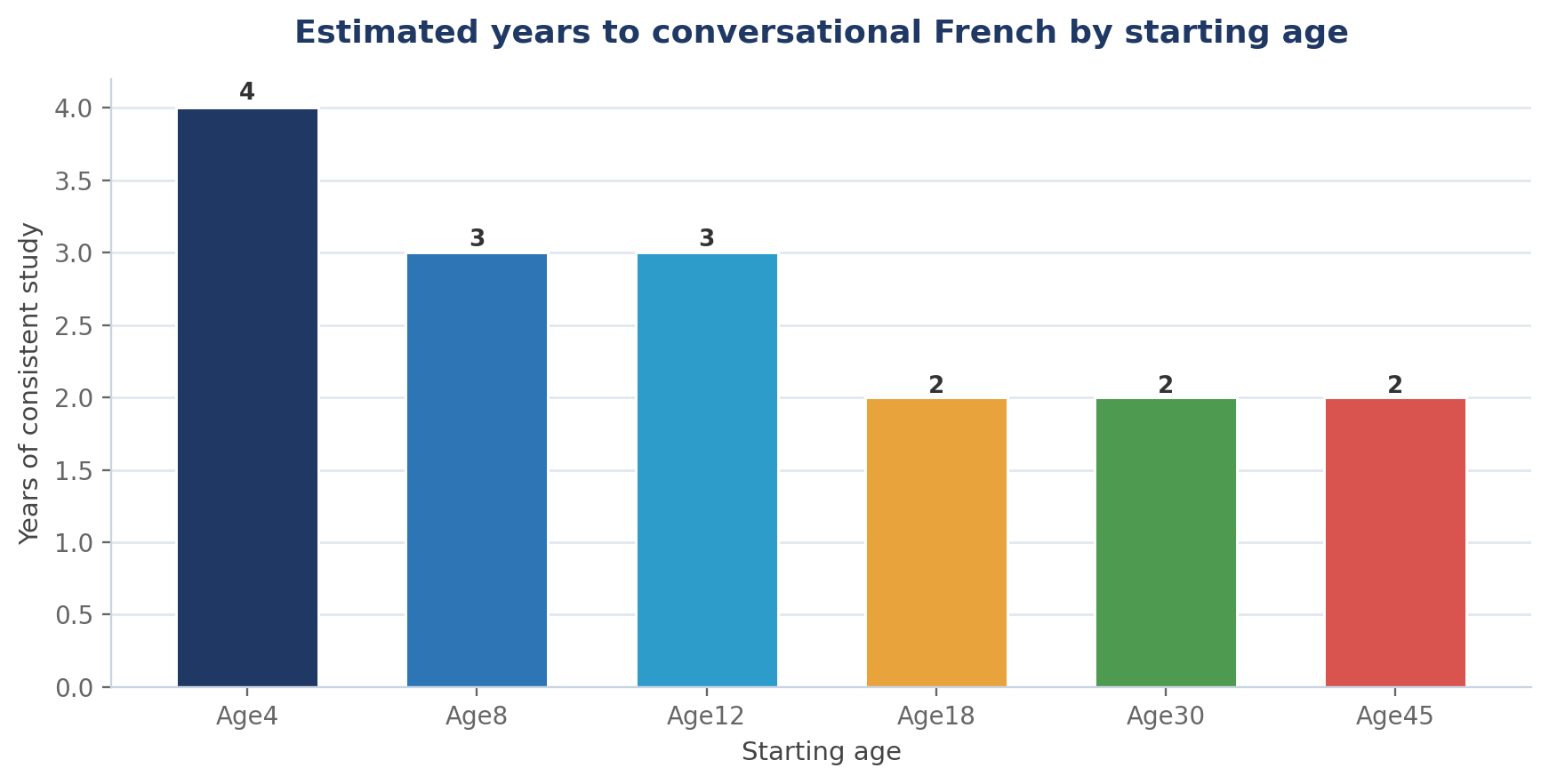
What matters practically is exposure hours, not just birthdays.
Notice the pattern. Younger children need enormous exposure because they learn slowly but deeply. Adults learn faster but from a fixed sound base.
The Two Ages That Change Everything
You do not have to choose between a toddler and a retiree. Two windows genuinely matter.
The under-12 window. This is where accent is won cheaply. If a child starts before roughly age twelve and gets regular, joyful exposure, French pronunciation stays natural for life. No grind required — songs, cartoons and games do the work.
The over-16 window. This is where speed lives. Teens and adults can use deliberate study: grammar tables, error logs, focused writing. They reach A1 in 60–90 guided hours, while a five-year-old takes years to reach the same milestone.
So the best age to learn french depends entirely on which prize you want.
What Each Age Looks Like in Practice
There is one universal rule hiding in this table. Every age band fails for the same reason — not starting, or stopping too early.
Try a real French lesson before you commit
See how our AI voice tutor handles your age group before you spend a cent. Create a free account and try a French lesson built for your level.
Create a free account →Create a free accountStarting Young Without Burnout
Parents usually overcorrect. They want immersion, tutors and daily drills — and by month four the child resents the language.
Children learn French best when it feels like something they do, not something done to them. A Saturday French club plus a cartoon habit beats an exhausted child with a workbook.
Starting Later Without Shame
Adults have one enormous advantage older learners rarely credit: they can read a grammar explanation once and apply it. A child cannot.
The accent will carry an English trace. That is fine. Millions of fluent French speakers have one, and every French person you meet will understand every word.
A Start-Now Plan, Any Age
Two habits, both cheap. Consistency for the child, feedback for the adult. That is what decides outcomes — not the birth certificate.
The Common European Framework gives you can-do checkpoints to aim at, whatever age you start.
The second-best day to start is today
Whether your learner is six or sixty, our AI voice tutor gives them the one thing apps cannot: a patient tutor who listens, corrects and keeps them going.
Explore French courses →Create a free accountFrequently Asked Questions
What is the best age to learn French? For a native-like accent, before roughly age seven to twelve. For fastest overall progress, the teen and adult years win, because grammar and literacy transfer far more quickly.
Is it too late to learn French at 40? No. Adults routinely reach A2 and B1 in one to three years of guided study, and pronunciation can still improve substantially with focused practice.
Should children learn French with an app? Apps work as a supplement, not a foundation. Young children learn best from interactive activities — songs, games and conversation with our AI voice tutor.
How many hours a week does a child need? For meaningful progress, aim for four to six hours of exposure weekly at minimum, and more if you want native-like pronunciation to develop naturally.
References & Further Reading
- Council of Europe — Common European Framework of Reference for Languages (CEFR)
- Alliance Française — French courses for children and teenagers
- France Éducation international — DELF Prim examinations for young learners
- LanguageSkills.net — self-paced French courses for all ages
- Harvard University Center on the Developing Child — research on early language development