A seven-year-old will not memorise a vocabulary list. But she will happily shout le chat ! forty times to win a card game — and that is the whole trick. Children learn language the way they learn to run: by playing until it stops being effort.
So put the flashcards away. Here are games that build real French, sorted by age, noise level, and how much of your evening they eat.
What you will get from this guide
- Games for ages 4–6, 7–9 and 10–12
- Kitchen-table activities with almost no preparation
- A weekly family rhythm that takes 15 minutes a day
- How to add self-paced AI voice practice without turning playtime into school
Why Games Beat Worksheets
Children's working memory is small and their patience is smaller. Games solve both problems at once: they repeat words many times, attach them to movement and emotion, and end before boredom arrives.
The key ingredient is repetition with a reason. A worksheet repeats a word because the page says so. A game repeats it because you want to win.
Games for Ages 4 to 6
At this age, French is sound and rhythm. No reading, no spelling.
Say the phrase, do the action, let them copy. Do not ask them to repeat perfectly. Let the ears do their work first.
Games for Ages 7 to 9
Now you can add rules, turns and a little competition.
The treasure hunt is the crowd-pleaser. Write five clues, hide five small prizes, and watch a child read French voluntarily.
A quick rule of thumb
If your child is laughing, the French is working. If they are squirming, the activity is too long or too hard — shorten it and let them win.
Play at home. Get AI voice feedback.
Home games build vocabulary fast, but structured speaking practice with AI feedback builds pronunciation and confidence faster. Our French course for children is self-paced, playful and taught entirely in French.
Start a kids' French course →Create a free accountGames for Ages 10 to 12
Older kids want to be taken seriously. Give them games with real stakes.
Kitchen-Table Activities With Zero Prep
You are not a teacher and you do not have time. Good news: the kitchen is a classroom.
One book, read at bedtime, five nights a week, for a year. That is 260 exposures to natural French sentences. No app does that.
Songs and Screen Time, Used Properly
Songs are the cheapest memory device ever invented. Frère Jacques, Sur le pont d'Avignon, Ainsi font, font, font and Alouette all work because the tune carries the words.
Screen time is fine if it is French and if it is chosen, not auto-played.
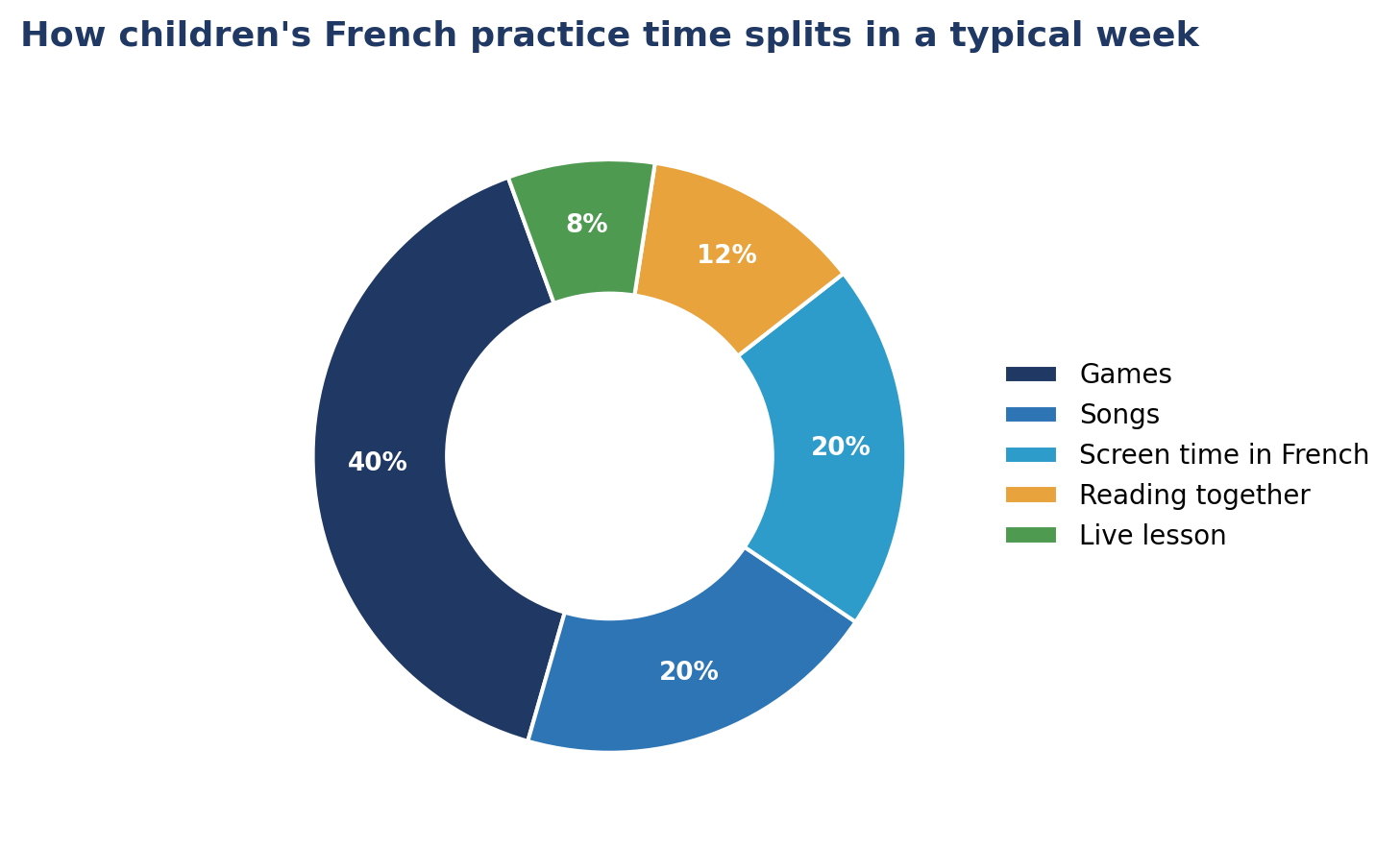
A Weekly Plan You Can Actually Keep
That is under two hours a week. Do it for a term and you will hear the difference.
Create a free account and start this week.
Play at home, then add one self-paced AI voice practice session a week to lock in pronunciation. A free account lets you explore levels before you commit to anything.
Create your free account →Create a free accountFrequently Asked Questions
What age should a child start learning French? Any age works. Ages 4–7 are excellent for accent and listening, while ages 8–12 learn vocabulary and grammar faster. The best start is simply the one that happens now.
How long should a game last? Ten to fifteen minutes for under-sevens, up to twenty-five for older children. Stop while they are still having fun; a game they beg to replay is worth more than a long session they dread.
Should I translate for them? Not immediately. Point, act, show a picture, and give them a moment. If they still do not understand, give the English once, then return to French — never mix the two in one sentence.
Do children need a tutor, or is home play enough? Home play builds vocabulary and joy. Structured speaking practice with AI feedback builds correct pronunciation and the habit of speaking aloud, which is what actually sticks long term.
References & Further Reading
- France Éducation International — official DELF Prim exam information for young learners.
- Alliance Française — children's and teen French course programmes worldwide.
- TV5MONDE Apprendre le français — free French learning activities including children's content.
- RFI Savoirs — graded audio and exercises, including beginner-friendly materials.
- Centre National de Documentation Pédagogique (Réseau Canopé) — French educational resources for schools and families.
Pick one game tonight. Say one French sentence. That is a curriculum.