The passé composé is the first past tense most French learners meet, and it is the one they use for the rest of their lives. It is how you say what you did yesterday, what happened last week, and what you have just finished. In everyday speech it does the work that several English past tenses share between them.
It also has a reputation for being fiddly, mostly because of one question: avoir or être? That question has a clean answer, and most of the difficulty evaporates once you see it.
What you will get from this guide
- The two-part structure of the passé composé
- How to choose between avoir and être
- The agreement rules, in plain language
- The mistakes that mark learners out, and the fixes
The structure: helper verb plus participle
The passé composé is built from two pieces: a helper verb in the present tense, and a past participle.
The name means "compound past", and that is exactly what it is: two words working as one tense.
Forming the past participle
The regular patterns cover the majority of verbs. The irregulars are a short, high-frequency list — être → été, avoir → eu, aller → allé, voir → vu, pouvoir → pu, vouloir → voulu, devoir → dû, venir → venu.
Avoir or être? The short answer
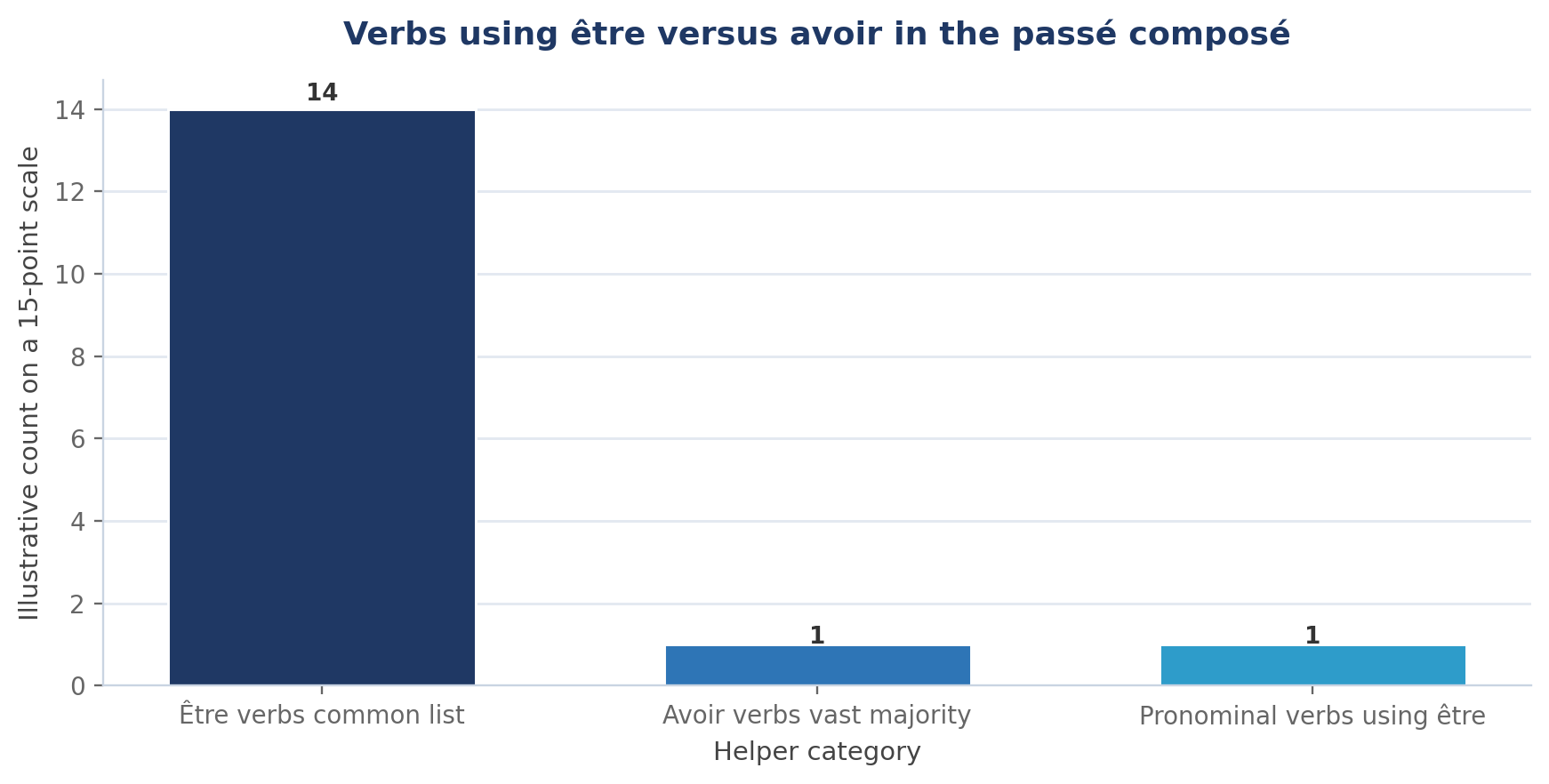
Most verbs use avoir. A small, closed set uses être.
The être list is usually taught as an acronym. The verbs are aller, venir, arriver, partir, entrer, sortir, monter, descendre, naître, mourir, rester, tomber, retourner, plus their compounds such as revenir and devenir. Learn those as a set and the question disappears.
Learn the past tense by using it, not memorising it
A personal AI voice tutor puts the passé composé into structured speaking practice — what you did at the weekend, where you went, what happened — until j'ai and je suis arrive automatically. Study at your own pace, any time.
Practise French tenses →Create a free accountAgreement: the rule learners fear
Agreement depends on which helper you used.
Examples make it clear.
Elle a mangé la pomme. No agreement — the object follows the verb. La pomme qu'elle a mangée. Agreement — the direct object la pomme now precedes the verb. Elle est allée. Agreement with the subject, feminine. Ils sont allés. Agreement with the subject, plural.
The avoir rule with a preceding object is the fussiest part of the tense. It matters most in writing; in everyday speech, many French speakers handle it loosely. Learn it, but do not let it stop you speaking.
When to use it — and when not to
The last row is the key insight. The imperfect sets the scene; the passé composé delivers the event. Je lisais describes the background; le téléphone a sonné is what happened.
The mistakes that give learners away
The infinitive mistake is the most common at first, and the easiest to fix: the participle always ends in a vowel sound, never in -er.
Turn the rules into reflexes before they harden
Every unlearned past-tense habit costs months to repair. Your AI voice tutor catches j'ai allé the first time you say it — and drills the right form until it sticks.
Start French grammar →Create a free accountA practice routine that works
The Monday task is the highest-value ten minutes of the week, because it forces you to generate the tense rather than recognise it.
Frequently Asked Questions
What is the passé composé in English? It usually translates as the simple past or the present perfect: j'ai mangé means both "I ate" and "I have eaten".
When do I use être instead of avoir? With a short list of movement and change-of-state verbs, including aller, venir, arriver, partir, entrer, sortir, monter, descendre, naître, mourir, rester, tomber.
Does the past participle agree after avoir? Usually not, unless a direct object comes before the verb: la pomme que j'ai mangée.
Is the passé composé the same as the imparfait? No. The passé composé reports completed events; the imperfect describes background, habits and ongoing states. They are often used together.
References & Further Reading
- Académie française — Questions fréquentes sur la langue française
- TV5Monde — Apprendre le français: grammar exercises by level
- France Éducation international — DELF and DALF examination resources
- Council of Europe — CEFR descriptors for grammatical accuracy
- Institut français — French courses and learning resources