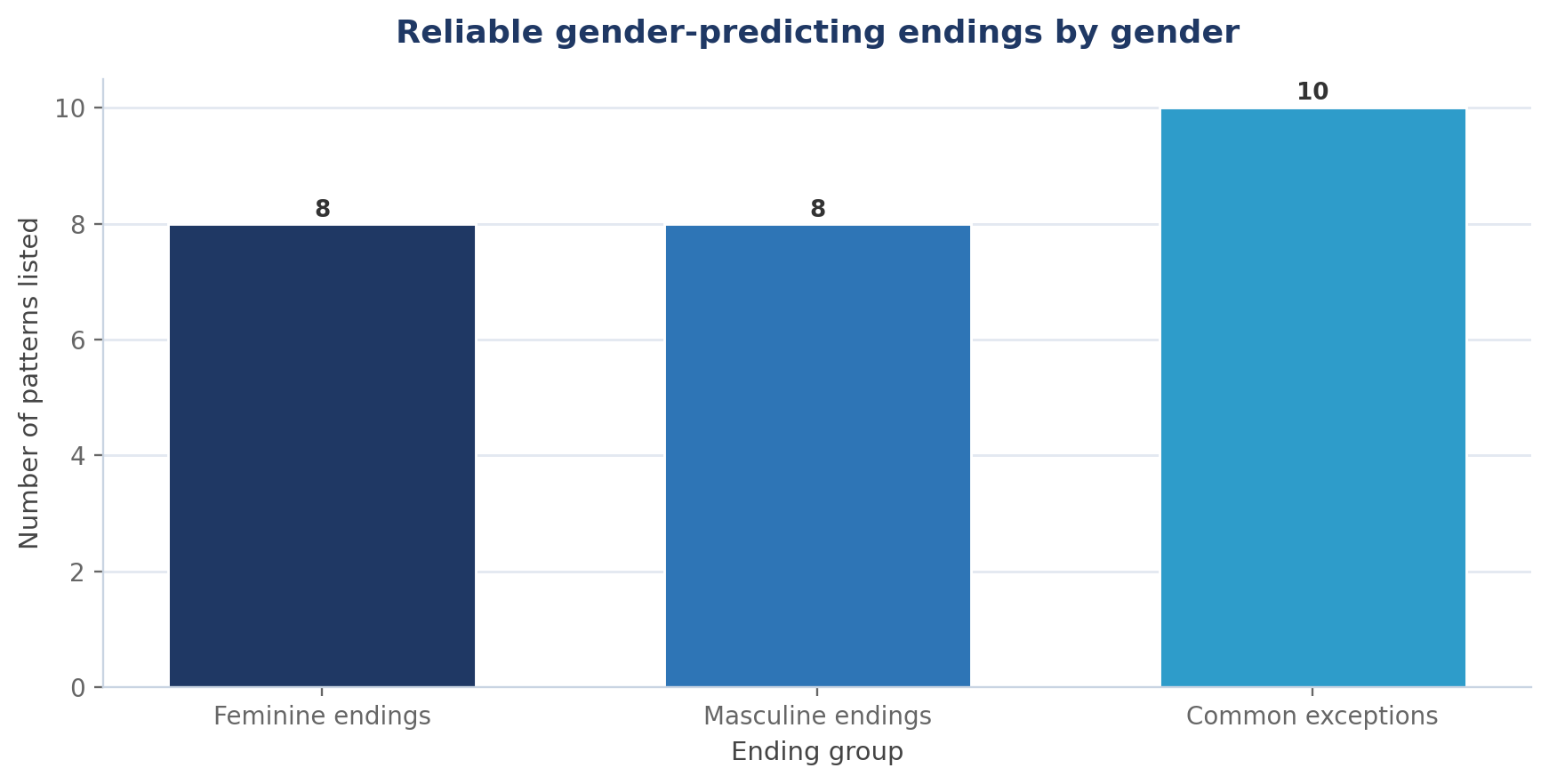
Every French noun has a gender, and every gender changes half the words around it. Le or la. Un or une. Beau or belle. Get the gender wrong and the sentence does not just sound imperfect — it sounds wrong to a native ear in the same way as "he is a nice woman" sounds wrong in English.
There is no way to avoid gender in French. But there is a system underneath it, and once you see it, guessing becomes far more accurate than learners expect.
What you will get from this guide
- Why French gender matters more than English speakers expect
- The endings that predict masculine and feminine nouns
- The high-frequency exceptions worth memorising
- The study habit that makes gender stick permanently
Why gender matters so much
French gender is not confined to articles. It propagates.
One wrong gender can ripple through four or five words in a single sentence. That is why teachers insist on it, and why learning nouns with their article from day one is not pedantry — it is efficiency.
Feminine endings: the reliable patterns
Roughly speaking, if a French noun ends in one of those patterns, treat it as feminine until proven otherwise. The -tion and -té families alone cover hundreds of everyday words.
Masculine endings: just as predictable
The -ment and -age patterns are especially valuable, because they generate new words constantly. Le gouvernement, le développement, le recyclage — all masculine, all predictable.
The exceptions you simply have to learn
A handful of very frequent nouns break the patterns. Learn these as a set.
Notice that several of these are among the most common nouns in the language. That is not a coincidence to complain about; it is simply a list of ten words to memorise once.
How to actually learn gender
Three habits do almost all the work.
Learn the article with the noun, always. Not table, but la table. Not problème, but le problème. A noun learned bare will be misgendered forever.
Say the noun with an adjective. Une petite table. Un grand problème. This forces the agreement into working memory instead of passive knowledge.
Group by ending. Whenever you meet a new noun, ask which ending family it belongs to. After a few weeks you will start predicting correctly before you check, which is exactly the skill you need in real conversation.
Colour-code your vocabulary notebook: one colour for masculine, one for feminine. Visual separation makes the pattern more memorable than lists on their own.
Fix your gender habits before they harden
Ten minutes of correction early saves months of repair later. A personal AI voice tutor hears every wrong le and la, and drills the right article until it arrives automatically.
Learn French grammar →Create a free accountGender in real conversation
Gender errors are the most noticeable mistakes a learner makes, and the least likely to block communication. That combination is exactly why they are worth fixing: you will be understood either way, but you will be heard differently with them.
The goal is not perfection. The goal is to reduce a stream of tiny signals that add up to "beginner" even when everything else in your French is strong.
Common mistakes to avoid
Turn gender rules into instinct
Rules help you predict; correction makes them stick. With a personal AI voice tutor, every le and la is checked as you speak, so the patterns move from your notes into your mouth.
Start your French Course Pass →Create a free accountFrequently Asked Questions
Is there a rule for French gender? There are strong patterns rather than absolute rules. Noun endings such as -tion, -té and -ette usually indicate feminine, while -ment, -age and -eau usually indicate masculine.
How many French nouns are feminine? Roughly half of French nouns are feminine, and about half are masculine. Statistics do not help you; endings and memorisation do.
What is the best way to remember if a noun is le or la? Learn every noun with its article as a single unit, then say it in a short phrase with an adjective. Une petite table teaches more than la table alone.
Do French speakers understand me if I use the wrong gender? Almost always, yes. But errors are noticeable and accumulate, so it is worth fixing early rather than late.
References & Further Reading
- Académie française — Questions fréquentes sur la langue française
- France Éducation international — DELF and DALF examination resources
- TV5Monde — Apprendre le français: grammar exercises by level
- Council of Europe — CEFR descriptors for grammatical accuracy
- Institut français — French courses and learning resources