A French app gave you a 400-day streak and a smug little owl. Then a Parisian asked for directions and you produced "Je suis un chat."
That is not a failure of discipline. That is the structural limit of app learning: it trains recognition and rewards guessing, while real conversation demands spontaneous production with a stranger watching.
So which actually works? Both — for different jobs. Here is the honest split.
What you will get from this guide
- What apps genuinely do better than any course
- The four things an app cannot teach, no matter the streak
- True cost per guided hour across apps, tutors and courses
- A hybrid plan that beats either option alone
The Head-to-Head Honest Matrix
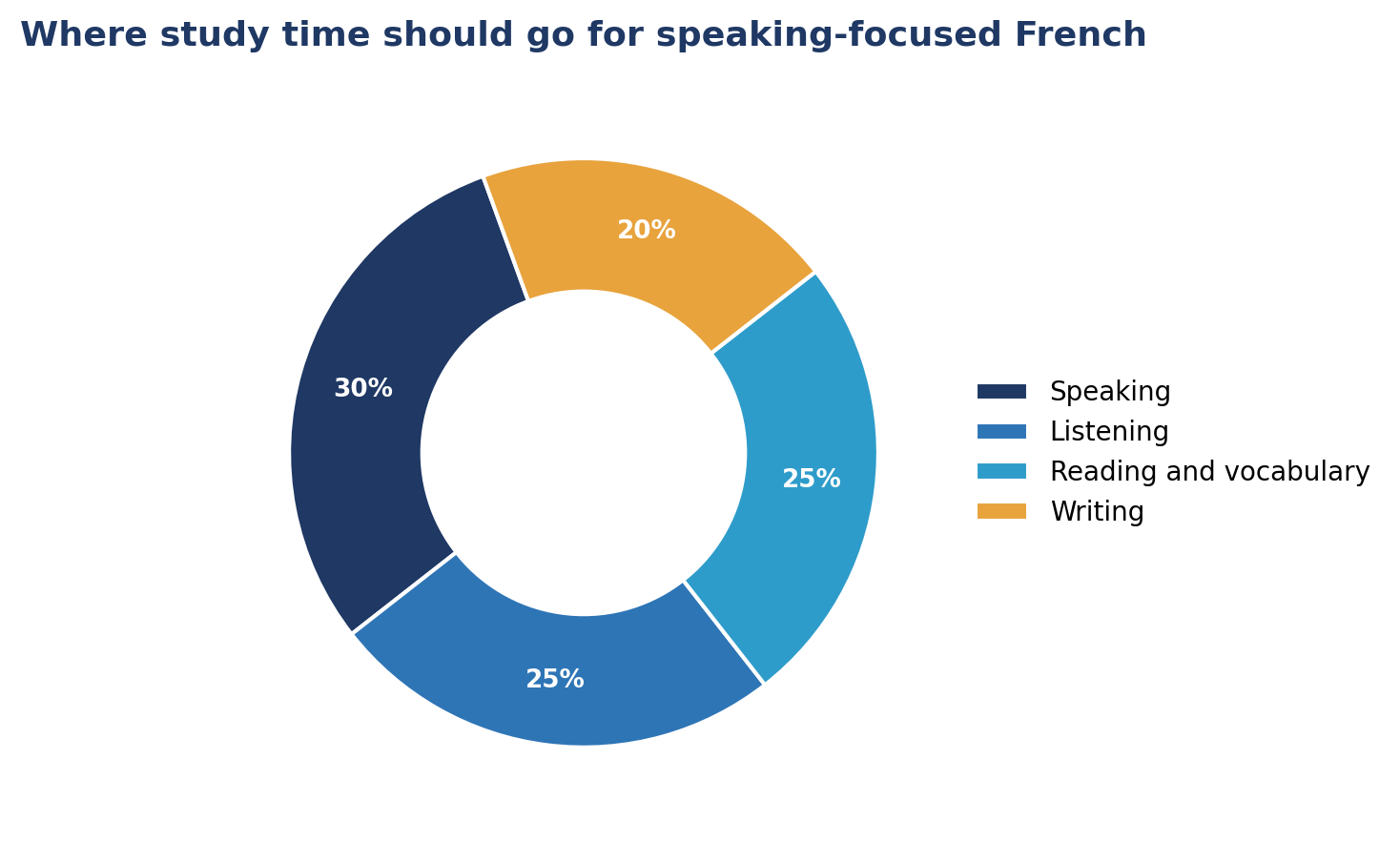
The pattern is brutal and clarifying. Apps excel at input and habit. A structured course with a tutor excels at output and nerve.
What Apps Actually Do Well
Do not skip this section. Apps are not a scam — they are just oversold.
If you are at absolute zero and terrified, an app is a superb on-ramp. Take the ramp. Just do not confuse it with the motorway.
What Apps Cannot Do
Four things, and each one is a wall.
French makes this sharper than most languages. Silent letters, liaison, and a written language that looks nothing like the spoken one mean you can read beaucoup for a year and still not recognise it out loud.
The Real Cost of Each Route
Cheapest per hour is the app. Cheapest per result is rarely the app, because self-directed hours are the ones you quietly stop doing.
Which Route Fits Which Goal
Notice that a structured course appears in every serious outcome. Apps hold the floor; a tutor builds the ceiling.
Your streak will not answer a Parisian
If your goal is speaking, you need guided practice on the other end of the sentence. Our self-paced French course puts you with a personal AI voice tutor at your level, with speaking feedback from day one.
See the French course →Create a free accountThe Honest Verdict
Use both, in the right proportion.
Apps are a treadmill. A course is a coach. You need the coach far more than you need the treadmill — but the treadmill keeps you warm on the days the coach is not there.
How You Know the App Is No Longer Enough
Three of these five signals and the app has done its job. Time to upgrade.
What "Actually Works" Looks Like in Practice
Real progress is measurable. You should be able to do something in week eight that you could not do in week one.
DELF and DALF certificates, awarded through France Éducation international, test all four skills including live speaking. No streak can sit that exam for you.
Keep the app. Add a tutor.
Regular guided lessons plus your existing app habit is the highest-return combination we see. Start with a level check and get a route that matches your actual goal.
Start French with your AI voice tutor →Create a free accountFrequently Asked Questions
Can I learn French with only an app? You can build vocabulary and reading comprehension. You will struggle badly with speaking, especially in French, where spelling and pronunciation diverge so sharply.
Is Duolingo enough for DELF A1? It can cover much of the vocabulary, but DELF includes a live speaking component and written production. Most candidates need a course or tutor for those two papers.
How many hours a week do I need to see progress? Three focused hours a week produces visible change within two months if at least one hour is guided speaking practice.
Are online French courses as good as in-person? For speaking practice, a well-structured online course with guided speaking feedback is comparable, and 1-to-1 tutoring often beats it because you speak far more.
References & Further Reading
- France Éducation international, DELF and DALF — official exam levels, format and registration (france-education-international.fr).
- Alliance Française — global network of French language centres and certified courses (alliancefr.org).
- Institut français — French language and cultural courses worldwide (institutfrancais.com).
- Council of Europe, Common European Framework of Reference for Languages — CEFR level descriptors (coe.int).
- TV5Monde, Apprendre le français — free CEFR-graded exercises and listening material (apprendre.tv5monde.com).