At 11pm you open an AI chatbot and type « Je voudrais réserver une table ». It answers instantly, corrects your accent in text, and never yawns. That is genuinely useful. It is also not the same thing as learning French.
Here's the fight, settled properly: AI wins on volume, price and zero embarrassment. Human classes win on listening, culture and the terrifying moment you must actually respond. The honest answer to AI tutor vs classes French is not either/or — it's sequence.
Where Each One Actually Wins
Read that table twice. The pattern is not "AI is worse." It's that AI is a brilliant drill partner and a terrible coach.
What you will get from this guide
- A clear-eyed comparison across cost, feedback, and speaking time
- The four things AI genuinely does better
- The three things only a human teacher can fix
- A hybrid routine that beats either option alone
The Case for AI, Made Honestly
AI is the best vocabulary drilling machine ever built. It never runs out of patience, it costs almost nothing, and it removes the single biggest blocker for adults: fear of looking stupid.
Four things it does well:
Volume. You can produce two hundred sentences a week and get them checked. No class does that.
Zero social cost. The shy learner who will not speak in a group will happily type to a machine. That's real progress, not a cop-out.
Instant explanations. Why de and not à in this sentence? Ask, get an answer in your language, immediately.
Low-stakes production. Drafting a French email, writing a lettre de motivation, testing whether a phrase sounds right.
That's a genuine advantage. Anyone who tells you AI is worthless has not used it properly.
The Case Against AI, Made Honestly
Now the harder part. Three failures that no prompt fixes.
Listening to real French. French speech is not clean. It swallows syllables — je ne sais pas becomes chais pas. Numbers, names and slang blur. AI audio, even good AI audio, tends to be tidier than a Tuesday morning in a Lyon bakery. And the messy version is what you'll actually face.
Pronunciation feedback. AI can tell you a word is wrong. It struggles to tell you why your mouth is doing the wrong thing. A teacher hears the problem in your vowel and moves your jaw. That's tactile knowledge passing between humans.
The pressure of a waiting human. This one is underrated. When a real person has asked you a question and is standing there waiting, something in your brain switches on. You retrieve words faster. You stop hedging. You find out, live, which gaps are real. No amount of chatbot practice reproduces it, because you always know you can just close the tab.
The Cost Question, Without the Spin
People assume AI is free and classes are expensive. True, but only in one direction.
The hidden cost of AI-only is the year you lose. A learner grinding alone often plateaus at A2 for eighteen months — endless matching exercises, no speaking, no one to say « that's wrong, and here's why. »
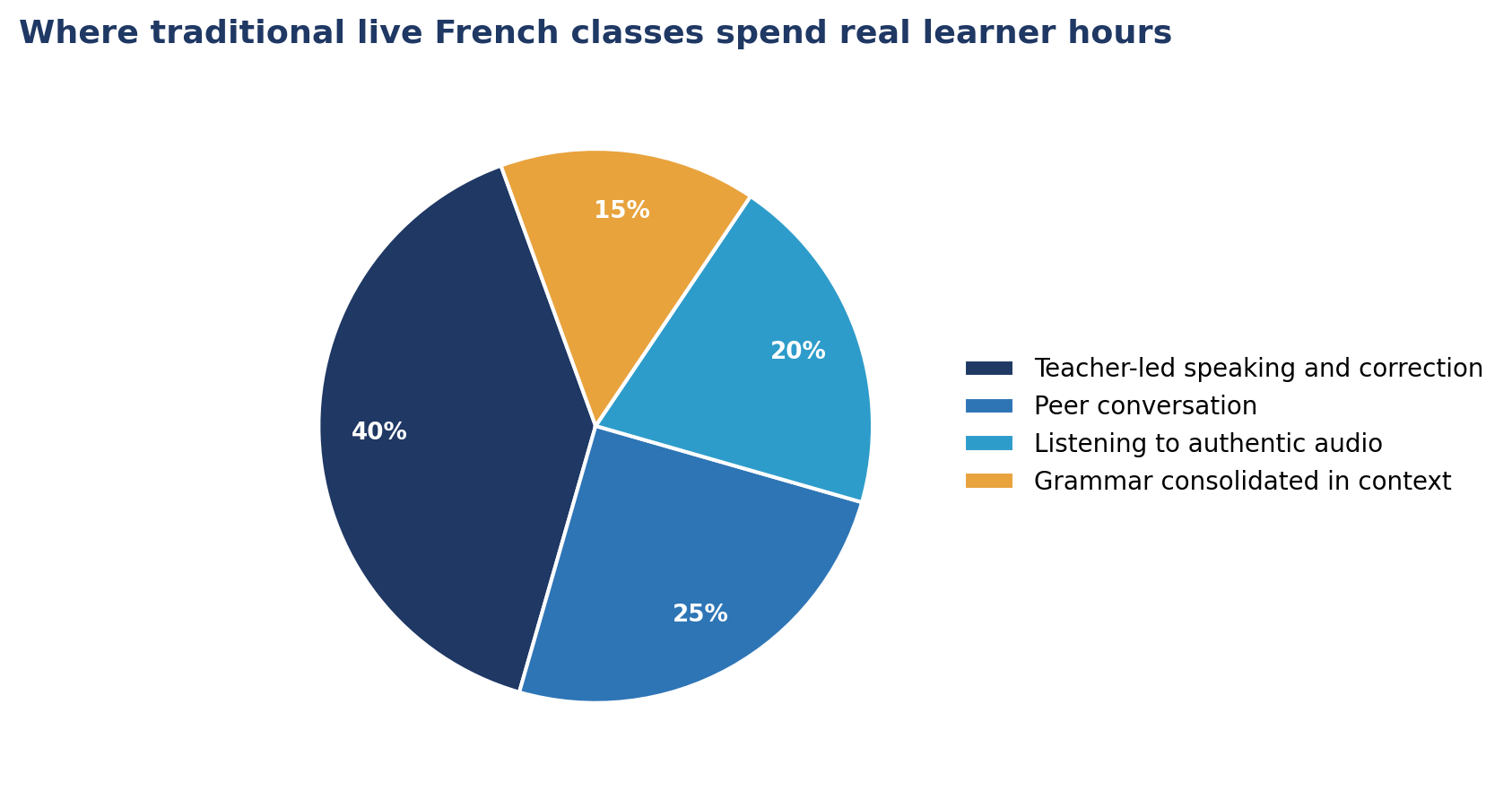
The pie is the point. In a well-run class, most of the time is spent on the two things AI cannot fake: correction and authentic listening.
Get the correction half right
Ready to turn reading into real French? Start your self-paced course today.
Start the French course →Create a free accountYou can build vocabulary alone. You can't correct your own accent, and you can't simulate a real conversation. Our self-paced AI voice tutor gives you speaking practice with instant feedback, so you can hear and fix what you're doing wrong — any time, at your own pace. Button: Explore the French course →
The Hybrid Routine That Actually Works
Stop choosing. Use both, deliberately, with different jobs.
The rule: AI handles volume and repetition. Humans handle correction and reality. Swap the roles and both tools underperform.
This is why the "AI replaces teachers" narrative gets it backwards. It became popular because AI is a fantastic practice partner. But practice only compounds when something corrects the errors you're practising. A learner who drills 500 wrong sentences a week is not improving — they're entrenching.
Which Should You Choose, Right Now?
Pick by your actual bottleneck.
If you're unsure, take a placement test. Guessing your level is how people spend a year in the wrong room.
Find your bottleneck in 20 minutes
Ready to turn reading into real French? Start your self-paced course today.
Start the French course →Create a free accountTake the free placement test, get your real CEFR level (A1 to B2), and we'll set you up with the right self-paced course — so the lessons you study are the lessons you needed. Button: Start with a free placement test →
Frequently Asked Questions
Can an AI tutor replace a real French class? For vocabulary, grammar drilling and low-stakes writing, largely yes. For listening to authentic speech, pronunciation correction and conversational nerve, no.
Is learning French with AI faster? Faster at accumulating vocabulary. Slower at speaking, unless you pair it with live conversation. Volume without correction plateaus.
Are traditional French classes still worth the money? Yes, if the class is communicative — lots of speaking, immediate correction, authentic audio. If it's a lecture, your money is better spent elsewhere.
How much does DELF B1 matter if I learn with AI? The exam tests listening, speaking, reading and writing under real conditions. AI can prepare you for the first two categories; the speaking test needs a human partner to rehearse against.
References & Further Reading
- CEFR levels and descriptors, Council of Europe: https://www.coe.int/en/web/common-european-framework-reference-languages
- France Éducation international, DELF/DALF official frameworks: https://www.france-education-international.fr/
- Alliance Française, global network of French language centres: https://www.fondation-alliancefr.org/
- Institut français, French language and culture resources: https://www.institut-francais.fr/
- Radio France Internationale, Journal en français facile for authentic listening: https://www.rfi.fr/fr/podcasts/journal-en-francais-facile/