Free French resources today are better than paid courses were twenty years ago. That is true, and it is also why so many learners stall at A2 with a phone full of green ticks.
The honest question is not free or paid. It is: which part of fluency does free cover, and which part does it structurally fail to deliver? Here is the free vs paid french course breakdown, with real numbers and no sales theatre.
What you will get from this guide
- Exactly what free French resources do well (and where they break)
- The four things you can only buy with money
- Cost-per-hour comparisons across every major option
- A hybrid stack that gets you to B1 without wasting a euro
What Free French Gives You — Genuinely
Free is not a consolation prize. It is a legitimate foundation.
If your goal is reading menus, ordering politely and following a slow podcast, free can take you most of the way. Build that base first. No shame in it.
Where Free Quietly Breaks
Free resources are optimised for engagement, not for your CEFR level. The mechanics are predictable.
No one corrects you. You can say je suis allé à la piscine with the wrong tense for six months and no app will flinch. Errors fossilise. By B1, un-teaching costs more than learning.
Difficulty is not sequenced to you. An algorithm serves content that keeps you tapping. A teacher serves content that exposes your gap.
Nothing is at stake. No appointment, no witness, no deadline. Motivation is a renewable resource only when something consumes it.
The gap free can't close is structured feedback
Everything above is a feedback problem, and feedback needs a system that notices. Our AI voice tutor hears the mistake you've been making for a year in the first ten minutes — then designs the next lesson around killing it.
Add a personal AI voice tutor to your French →Create a free accountThe Real Cost Numbers
Money is only half the ledger. Time is the expensive column.
Notice free is never actually free. At 700 hours versus 350, free costs you roughly ten months of extra calendar time. If your visa, job or exam has a date attached, that difference is the whole point.
Feedback Is the Product
Here is the uncomfortable truth of language learning: input is cheap and correction is expensive.
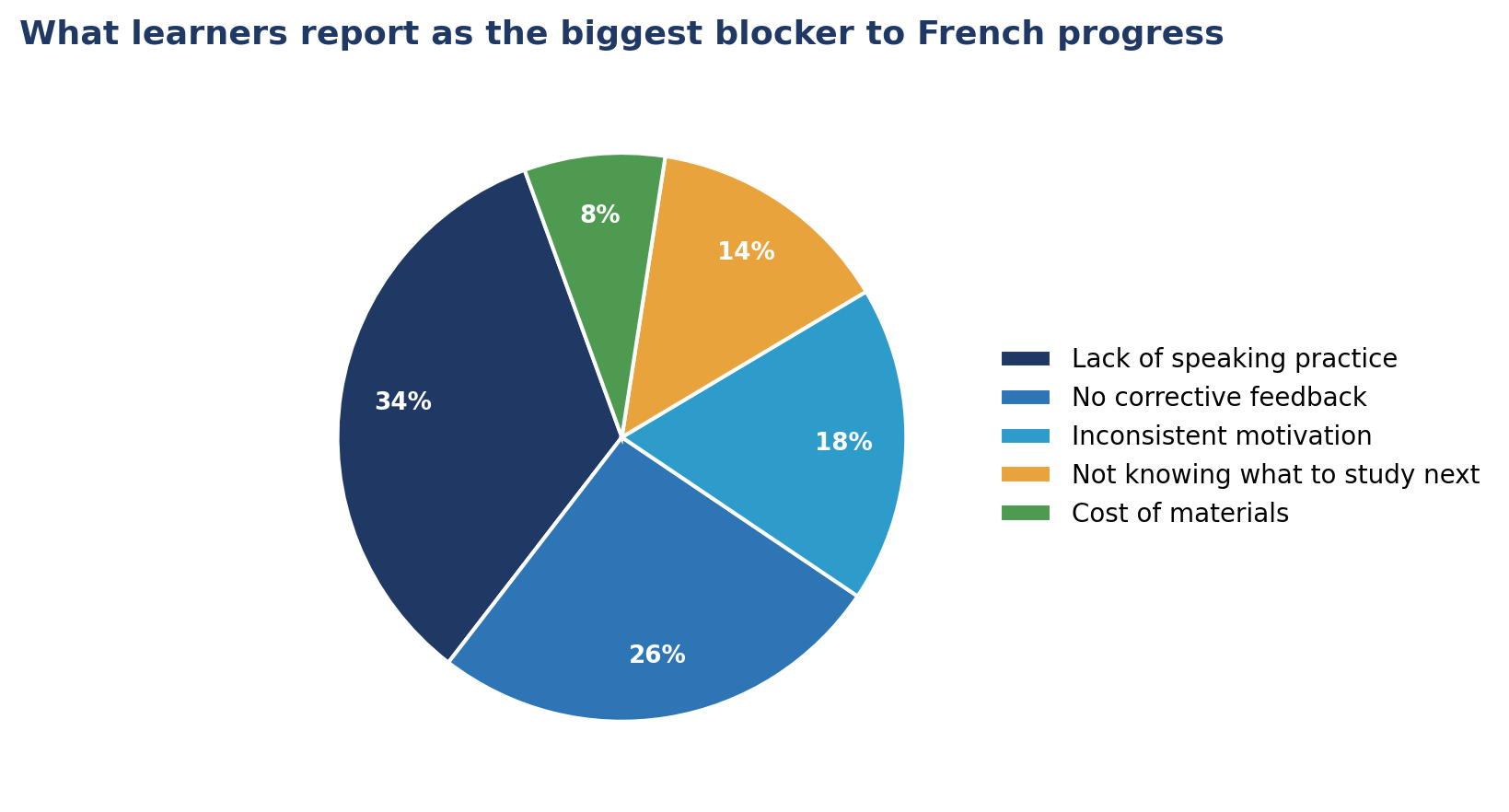
Three quarters of the complaints are feedback and structure problems. Those are exactly the things a paid course is designed to supply — and the things no free tier has an incentive to add.
What You Are Actually Buying
None of that is a mystery. It is just labour, and labour costs money.
The Hybrid Stack That Wins
Cheapest honest route to B1, in order.
Spend money where feedback lives. Save money where input lives. That single rule cuts cost meaningfully without cutting speed.
Red Flags in Paid Courses
Not every paid course deserves your money.
Ask two questions before paying anyone: how many minutes will I personally speak per lesson? and who corrects my writing? Vague answers mean vague progress.
Pay once, move one level
The measure of a French course is not how much content it contains — it is whether you finish it one CEFR level higher than you started. Ours is built around a personal AI voice tutor, structured lessons and real correction. Free got you here. We get you further.
See the French course pass →Create a free accountFrequently Asked Questions
Can I reach B1 in French for free? Yes, technically — with podcasts, YouTube, exchange partners and a lot of discipline over a longer timeline. What free cannot give you is consistent correction. Most self-taught learners reach a functional B1 reading level while their speaking lags a full level behind.
Is a paid French course worth it compared to a tutor? A self-paced AI voice tutor course is generally better value for structured progression; one-to-one tutoring is better for targeted repair of specific weaknesses. Many learners use a structured course for the syllabus and a few tutor hours for extra speaking practice.
How much should a good French course cost? Cost varies widely by country and format. Judge it per guided hour, not per month, and compare against the CEFR hour band you need — around 180 hours from A2 to B1. A cheap course that doubles your hours is not cheap.
Do free apps ever get you to fluency? Not alone. They are excellent habituation tools and weak production tools. Treat them as the warm-up, not the workout.
References & Further Reading
- Council of Europe — CEFR global scale and self-assessment grid. https://www.coe.int/en/web/common-european-framework-reference-languages
- France Éducation international — DELF/DALF level descriptions. https://www.france-education-international.fr
- Alliance Française — courses, exams and level placement worldwide. https://www.fondation-alliancefr.org
- Radio France — free French-language audio archives for listening practice. https://www.radiofrance.fr
- Ministère de la Culture — promotion of the French language and reading resources. https://www.culture.gouv.fr