You have 400 flashcards, a streak of 112 days, and zero French friends. You can order a coffee in Lyon without panicking — and then a real waiter asks a follow-up question and the whole tower falls over.
That gap is the whole argument. Self-study builds vocabulary fast and speaking slowly. A guided French course does the opposite. Which one you need depends on the wall you keep hitting.
What you will get from this guide
- Real cost and hour comparisons between self-study and a guided AI-tutor course
- Where self-study genuinely wins, and where it quietly fails
- A decision rule based on your level and your deadline
The Honest Comparison
Let me put both options on one table and stop pretending they are rivals.
Self-study is not "free". It costs you the one thing you cannot buy back: correction. Every unspoken mistake you rehearse for six months becomes a habit you then pay to unlearn.
What Self-Study Actually Does Well
Self-study shines in the boring-but-vital early work. Vocabulary breadth, reading stamina, listening exposure to fast native speech — apps and podcasts deliver all three for pocket change.
The numbers back it up. According to the CEFR, reaching A1 is a modest target, and a disciplined learner with a good deck can absolutely get there alone. Millions do.
Three real strengths:
- Cost is close to zero and there is no scheduling friction
- You can drill exactly what your job or hobby demands
- Anki plus French radio is a genuinely powerful combination at A2
Where it breaks: around the middle of A2, when sentences stop being puzzles and start being conversations.
Where Guided Courses Take Over
Here is the villain of the self-study story. You do not notice your own fossilised errors. You say je suis allé when you mean je suis allée, and nobody winces, so the wrong version stays.
A guided course catches that in week one. Beyond correction, a course gives you something apps structurally cannot: structured feedback that adapts to your gap in real time.
Notice the cliff. A2 to B1 is where solo learners stall for years, because the bottleneck shifts from knowledge to performance — and performance needs an audience.
Cost and Time, Side by Side
Money matters, so put it on the table. Estimates below are typical market ranges, not promises.
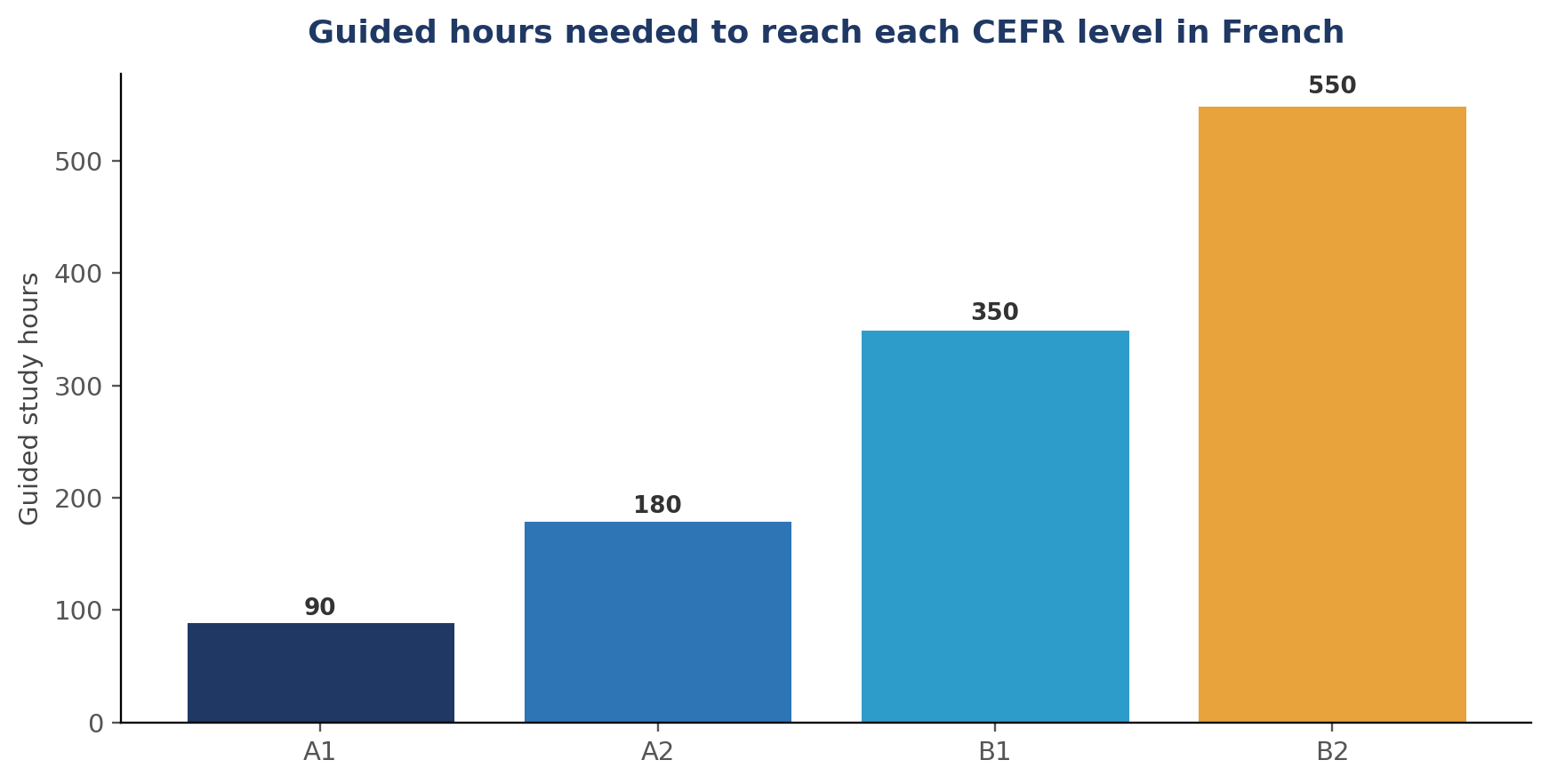
The CEFR-guided hour bands below are planning estimates widely used by language schools, including the Goethe-Institut and Alliance Française networks.
Read that chart honestly. B1 is 350 guided hours. If your entire plan is fifteen minutes on a train, the arithmetic is not in your favour.
Stop guessing whether it is working
A personal AI voice tutor gives you structured speaking practice and feedback, and keeps your French moving past A2. Join a guided French course and get corrected properly.
Start learning French →Create a free accountThe Hybrid That Beats Both
The smart answer is not "pick one". It is sequencing. Self-study is superb for input, courses are superb for output. Blend them by level.
The percentage is guided time, not importance. Fifteen minutes of focused AI-tutor feedback can outperform two hours of solo drilling.
How to Choose in Two Minutes
Ask yourself three questions.
Two or more "take the course" answers means self-study is a comfortable way to avoid the hard part.
And if you are wondering about exams, both DELF and DALF test production and interaction, not just recognition. The Alliance Française describes these certifications in detail — and every one of them requires you to speak.
French you can actually use out loud
Grammar decks will not answer you. A personal AI voice tutor will. Take the free placement check and find the French course level that matches where you really are.
Book your French course →Create a free accountFrequently Asked Questions
Can I reach fluency with self-study alone? In theory, yes. In practice, most solo learners plateau at A2 or early B1, because fluency is a performance skill and performance needs structured speaking practice with feedback.
Is self study vs course French cheaper always self-study? Upfront, yes. But years of stalling has a cost too — usually measured in delayed job offers, missed exams and the money spent on apps you abandoned.
How many hours a week do I need for a guided French course? Two guided sessions plus fifteen minutes of daily practice is a realistic minimum. That rhythm puts B1 in reach within roughly twelve to eighteen months.
What does DELF actually test? Four skills: listening, reading, writing and speaking, including a live interaction task. Recognition-only study will not carry you through the speaking paper.
References & Further Reading
- Council of Europe — Common European Framework of Reference for Languages (CEFR), global scale descriptors
- Alliance Française — DELF and DALF certification information
- France Éducation international — official DELF/DALF exam specifications
- Goethe-Institut — published CEFR guided learning hour guidance
- LanguageSkills.net — guided French courses with AI-tutor feedback