Twenty euros a month for an app. Twelve euros an hour for a tutor. Both promise fluency. Only one of them will make you speak when a French colleague asks a question you did not rehearse.
Let us do the arithmetic instead of the marketing.
What you will get from this guide
- What free tools genuinely do well — and where they stop dead
- Real 2026 price bands for classes, apps, tutors and immersion
- A cost-per-level comparison you can apply to your own budget
- The three signs you are paying for a French course you do not need
The question nobody answers honestly
"Is a french course worth it" is really two questions wearing one coat. Will a course make me learn faster? And is faster worth the money to me, specifically, this year?
The first has a firm answer: yes, for most people, structured instruction shortens the path. The second depends on your deadline, your discipline and whether anyone in your life already speaks French to you daily.
What free actually buys you
Free is not a scam. It is just limited in a very specific way.
Apps build a foundation. They do not build a speaker. The gap between understanding French and producing it under pressure is precisely where paid instruction earns its keep.
What a course costs in 2026
Prices vary by country, format and teacher seniority. These are representative bands for online and in-person options in 2026.
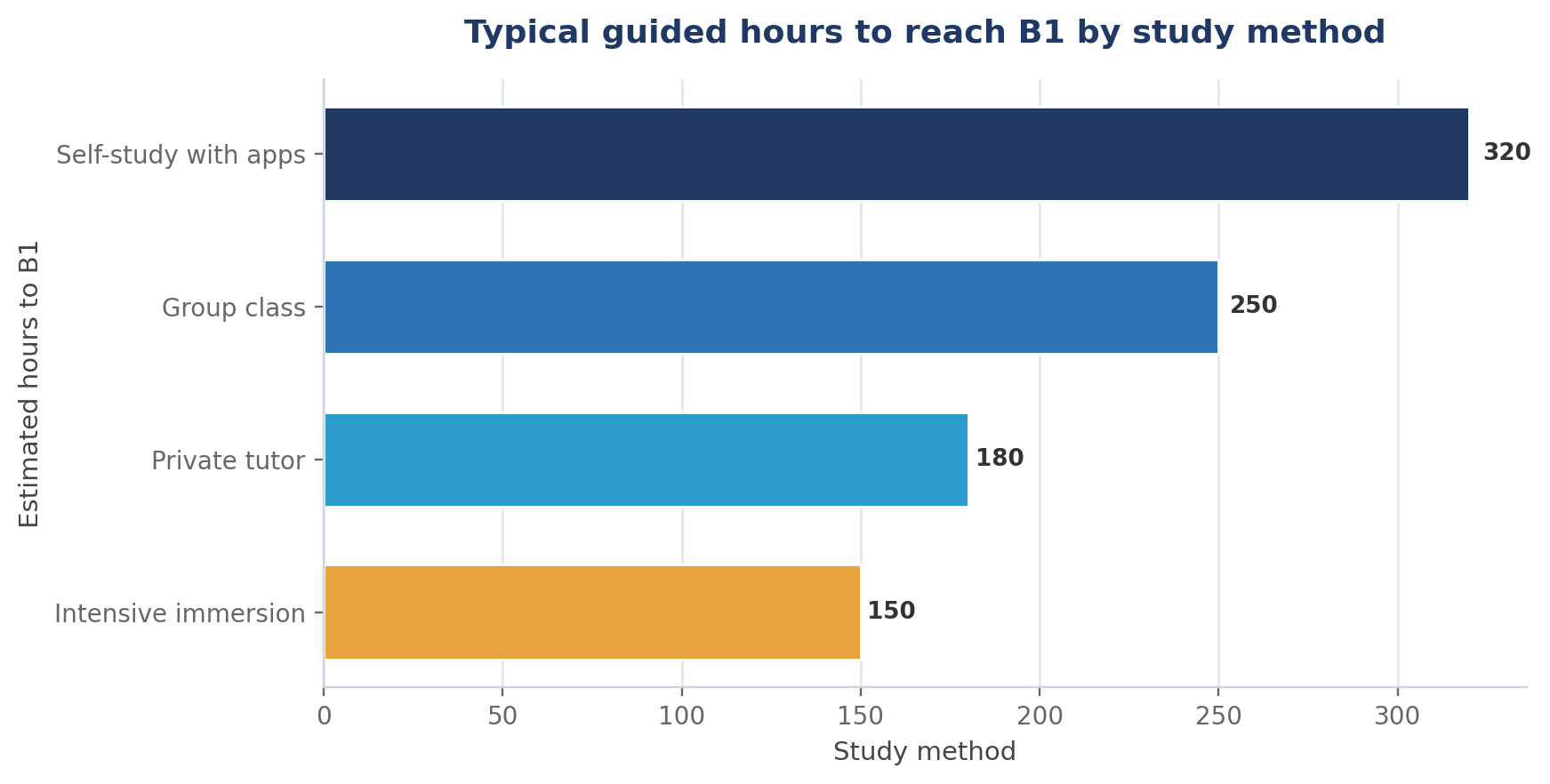
The sticker price is not the real price. The real price is cost divided by hours you actually attend. An app you use twice costs more per useful hour than a class you never skip.
Cost per level, the number that matters
Here is the same data rebuilt as cost per learner-hour, so you can compare apples with lessons.
If your deadline is eighteen months away, the cheap route is rational. If you have a DELF B2 exam in six months, the cheap route is a gamble.
Buy the hours, not the hope
Ready to turn reading into real French? Start your self-paced course today.
Start the French course →Create a free accountA course pass gives you a personal AI voice tutor, structured lessons you take at your own pace, and speaking practice with AI feedback. You bring the effort; the structure carries the rest. Button: Compare French course options →
Three signs you should not pay yet
Paying too early wastes money. Be honest about these.
First, if you cannot protect four hours a week in your calendar, a course will become an expensive guilt object. Second, if your goal is "someday speak French on holiday", an app plus podcasts is genuinely enough. Third, if you have started and abandoned three courses already, fix the habit before you buy the fourth.
Nobody sells you this advice, because nobody earns from it.
Three signs you are already paying too little
The reverse is just as common. Pay for structure when the free route has stalled for months, when you can read French well but freeze the moment you speak, or when you have a dated target — a DELF exam, an interview, a move to Lyon, a French-speaking in-law.
That last one decides it for most people. A deadline converts a hobby into a project, and projects respond to teaching.
What a good French course actually contains
Judge a course by what it forces you to do, not what it promises.
If a course has none of these, you are buying a well-designed app with a subscription wrapper.
The verdict
For most learners with a real deadline, yes — a French course is worth it. For casual learners with no target, no. The deciding variable is not talent. It is whether a fixed schedule and a person expecting you to speak will change your behaviour.
If it will, pay. If it will not, your money is better spent on a plane ticket and a stubborn refusal to use English.
Start with a level, build real speaking
Ready to turn reading into real French? Start your self-paced course today.
Start the French course →Create a free accountOur French course pass takes you from your current level to a CEFR target (A1 to B2) with a personal AI voice tutor, guided lessons and speaking practice with AI feedback. Ask about the DELF track when you enrol. Button: Enrol in French →
Frequently Asked Questions
Is a French course worth it if I can already read French? Usually yes, and urgently. Reading well while speaking badly is the classic B1 plateau. Structured production practice is the fastest way off it.
How much should I expect to pay for a good French course? Online self-paced lessons in 2026 typically run about 10 to 25 per hour, private tutors 25 to 70 per hour, and fixed DELF preparation courses 300 to 900. Judge value by live speaking minutes, not by the headline fee.
Can free apps really get me to B2 in French? They can get you to a strong A2 or low B1 for reading and listening. Spontaneous production at B2 is very rarely reached through apps alone, because nothing tests you under pressure.
Do I need a course to pass DELF B2? Not strictly. But the exam rewards format familiarity, timed argument and examiners' expectations. A focused preparation course usually shortens the journey significantly.
References & Further Reading
- Common European Framework of Reference for Languages (Council of Europe) — official level descriptors and hour guidance.
- France Éducation International — DELF and DALF examination formats, fees and centres.
- Centre national de la recherche scientifique (CNRS) — research on second-language acquisition and practice effects.
- Alliance Française — course structures and level placement testing worldwide.
- Institut français — French course provision and certification information.