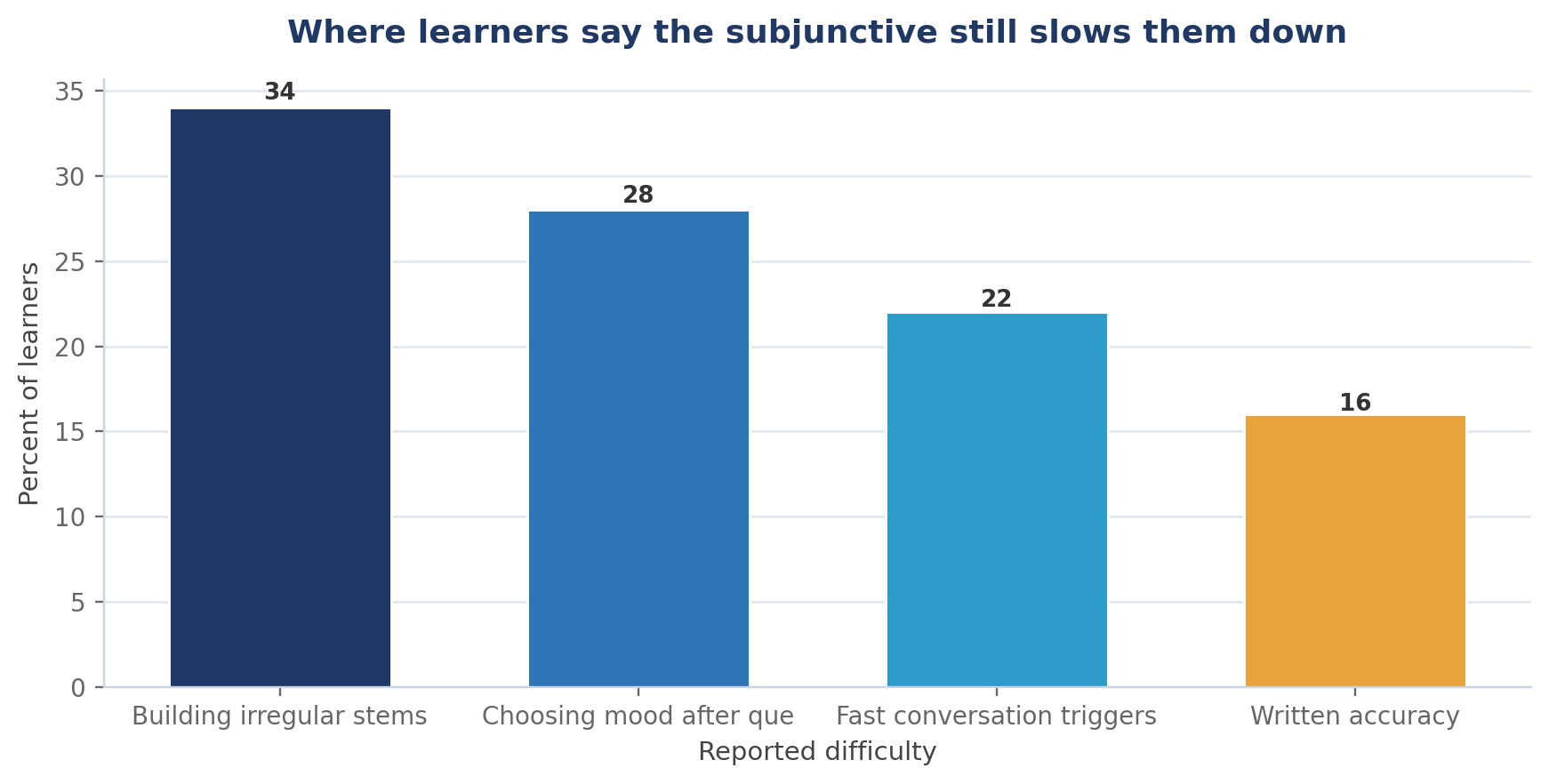
The French subjunctive has a reputation as the grammar monster under the bed. It is not. It is a mood French uses to talk about wishes, doubt, emotion and necessity — the stuff of real conversation. Learn its shape and its triggers, and you will stop fearing it and start using it.
What the subjunctive is — and why French keeps it alive
A mood is not a tense. Tense tells you when something happens; mood tells you how the speaker feels about it. The indicative reports facts. The subjunctive frames the same idea as desired, doubted, feared or required.
That is why French grammar the subjunctive appears so often in speech: French speakers constantly soften, wish, regret and insist. Saying je veux que tu viennes ("I want you to come") is not a statement of fact about your coming — it is a wish, so the verb bends into the subjunctive.
The subjunctive is French telling you what it feels, not merely what it knows.
The mood, not the tense
Most subjunctive forms are built from the present tense. Master the present, and you have already done 80% of the work.
How to form the subjunctive: regular stems
For regular verbs, take the ils / elles form of the present indicative, drop -ent, and add the subjunctive endings. Almost every ending sounds the same out loud — que je parle, que tu parles, qu'il parle — which is a gift, not a trap.
Notice nous and vous: these are the only two forms you truly hear. Two irregular patterns are worth memorising early — être (sois, sois, soit, soyons, soyez, soient) and avoir (aie, aies, ait, ayons, ayez, aient) — because they appear inside hundreds of everyday expressions.
The irregular stems you simply have to learn
Some verbs build their subjunctive from a different stem. The good news: they follow two families, and both have a tell-tale -ss- or a doubled consonant.
If you can conjugate a verb in the ils present form, you can usually build its subjunctive. Irregular stems are exceptions, not the rule — learn them in chunks, sing them out loud, and let your ear do the filing.
The trigger expressions that demand the subjunctive
Rather than asking "is this subjunctive?", train yourself to spot the trigger in front of it. Almost every subjunctive is set off by one of these.
Turn grammar rules into real conversation
Knowing the triggers is easy; firing them automatically mid-sentence is where learners stall. Self-paced lessons with a personal AI voice tutor let you practise your subjunctive any time, with instant AI feedback the moment it slips.
Start speaking French with a Course Pass →Create a free accountSubjunctive vs indicative, side by side
The same verb can switch mood depending on how certain the speaker is. Compare these pairs, and the logic becomes obvious.
Negation and question often flip a verb into the subjunctive: je pense que takes the indicative, but je ne pense pas que usually triggers the subjunctive. Affirmative belief = indicative; doubt, denial and distance = subjunctive.
The mistakes learners make
Using the indicative after il faut que. This is the single most common error. Il faut que tu viens rings false; say il faut que tu viennes.
Forgetting the -ions and -iez forms. These are the two shapes listeners actually hear, so skipping them is instantly audible.
Over-applying the subjunctive after "que". Que does not automatically demand it. Je sais qu'il travaille is perfectly indicative, because certainty is at stake.
Freezing in the middle of a sentence. Hesitation kills fluency. Leara a handful of chunks — quoique ce soit, avant que tu partes — and say them whole.
How to practise the subjunctive in speech
Set a daily ritual of five sentences. Take one trigger and one verb, and build a line around it: Il faut que je finisse ce dossier. Say it aloud, then swap the verb. Ten verbs later, the pattern belongs to you.
Shadowing helps enormously. Listen to a short radio bulletin or a news segment, pause, and repeat the sentence while copying the rhythm. French speakers run the subjunctive into the main clause, and your mouth must learn that glide.
Then make it real. Write three wishes, three doubts and three obligations in your notebook, and use them in your next conversation. Grammar practised only on paper stays on paper; grammar practised in conversation becomes fluent French.
Practise the subjunctive with an AI voice tutor, free to start
Create your free account and get a placement check, study plan and a first taste of the AI voice tutor. Then bring your trigger expressions and use them out loud with instant AI feedback.
Create your free account →Create a free accountFAQ
Is the subjunctive really necessary?
Yes. It is alive and well in everyday French, especially after il faut que, bien que and vouloir que. Ignoring it marks your French as clearly non-native, both in conversation and in exams such as the DELF and DALF.
Can I survive with the indicative instead?
Sometimes, and that is part of the problem: you will be understood but sound blunt or wrong. Learners who consciously drill five triggers quickly find the subjunctive becomes automatic.
Which subjunctive forms matter most?
Être, avoir, faire, aller, pouvoir and vouloir. Once those six run on reflex, most everyday sentences fall into place.
How long does it take to master?
With twenty minutes of focused practice five days a week, most learners reach confident, spontaneous use in two to three months — with regular self-paced practice and instant AI feedback.
References
- Académie française — authoritative guidance on French usage and grammar.
- France Éducation international (DELF/DALF) — official exam frameworks and sample papers.
- TV5Monde – Apprendre le français — free exercises and listening material.
- RFI – Le journal en français facile — everyday spoken French at learner speed.
- Council of Europe – CEFR — the level descriptors behind DELF and DALF.