Someone asks what you did last weekend in French. You reach for the past tense and freeze — because French has two of them, and they are not interchangeable. Choose wrong and a simple story about a rainy Sunday turns into a grammatical shrug.
The imparfait is the tense that describes how things were, not what happened. Once that distinction clicks, French past narration stops feeling like a trap and starts feeling like a toolkit.
What you will get from this guide
- What the imparfait actually does, in plain language
- How to form it — endings, stems and the one irregular verb
- Imparfait vs passé composé, side by side
- The trigger phrases that tell you which tense to pick
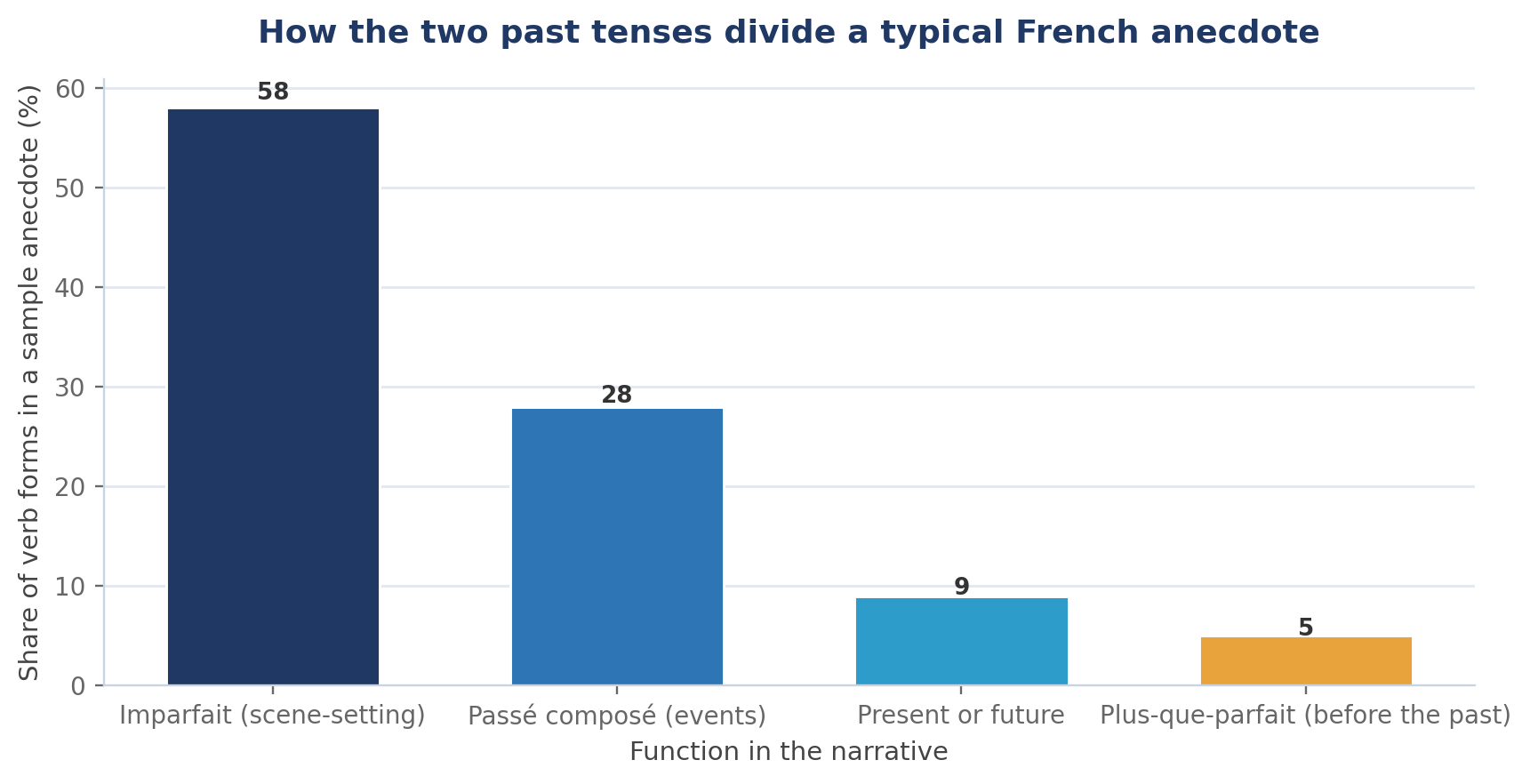
- A chart of how the two tenses share a real narrative
What the imparfait really means
English has no single tense that matches it, which is why it feels slippery. The imparfait describes a state, a habit, or background action that was ongoing or repeated in the past — with no emphasis on when it started or finished.
Think of it as the setting, not the event.
Notice the pattern: nothing here is a single completed act. The imparfait paints; it does not snap a photo.
How to form the imparfait
Take the nous form of the present tense, drop -ons, and add the endings. That is the entire system.
The endings — -ais, -ais, -ait, -ions, -iez, -aient — never change. Learn them once and they apply to almost every verb in the language, including -re verbs and most irregulars.
Two practical notes worth memorising:
- The je / tu / il forms sound identical. Only context, spelling or pronouns reveal who is speaking.
- If a verb's nous present form ends in
-issons, the imparfait carries that sameissthrough every person. Say it out loud once and it stays.
The one verb you must simply learn
Être is the sole exception. Its stem is ét-.
Every other verb, including avoir, faire, aller and prendre, follows the regular nous-stem rule.
Imparfait vs passé composé: the real difference
This is where most learners lose marks — and confidence. The two tenses do not compete; they cooperate.
Put them together and the logic becomes visible in a single sentence:
Il pleuvait et je n'avais pas de parapluie quand un chien a traversé la rue. It was raining and I had no umbrella when a dog crossed the road.
The rain and the lack of an umbrella are the stage. The dog is the event. Get used to building sentences in that shape and you will sound unmistakably more French.
Trigger words that make the choice easy
Before you memorise rules, memorise the signals. Most French sentences contain a clue.
When both signals appear in one sentence, the imparfait usually sets up the clause and the passé composé delivers the punch.
Five mistakes that keep the imparfait hard
Ready to turn reading into real French? Start your self-paced course today.
Start the French course →Create a free accountLearn the tense by using it, not just reading about it
Rules are cheap; production is what sticks. With a personal AI voice tutor, your imparfait slip is caught the moment it happens and corrected before it becomes a habit — the fastest route from "I understand the rule" to "I say it without thinking."
Button: See the French course pass →
How to practise the imparfait properly
Passive recognition is not enough. You need to produce the tense under mild pressure, in sentences that mix both past tenses.
Fifteen minutes a day of active production beats an hour of reading grammar tables. Free audio from RFI's *Journal en français facile* is ideal raw material: slow, clear, and full of past-tense narration.
Ready to turn reading into real French? Start your self-paced course today.
Start the French course →Create a free accountStart with a free account — no card needed
Create a free languageskills.net account to try guided French practice and see how the imparfait behaves in real conversation. Upgrade to the course pass only when you are ready for the full guided course.
Button: Create your free account →
Frequently Asked Questions
**What is the imparfait in one sentence?** It is the French past tense for ongoing, repeated or descriptive actions — the background of a story, not its events.
**How do I know whether to use imparfait or passé composé?** Ask whether the action was in progress or habitual (imparfait) or completed and specific (passé composé). Trigger words like souvent and soudain usually decide it.
**Which verbs are irregular in the imparfait?** Only être. Its stem is ét- (j'étais, tu étais, il était). Every other verb uses the nous-present stem.
Do native speakers really distinguish the two tenses? Constantly. Mixing them changes meaning, not just style — an imparfait where a passé composé belongs can suggest an action never finished.
References & Further Reading
- Académie française — Official guidance on French grammar and usage
- France Éducation international — DELF and DALF level descriptors
- TV5Monde — Apprendre le français: exercises by level
- RFI — Journal en français facile, daily slow-news audio
- Council of Europe — CEFR levels and descriptors