French object pronouns are the difference between speaking like a textbook and speaking like a human. Instead of repeating le livre five times, you say je le lis. Instead of je parle a Marie, you say je lui parle. Learn the system once and your sentences suddenly breathe.
The Cast: Direct and Indirect Object Pronouns
Direct object pronouns replace a person or thing that receives the verb's action without a preposition. Indirect object pronouns replace a person introduced by a or de.
Notice the gap: lui and leur cover both genders. There is no she-him or her-them puzzle here, which is one small mercy French hands you.
Direct or Indirect? The Verb Tells You
Ask who or what receives the action with no preposition, and you have a direct object. Ask to whom and you have an indirect one. Some verbs are famously indirect: parler a, telephoner a, repondre a, dire a, ecrire a, offrir a.
The verb decides. Memorise the verb's short list of prepositions and the pronoun follows on its own.
Word Order: The Rule That Beats English
English says I give it to her. French says je le lui donne — object pronouns go before the verb, and indirect sits before direct. That single reversed rhythm is why so many learners sound hesitant. Read more of the official CEFR level descriptions at the Council of Europe to see how this precision is graded across levels.
Negation wraps the whole pronoun block plus the verb: ne + pronoun(s) + verb + pas.
Stop guessing, start placing pronouns like a native
Object pronoun order is exactly the kind of thing a personal AI voice tutor catches in thirty seconds and a textbook never catches at all. Our Course Pass gives you a personal AI voice tutor who drills your own sentences until the order becomes instinct.
Get your French Course Pass →Create a free accountY and En: The Little Pronouns That Do Heavy Lifting
Y replaces a place or a thing introduced by a. En replaces a quantity or a thing introduced by de.
Pronouns in the Passe Compose and Agreement
With avoir, the past participle agrees with a direct object pronoun placed before it. This is the rule examiners love.
Agreement only happens when the direct object pronoun sits before the auxiliary. J ai ecrit les lettres stays untouched; je les ai ecrites picks up the feminine plural.
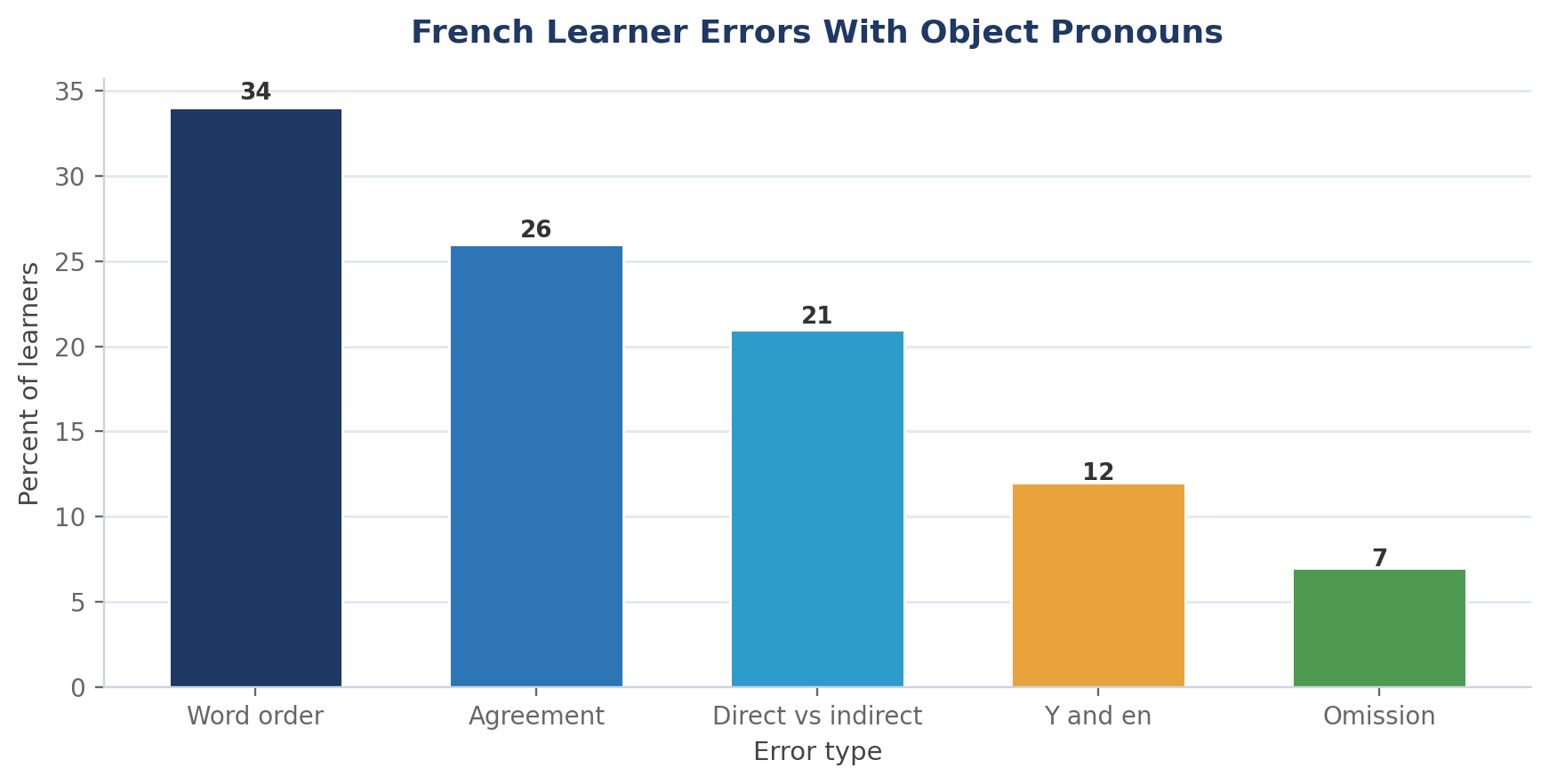
The Six Errors That Keep Learners Stuck
Drills That Actually Stick
Free audio from RFI and the guidance of France Education International make excellent companions. But nothing replaces a personal AI voice tutor hearing your mistakes in real time — create your free account and bring your hardest sentences to a self-paced lesson.
Hear yourself get it right, out loud
Reading about le lui is not the same as saying it fluently under pressure. A free account unlocks your first guided AI-tutor lesson and a level check, so you know exactly which pronouns to attack first.
Create your free account →Create a free accountFAQ
Why do French object pronouns go before the verb? Because French inherited a fixed clitic order from Latin, where unstressed pronouns attach to the verb itself; the block me, te, se, nous, vous comes before le, la, les, which comes before lui, leur.
Is it ever correct to put the pronoun after the verb? Yes, in the affirmative imperative: donne-le-lui, parle-lui, ecoute-les. In the negative imperative it jumps back in front: ne le lui donne pas.
Do I always need agreement in the passe compose? Only with avoir and only when a direct object precedes the auxiliary. With etre verbs, agreement follows the subject instead.
Are y and en optional? No. Dropping them is one of the clearest markers of an intermediate plateau, and DELF examiners listen for them. Spell out the full noun once, then switch to the pronoun.
References
- Academie francaise — authority on French usage and grammar rulings
- France Education International (DELF/DALF) — official exam frameworks and level descriptors
- TV5Monde Apprendre le francais — free graded exercises and audio
- RFI Francais Facile — news-based listening practice
- Council of Europe CEFR — the reference framework behind every level