Most people do not fail at French. They fail at sequencing it. They start with the subjunctive because it sounds impressive, or they grind Duolingo for two years and never say a sentence out loud, then conclude they lack the gift.
Nobody lacks the gift. They lack a map. Here is the map — six levels, what belongs in each, how long each honestly takes, and the milestone that tells you it is time to move on.
What this roadmap gives you
- What to learn at each CEFR stage, A1 to B2
- Realistic hour estimates and timelines
- The exam that certifies each level
- Milestones that prove you are ready to advance
- The one activity that should appear at every single stage
The shape of the whole journey
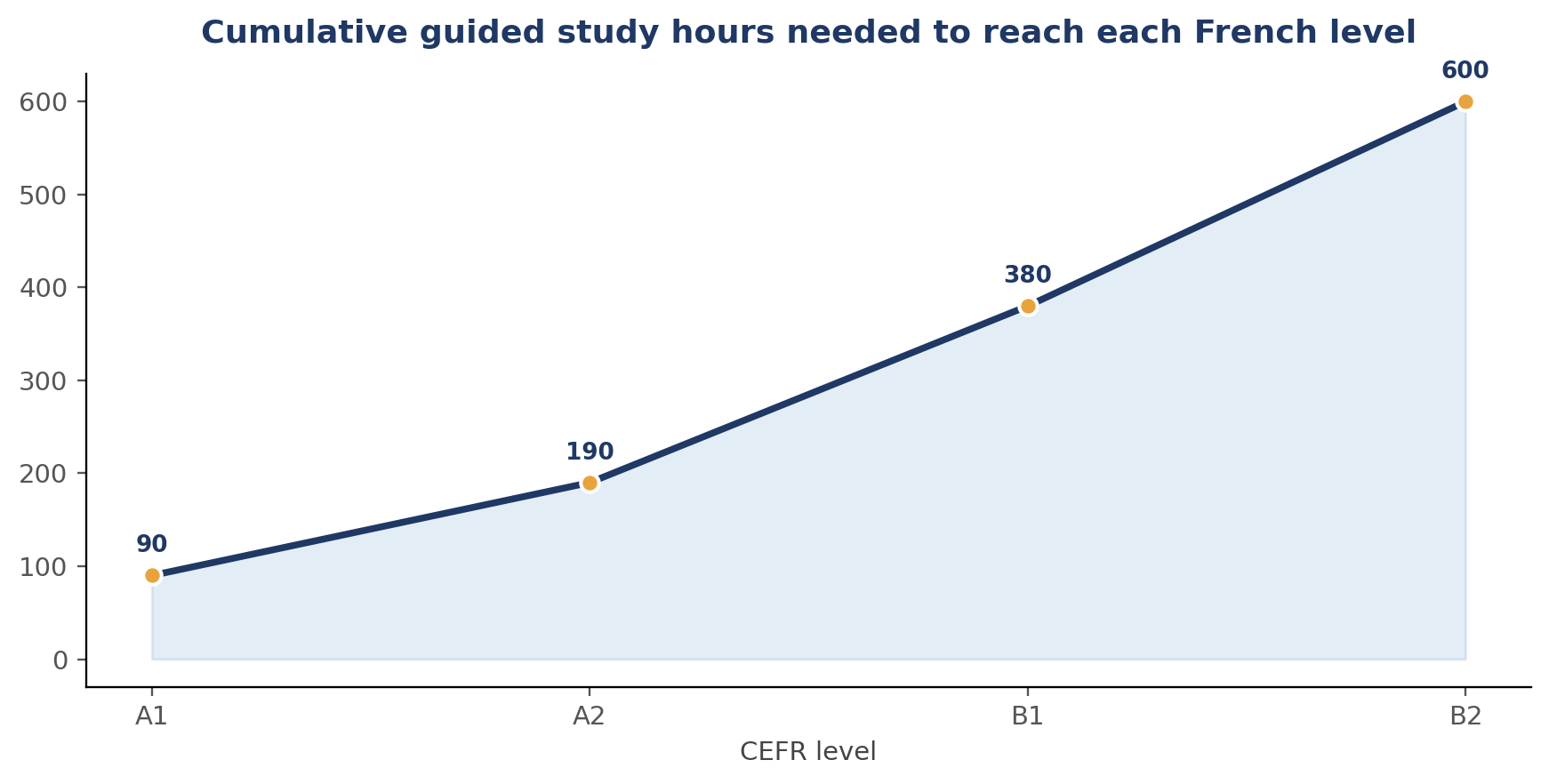
French is a long-haul language with a steep opening hill. Pronunciation, gender and verb conjugation all land in the first year. After that, progress accelerates noticeably — which is why so many learners quit at exactly the wrong moment.
These are guided-hour figures aligned with CEFR guidance and the DELF/DALF framework. Self-study hours are usually higher, because the feedback loop is slower.
A1 — the foundation you must not rush
Goal: survive a simple exchange. Introduce yourself, order, ask a basic question, understand slow speech about familiar topics.
The non-negotiable at A1 is pronunciation. French spelling and sound diverge sharply, and unlearning a bad accent later costs ten times what learning it properly costs now. Say everything aloud from day one.
A2 — becoming actually useful
Goal: handle predictable everyday situations — travel, shopping, appointments, simple past narration.
Milestone to advance: you can describe last weekend for two minutes without switching to English.
B1 — the level that changes everything
Goal: cope with most travel, work and social situations; express opinions; handle unexpected input.
B1 is where French stops being an exercise and starts being a tool. It is also where the subjunctive finally makes sense — because you have sentences that need it, not because a textbook announced it.
Learn the grammar you need for the sentence you are already trying to say. Every other order wastes months.
B2 — professional and academic territory
Goal: argue a position, follow debates, understand films and native-speed speech with effort.
B2 is the level employers and universities recognise. DELF B2 is also the qualification most commonly required for French university admission.
Ready to turn reading into real French? Start your self-paced course today.
Start the French course →Create a free accountSkip the plateau that stops most learners at B1
The gap between B1 and B2 is not knowledge — it is speaking volume under correction. A personal AI voice tutor gives you feedback on the same mistake three weeks running and helps you do something about it.
Button: Explore the French Course Pass →
What to do at every single stage
Reading that table left to right, one row stands out: daily speaking appears at every level. It is the only line that never becomes optional, because feedback is the one thing you cannot give yourself.
Ready to turn reading into real French? Start your self-paced course today.
Start the French course →Create a free accountFind out where you actually are
Most learners overestimate their level by one full band. A free languageskills.net account gives you a level check and a roadmap that starts from reality, not optimism.
Button: Create your free account →
Frequently Asked Questions
How long does it take to become fluent in French? Expect roughly 550–650 guided hours to reach B2. At a steady pace that is two to four years, faster with regular speaking practice.
Should I take the DELF or DALF? Both are certified by France Éducation international. DELF covers A1–B2; DALF covers C1–C2. DELF B2 is the standard requirement for French university admission.
Can I skip A2 if I studied French at school? Sometimes, but verify. Take a level check rather than guessing — starting one level too high is the most common reason learners stall.
Is grammar study a waste of time? No, but the order matters. Learn grammar to fix sentences you are already speaking; rules learned in the abstract rarely survive a real conversation.
References & Further Reading
- France Éducation international — DELF and DALF levels and descriptors
- Académie française — French language guidance and usage
- TV5Monde — Apprendre le français: exercises by CEFR level
- RFI — Journal en français facile, daily slow-news audio
- Council of Europe — CEFR levels and descriptors